Zhu Xue-Xue, Zhao Chen-Yang, Meng Xin-Yu, Yu Xiao-Yi, Ma Lin-Chun, Chen Tian-Xiao, Chang Chang, Chen Xin-Yu, Zhang Yuan, Hou Bao, Cai Wei-Wei, Du Bin, Han Zhi-Jun, Qiu Li-Ying, Sun Hai-Jian
Department of Basic Medicine, Wuxi School of Medicine, Jiangnan University, Wuxi 214122, China.
Department of Physiology, Eberhard-Karls-University of Tübingen, 72074 Tübingen, Germany.
Pharmaceuticals (Basel). 2024 Aug 1;17(8):1015. doi: 10.3390/ph17081015.
Type 2 diabetes mellitus (T2DM) is a metabolic syndrome characterized by chronic inflammation, insulin resistance, and islet cell damage. The prevention of T2DM and its associated complications is an urgent public health issue that affects hundreds of millions of people globally. Numerous studies suggest that disturbances in gut metabolites are important driving forces for the pathogenesis of diabetes. However, the functions and mechanisms of action of most commensal bacteria in T2DM remain largely unknown.
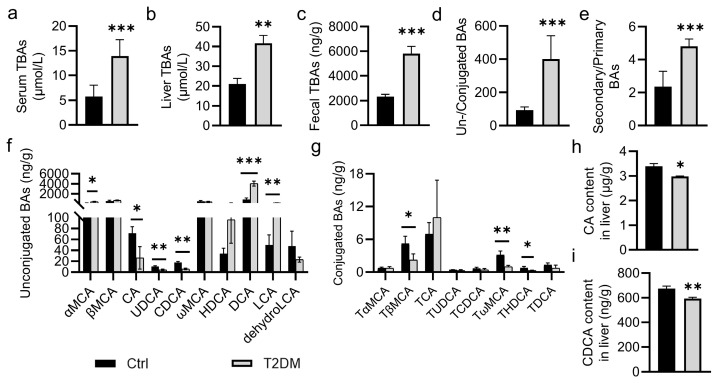
The quantification of bile acids (BAs) in fecal samples was performed using ultra-performance liquid chromatography-tandem mass spectrometer (UPLC-MS/MS). The anti-diabetic effects of () and its metabolites cholic acid (CA) and chenodeoxycholic acid (CDCA) were assessed in T2DM mice induced by streptozocin (STZ) plus high-fat diet (HFD).
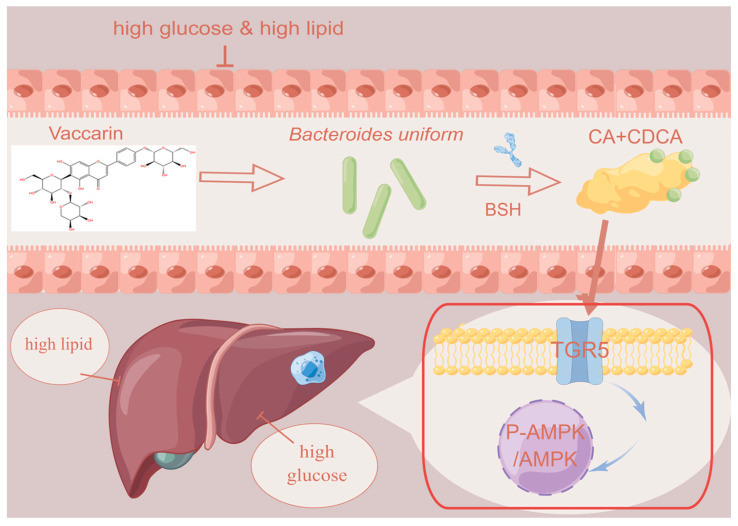
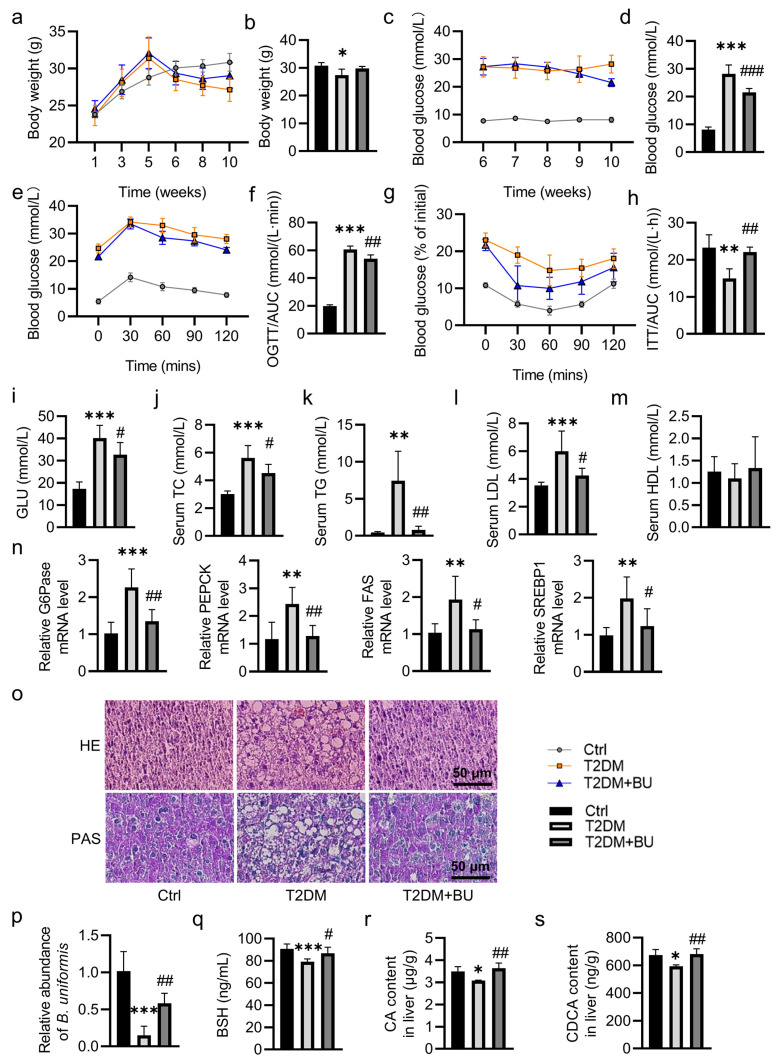
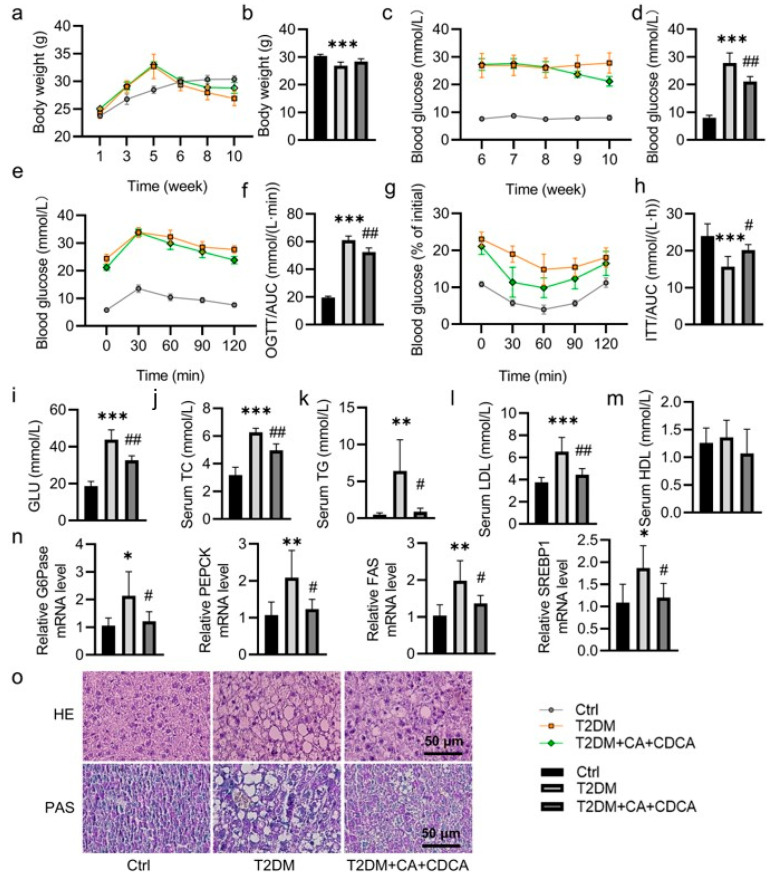
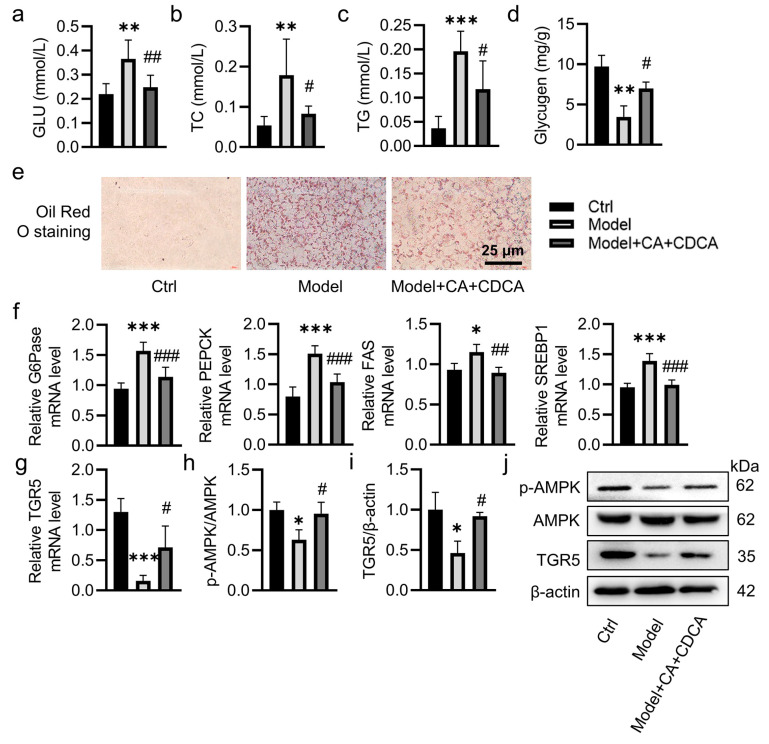
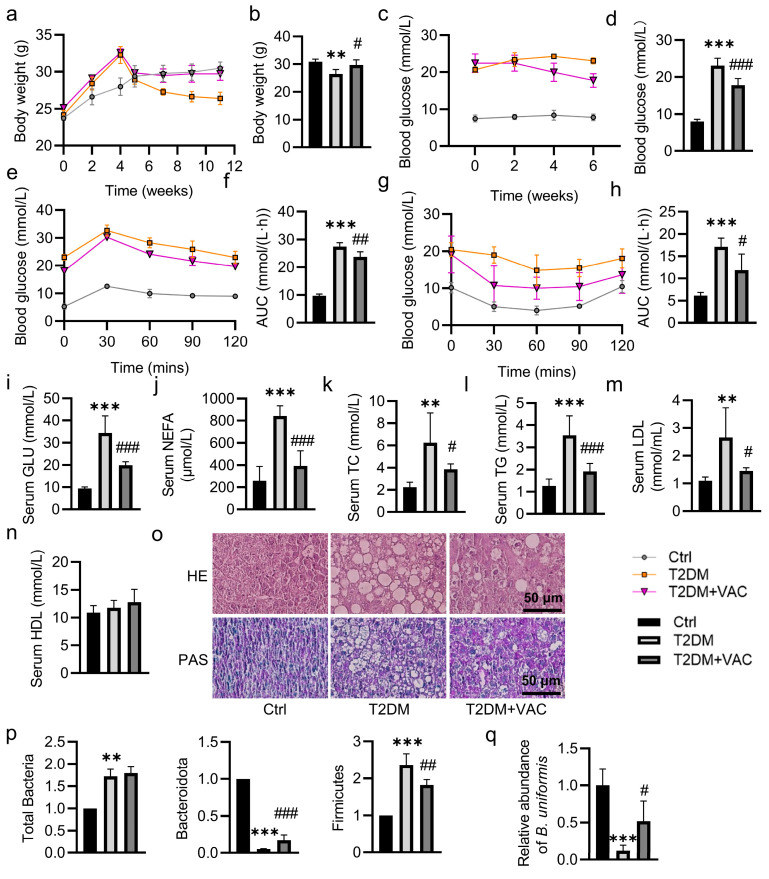
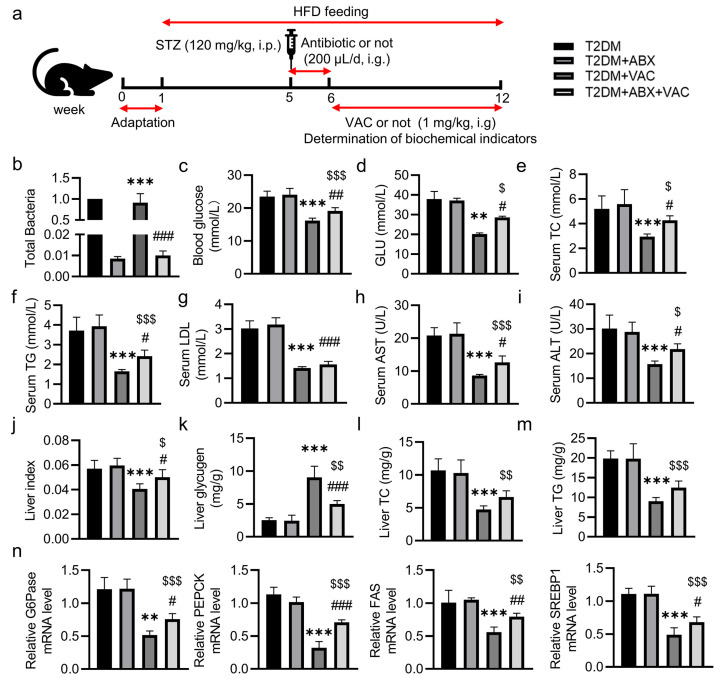
We found that the abundance of in the feces and the contents of CA and CDCA were significantly downregulated in T2DM mice. was diminished in diabetic individuals and this bacterium was sufficient to promote the production of BAs. Colonization of and intragastric gavage of CA and CDCA effectively improved the disorder of glucose and lipid metabolism in T2DM mice by inhibiting gluconeogenesis and lipolysis in the liver. CA and CDCA improved hepatic glucose and lipid metabolism by acting on the Takeda G protein-coupled receptor 5 (TGR5)/adenosine monophosphate-activated protein kinase (AMPK) signaling pathway since knockdown of TGR5 minimized the benefit of CA and CDCA. Furthermore, we screened a natural product-vaccarin (VAC)-that exhibited anti-diabetic effects by promoting the growth of in vitro and in vivo. Gut microbiota pre-depletion abolished the favorable effects of VAC in diabetic mice.
These data suggest that supplementation of may be a promising avenue to ameliorate T2DM by linking the gut and liver.
2型糖尿病(T2DM)是一种以慢性炎症、胰岛素抵抗和胰岛细胞损伤为特征的代谢综合征。预防T2DM及其相关并发症是一个紧迫的公共卫生问题,全球数亿人受其影响。众多研究表明,肠道代谢物紊乱是糖尿病发病机制的重要驱动力。然而,大多数共生菌在T2DM中的功能和作用机制仍 largely 未知。
使用超高效液相色谱 - 串联质谱仪(UPLC-MS/MS)对粪便样本中的胆汁酸(BAs)进行定量。在链脲佐菌素(STZ)加高脂饮食(HFD)诱导的T2DM小鼠中评估()及其代谢产物胆酸(CA)和鹅去氧胆酸(CDCA)的抗糖尿病作用。
我们发现T2DM小鼠粪便中()的丰度以及CA和CDCA的含量显著下调。在糖尿病个体中减少,并且这种细菌足以促进BAs的产生。()的定殖以及CA和CDCA的灌胃通过抑制肝脏中的糖异生和脂肪分解有效地改善了T2DM小鼠的糖脂代谢紊乱。CA和CDCA通过作用于武田G蛋白偶联受体5(TGR5)/单磷酸腺苷激活蛋白激酶(AMPK)信号通路改善肝脏糖脂代谢,因为敲低TGR5使CA和CDCA的益处最小化。此外,我们筛选了一种天然产物 - vaccarin(VAC),其通过在体外和体内促进()的生长表现出抗糖尿病作用。肠道微生物群预先耗尽消除了VAC对糖尿病小鼠的有利影响。
这些数据表明,补充()可能是通过连接肠道和肝脏来改善T2DM的一个有前景的途径。