Ma Wenchao, Mao Shiyu, Bao Meiyu, Wu Yuan, Guo Yadong, Liu Ji, Wang Ruiliang, Li Cheng, Zhang Junfeng, Zhang Wentao, Yao Xudong
Shanghai Clinical College, Anhui Medical University, Hefei 230032, China.
Department of Urology, Shanghai Tenth People's Hospital, Tongji University, Shanghai 200072, China.
Transl Androl Urol. 2020 Apr;9(2):295-302. doi: 10.21037/tau.2020.03.08.
Bladder cancer is one of the most common cancers worldwide. It ranks ninth among all cancers and fourth among cancers in male patients. Recent studies reported that red blood cell (RBC) distribution width (RDW) was a potential predictor in some cancers. This study explored the significance of RDW in patients with bladder cancer after radical cystectomy.
This study involved 169 patients who underwent radical cystectomy between March 2009 and October 2018. The overall survival (OS), cancer-specific survival (CSS), and disease-free survival (DFS) were analyzed using the Kaplan-Meier method. Univariate and multivariate Cox analyses were used to evaluate the prognostic significance of RDW.
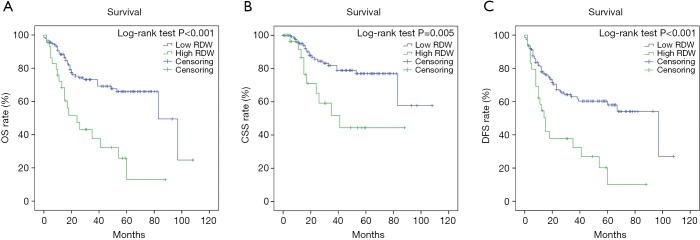
The patients with bladder cancer were divided into two subgroups according to the RDW value (0.1395). A high RDW value significantly correlated with higher mortality, a decrease in hemoglobin, an increase in C-reactive protein, a decrease in RBC count, and T stage (P<0.05). Statistically significant differences in OS, CSS, and DFS were found between high- and low-RDW groups. Hence, a high RDW value was presumed to be a risk factor for poor prognosis in patients with bladder cancer after radical cystectomy (P<0.001).
Patients with a high RDW value had a poor prognosis. Therefore, RDW is a reliable predictor for the prognosis of patients with bladder cancer who underwent radical cystectomy.
膀胱癌是全球最常见的癌症之一。在所有癌症中排名第九,在男性患者癌症中排名第四。最近的研究报告称,红细胞分布宽度(RDW)在某些癌症中是一个潜在的预测指标。本研究探讨了RDW在根治性膀胱切除术后膀胱癌患者中的意义。
本研究纳入了2009年3月至2018年10月期间接受根治性膀胱切除术的169例患者。采用Kaplan-Meier法分析总生存期(OS)、癌症特异性生存期(CSS)和无病生存期(DFS)。单因素和多因素Cox分析用于评估RDW的预后意义。
根据RDW值(0.1395)将膀胱癌患者分为两个亚组。高RDW值与较高的死亡率、血红蛋白降低、C反应蛋白升高、红细胞计数降低和T分期显著相关(P<0.05)。高RDW组和低RDW组在OS、CSS和DFS方面存在统计学显著差异。因此,高RDW值被认为是根治性膀胱切除术后膀胱癌患者预后不良的危险因素(P<0.001)。
RDW值高的患者预后较差。因此,RDW是接受根治性膀胱切除术的膀胱癌患者预后的可靠预测指标。