Guo Yaxin, Liao Jun, Li Shunian, Shang Yiyan, Wang Yunxia, Wu Qingxia, Wu Yaping, Wang Meiyun, Yan Fengshan, Tan Hongna
Department of Radiology, People's Hospital of Zhengzhou University & Henan Provincial People's Hospital, Zhengzhou, People's Republic of China.
Department of Radiology, People's Hospital of Henan University, Zhengzhou, People's Republic of China.
Breast Cancer (Dove Med Press). 2024 Dec 19;16:981-991. doi: 10.2147/BCTT.S487988. eCollection 2024.
Histological grade is an acknowledged prognostic factor for breast cancer, essential for determining clinical treatment strategies and prognosis assessment. Our study aims to establish intra- and peritumoral radiomics models using T2WI and DWI MR sequences for predicting the histological grade of breast cancer.
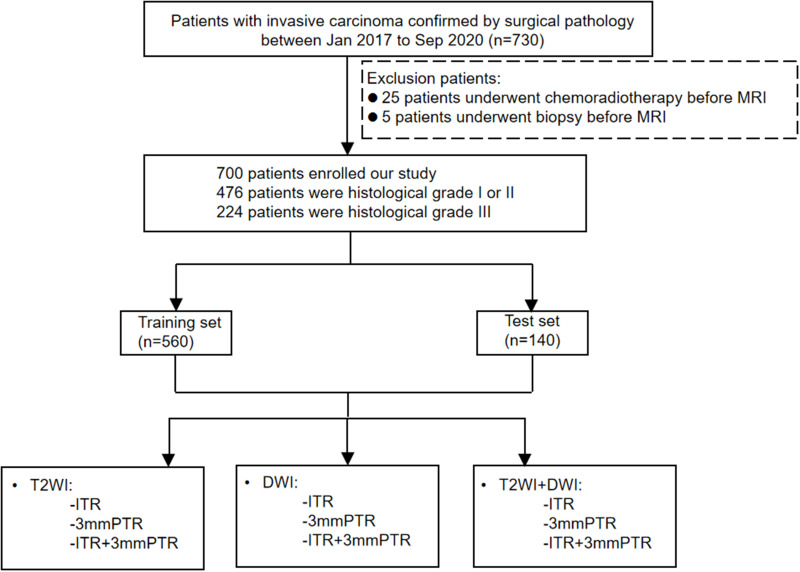
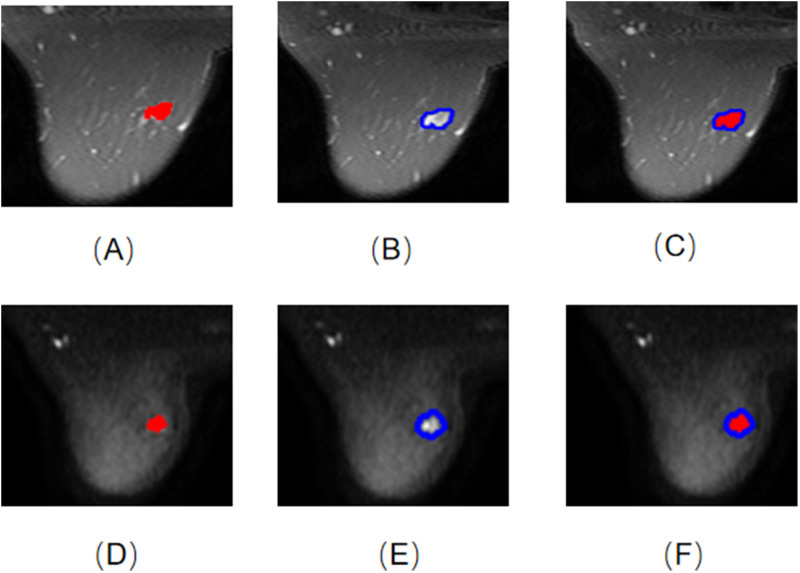
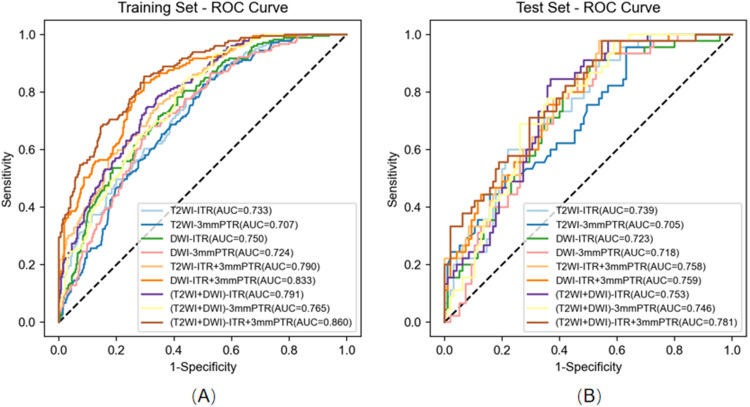
700 breast cancer cases who had MRI scans before surgery were included. The intratumoral region (ITR) of interest was manually delineated, while the peritumoral region (PTR-3 mm) was automatically obtained by expanding the ITR by 3 mm. Radiomics features were extracted using the intra- and peritumoral images from T2WI and DWI sequences on breast MRI. Then, the key features with the strongest predictivity of histological grade were selected. Finally, 9 predictive radiomics models were established based on T2WI-ITR, T2WI-3mmPTR, DWI-ITR, DWI-3mmPTR, T2WI-ITR + 3mmPTR, DWI-ITR + 3mmPTR, (T2WI + DWI)-ITR, (T2WI + DWI)-3mmPTR and (T2WI + DWI)-ITR + 3mmPTR.
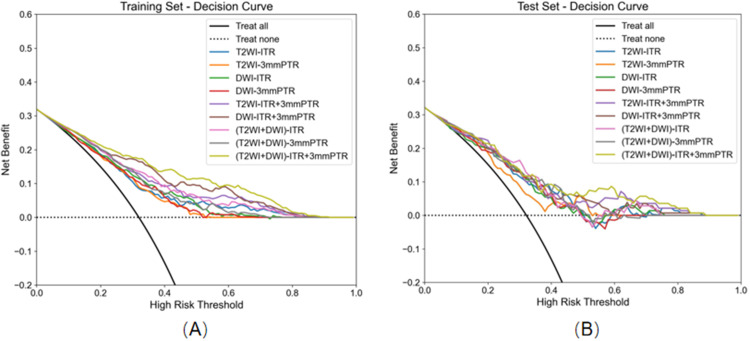
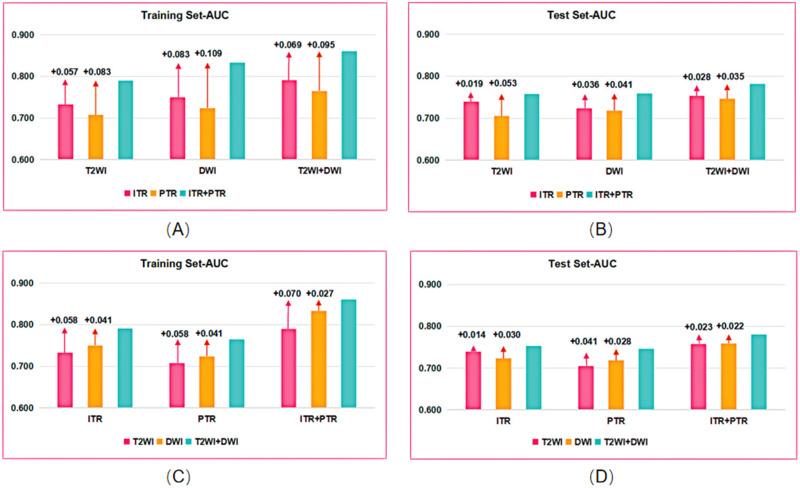
The (T2WI + DWI)-ITR + 3mmPTR contained 13 DWI features which included a shape feature, a texture feature, and 11 filtered features, as well as 10 T2WI features, all of which were filtered features. Among the 9 models, the combined models showed better performance than the single models in both the training and test sets, especially for the (T2WI + DWI)-ITR + 3mmPTR radiomics model. The (T2WI + DWI)-ITR + 3mmPTR radiomics model achieved a sensitivity, specificity, accuracy, and AUC of 80.4%, 72.4%, 75.0%, and 0.860 in the training set, and 68.9%, 70.5%, 70.0%, and 0.781 in the test set. Decision curve analysis (DCA) showed that the (T2WI + DWI)-ITR + 3mmPTR model had the greatest net clinical benefit compared to the other models.
The intra- and peritumoral radiomics methodologies using T2WI and DWI MR sequences could be utilized to assess histological grade for breast cancer, particularly with the (T2WI + DWI)-ITR + 3mmPTR radiomics model demonstrating significant potential for clinical application.
组织学分级是公认的乳腺癌预后因素,对确定临床治疗策略和预后评估至关重要。我们的研究旨在利用T2WI和DWI MR序列建立瘤内和瘤周放射组学模型,以预测乳腺癌的组织学分级。
纳入700例术前进行过MRI扫描的乳腺癌病例。手动勾勒出感兴趣的瘤内区域(ITR),而瘤周区域(PTR-3mm)通过将ITR扩大3mm自动获得。使用乳腺MRI上T2WI和DWI序列的瘤内和瘤周图像提取放射组学特征。然后,选择对组织学分级预测性最强的关键特征。最后,基于T2WI-ITR、T2WI-3mmPTR、DWI-ITR、DWI-3mmPTR、T2WI-ITR + 3mmPTR、DWI-ITR + 3mmPTR、(T2WI + DWI)-ITR、(T2WI + DWI)-3mmPTR和(T2WI + DWI)-ITR + 3mmPTR建立了9个预测性放射组学模型。
(T2WI + DWI)-ITR + 3mmPTR包含13个DWI特征,其中包括1个形状特征、1个纹理特征和11个过滤特征,以及10个T2WI特征,均为过滤特征。在9个模型中,联合模型在训练集和测试集中均表现出比单一模型更好的性能,特别是(T2WI + DWI)-ITR + 3mmPTR放射组学模型。(T2WI + DWI)-ITR + 3mmPTR放射组学模型在训练集中的灵敏度、特异度、准确度和AUC分别为80.4%、72.4%、75.0%和0.860,在测试集中分别为68.9%、70.5%、70.0%和0.781。决策曲线分析(DCA)表明,与其他模型相比,(T2WI + DWI)-ITR + 3mmPTR模型具有最大的净临床效益。
利用T2WI和DWI MR序列的瘤内和瘤周放射组学方法可用于评估乳腺癌的组织学分级,特别是(T2WI + DWI)-ITR + 3mmPTR放射组学模型具有显著的临床应用潜力。