He Xucong, Xie Zhibin, Xia Zhichun, Liu Xiulan, Wei Yanheng, Yang Yong
Department of Adult Psychiatry, The Affiliated Brain Hospital, Guangzhou Medical University, Guangzhou, Guangdong Province, People's Republic of China.
Department of Clinical One, Third People's Hospital, Meizhou City, Guangdong Province, People's Republic of China.
Neuropsychiatr Dis Treat. 2024 Dec 20;20:2571-2583. doi: 10.2147/NDT.S482994. eCollection 2024.
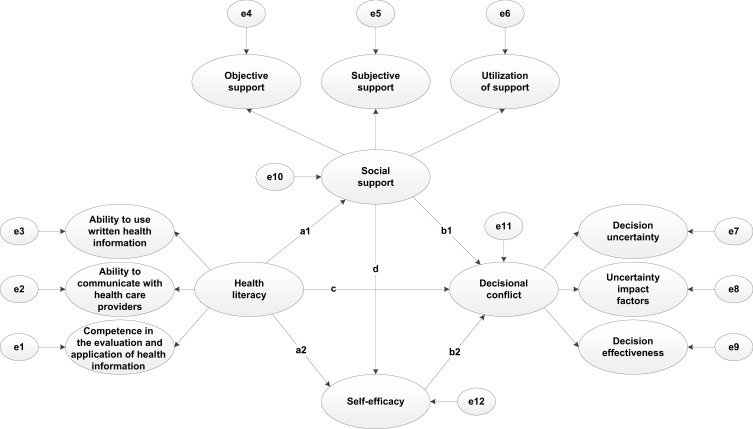
Constructing a multiple mediation model based on two mediating variables, social support and self-efficacy, to explore the mechanism of health literacy's effect on decisional conflict in patients with stable schizophrenia.
A total of 205 patients with stable schizophrenia who were hospitalized in a psychiatric hospital in Guangdong Province, China, were selected for the study. The All Aspects of Health Literacy Scale (AAHLS), Decisional Conflict Scale (DCS), Social Support Rating Scale (SSRS) and General Self-Efficacy Scale (GSES) were used to evaluate health literacy, decisional conflict, social support and self-efficacy. Path analysis was performed by constructing a structural equation model, and the mediating effect between variables was validated by the bias-corrected nonparametric percentile bootstrap method.
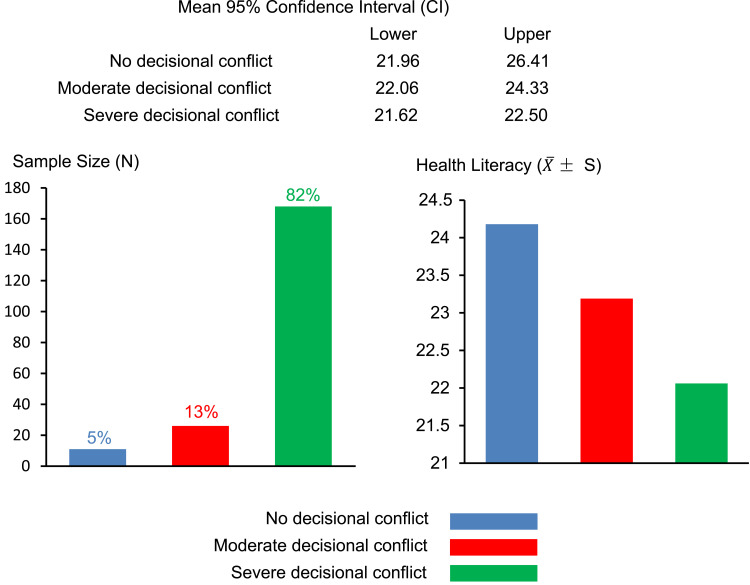
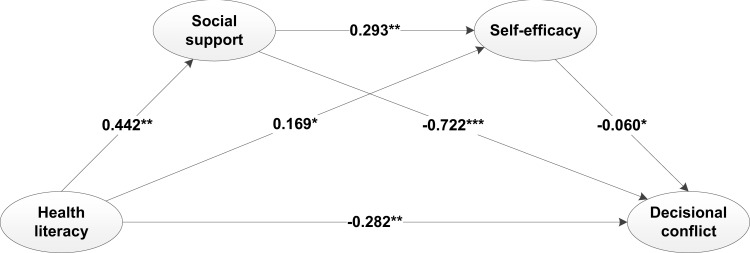
Health literacy, social support, and self-efficacy together explained 20.4% of the variance in decisional conflict. (1) Severe decisional conflict group accounted for 82% of overall patients with stable schizophrenia. (2) there were strong and significant negative relationships between decisional conflict and health literacy, social support, self-efficacy and each of their dimensions (=-0.14-0.27, <0.01 or <0.05). (3) The path analysis showed that health literacy directly affects decisional conflict (=-0.282); additionally, health literacy indirectly affects decisional conflict through social support (=-0.319), self-efficacy (=-0.010) and through the chain mediating effect of social support and self-efficacy (=-0.008).
Patients with stable schizophrenia have serious decisional conflict in China, and necessary interventions have to be made. This study found that social support and self-efficacy mediate the relationship between health literacy and decisional conflict in patients with stable schizophrenia in China. Healthcare professionals should emphasize health literacy education for patients, and implement pathway-based targeted interventions to improve health literacy, reduce decisional conflict, and promote the recovery of patients with stable schizophrenia.
构建一个基于社会支持和自我效能这两个中介变量的多重中介模型,以探讨健康素养对稳定期精神分裂症患者决策冲突影响的机制。
选取中国广东省某精神病院住院的205例稳定期精神分裂症患者进行研究。采用健康素养综合评定量表(AAHLS)、决策冲突量表(DCS)、社会支持评定量表(SSRS)和一般自我效能感量表(GSES)分别评估健康素养、决策冲突、社会支持和自我效能。通过构建结构方程模型进行路径分析,并采用偏差校正非参数百分位Bootstrap法验证变量间的中介效应。
健康素养、社会支持和自我效能共同解释了决策冲突变异的20.4%。(1)严重决策冲突组占稳定期精神分裂症患者总数的82%。(2)决策冲突与健康素养、社会支持、自我效能及其各维度之间均存在强烈且显著的负相关(=-0.14 - 0.27,<0.01或<0.05)。(3)路径分析显示,健康素养直接影响决策冲突(=-0.282);此外,健康素养还通过社会支持(=-0.319)、自我效能(=-0.010)以及社会支持和自我效能的链式中介效应(=-0.008)间接影响决策冲突。
中国稳定期精神分裂症患者存在严重的决策冲突,必须进行必要的干预。本研究发现,社会支持和自我效能在我国稳定期精神分裂症患者健康素养与决策冲突的关系中起中介作用。医护人员应重视对患者的健康素养教育,并实施基于路径的针对性干预措施,以提高健康素养,减少决策冲突,促进稳定期精神分裂症患者康复。