Karp Celia, Tikofsky Shira, Shiferaw Solomon, Seme Assefa, Yihdego Mahari, Zimmerman Linnea
Department of Population, Family and Reproductive Health, Johns Hopkins Bloomberg School of Public Health, Baltimore, MD, USA.
Department of Reproductive Health and Health Service Management, School of Public Health, Addis Ababa University, Addis Ababa, Ethiopia.
Contracept X. 2024 Nov 19;6:100114. doi: 10.1016/j.conx.2024.100114. eCollection 2024.
To estimate levels of person-centered contraceptive counseling among current and recent contraceptive users, assess for whom counseling differs, and examine the relationship between counseling and contraceptive practices, specifically use of provider-dependent methods and use of one's preferred method, among women in Ethiopia.
This cross-sectional study uses nationally representative data collected by the Performance Monitoring for Action Ethiopia project among current and recent contraceptive users ( = 2731) aged 15-49 between October and November 2021. Descriptive analyses estimated person-centered counseling levels via the recently validated quality of contraceptive counseling short scale (QCC-10). Bivariable and multivariable logistic regression estimated associations with contraceptive practices.
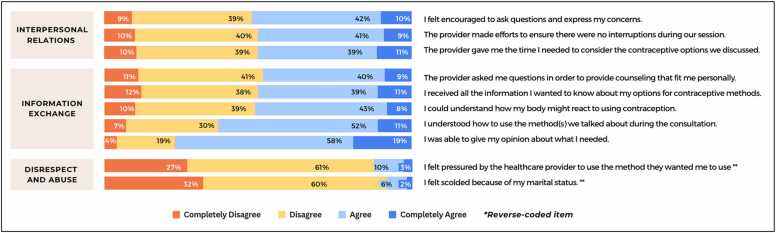
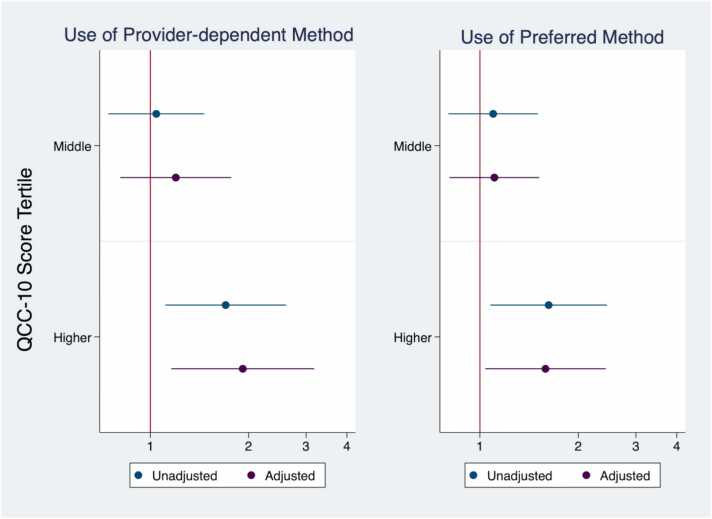
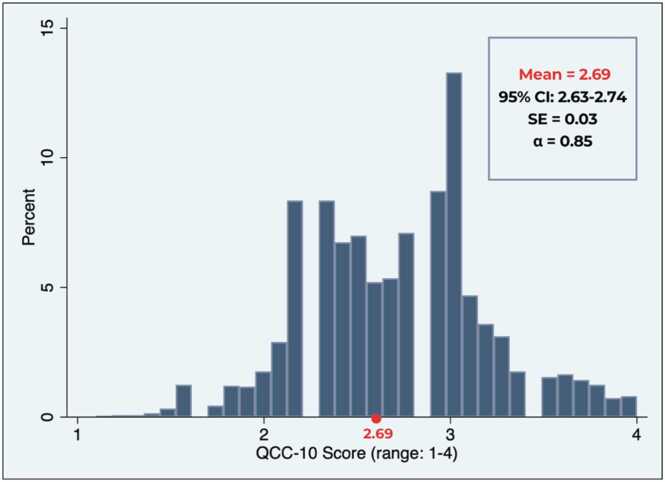
Contraceptive users in Ethiopia receive moderate quality counseling (mean QCC-10 score = 2.69, range: 1.1-4.0) with significant social inequities in the receipt of person-centered care. Women who are younger, uneducated, not in union, from poorer households, or who sourced their method from a non-public facility reported less person-centered care. Strong relationships were observed between higher quality counseling and women's contraceptive practices. Those receiving highest quality counseling had nearly double the odds of using provider-dependent methods compared to those reporting lowest quality counseling (AOR: 1.92; 95% CI: 1.16-3.18). Among current users, women reporting highest quality counseling had 62% higher odds of using their preferred method relative to women receiving poorest quality care (95% CI: 1.06-2.48).
Poorer quality care is associated with use of non-preferred methods and reliance on provider-independent methods. Efforts to reduce reproductive health disparities and promote contraceptive autonomy should prioritize a person-centered approach to contraceptive counseling for all.
Inequitable delivery of person-centered contraceptive care based on individuals' sociodemographic characteristics, such as education or marital status, undermines women's reproductive autonomy and hinders contraceptive experiences. Person-centered contraceptive counseling should be provided to all women in Ethiopia, regardless of their background, to support individuals in achieving their reproductive goals.
评估当前及近期避孕药具使用者以个人为中心的避孕咨询水平,确定咨询存在差异的对象,并研究咨询与避孕措施之间的关系,特别是在埃塞俄比亚女性中依赖提供者的避孕方法的使用情况以及首选避孕方法的使用情况。
这项横断面研究使用了埃塞俄比亚行动绩效监测项目在2021年10月至11月期间收集的具有全国代表性的数据,数据来自15至49岁的当前及近期避孕药具使用者(n = 2731)。描述性分析通过最近验证的避孕咨询质量短量表(QCC - 10)评估以个人为中心的咨询水平。双变量和多变量逻辑回归分析估计与避孕措施的关联。
埃塞俄比亚的避孕药具使用者接受的咨询质量中等(QCC - 10平均得分 = 2.69,范围:1.1 - 4.0),在接受以个人为中心的护理方面存在显著的社会不平等。年龄较小、未受过教育、未婚、来自贫困家庭或从非公共机构获取避孕方法的女性接受的以个人为中心的护理较少。高质量咨询与女性的避孕措施之间存在密切关系。与报告咨询质量最低的女性相比,接受最高质量咨询的女性使用依赖提供者的避孕方法的几率几乎高出一倍(调整后比值比:1.92;95%置信区间:1.16 - 3.18)。在当前使用者中,报告咨询质量最高的女性使用首选避孕方法的几率比接受最差质量护理的女性高62%(95%置信区间:1.06 - 2.48)。
较差的护理质量与使用非首选避孕方法以及依赖非提供者提供的避孕方法有关。减少生殖健康差距和促进避孕自主性的努力应优先为所有人采用以个人为中心的避孕咨询方法。
基于个人社会人口学特征(如教育程度或婚姻状况)不平等地提供以个人为中心的避孕护理,会损害女性的生殖自主性并阻碍避孕体验。埃塞俄比亚应向所有女性提供以个人为中心的避孕咨询,无论其背景如何,以支持个人实现其生殖目标。