Senner Fanny, Kerkhoff Lisa, Adorjan Kristina, Lauseker Michael, Budde Monika, Heilbronner Maria, Kalman Janos L, Kohshour Mojtaba Oraki, Papiol Sergi, Reich-Erkelenz Daniela, Schaupp Sabrina K, Schulte Eva C, Vogl Thomas, Anghelescu Ion-George, Arolt Volker, Baune Bernhardt T, Dannlowski Udo, Dalkner Nina, Dietrich Detlef E, Fallgatter Andreas J, Figge Christian, Konrad Carsten, Lang Fabian U, Reimer Jens, Reinighaus Eva Z, Schmauß Max, Schmitt Andrea, Senner Simon, Spitzer Carsten, Zimmermann Jörg, Hasan Alkomiet, Falkai Peter, Schulze Thomas G, Heilbronner Urs, Greiner Sophie-Kathrin
Institute of Psychiatric Phenomics and Genomics (IPPG), LMU University Hospital, LMU Munich, Germany.
Department of Psychiatry and Psychotherapy, LMU University Hospital, LMU Munich, Germany.
BJPsych Open. 2024 Dec 26;11(1):e11. doi: 10.1192/bjo.2024.816.
Employment and relationship are crucial for social integration. However, individuals with major psychiatric disorders often face challenges in these domains.
We investigated employment and relationship status changes among patients across the affective and psychotic spectrum - in comparison with healthy controls, examining whether diagnostic groups or functional levels influence these transitions.
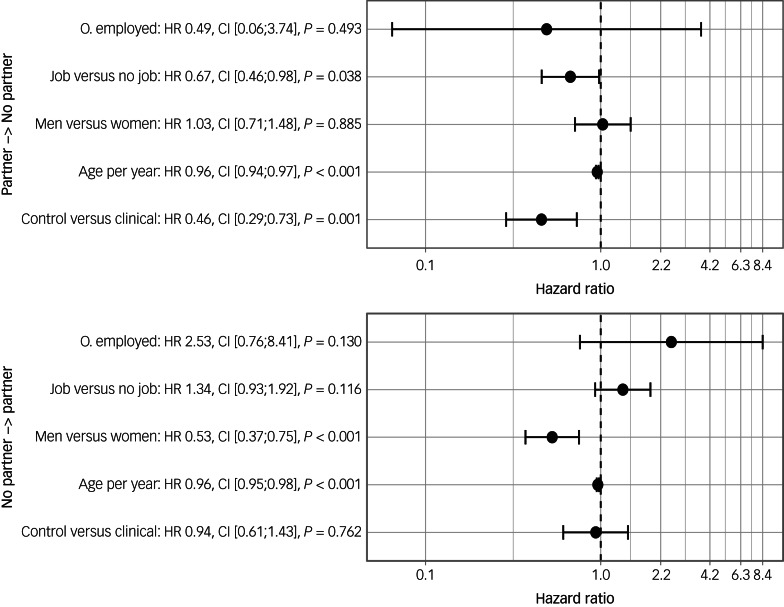
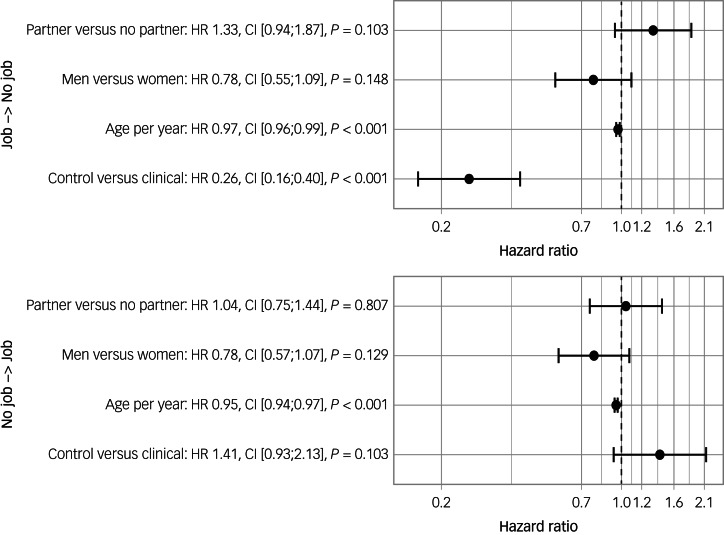
The sample from the longitudinal multicentric PsyCourse Study comprised 1260 patients with affective and psychotic spectrum disorders and 441 controls (mean age ± s.d., 39.91 ± 12.65 years; 48.9% female). Multistate models (Markov) were used to analyse transitions in employment and relationship status, focusing on transition intensities. Analyses contained multiple multistate models adjusted for age, gender, job or partner, diagnostic group and Global Assessment of Functioning (GAF) in different combinations to analyse the impact of the covariates on the hazard ratio of changing employment or relationship status.
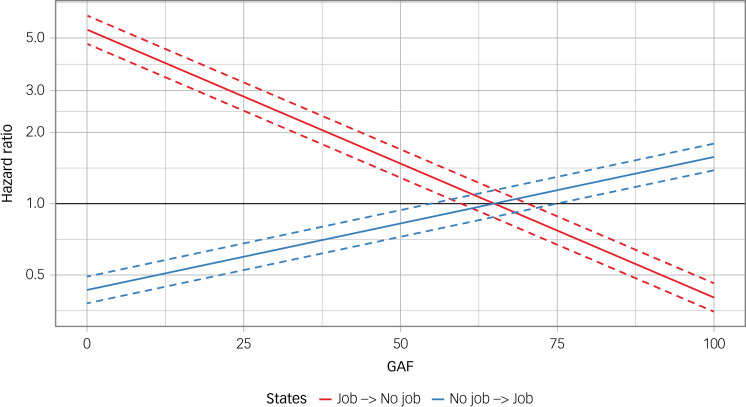
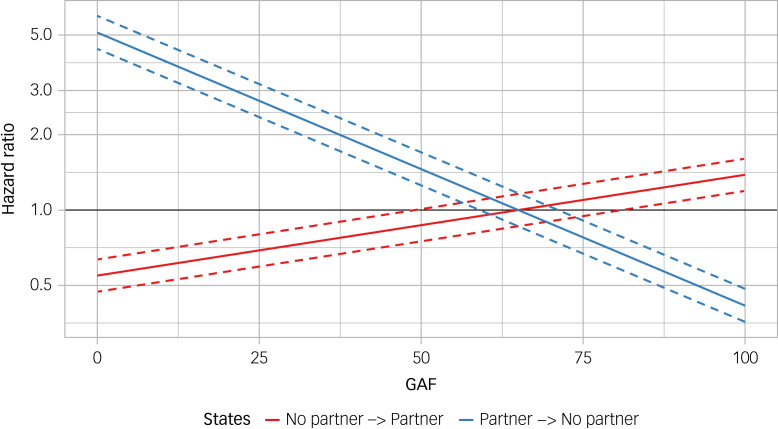
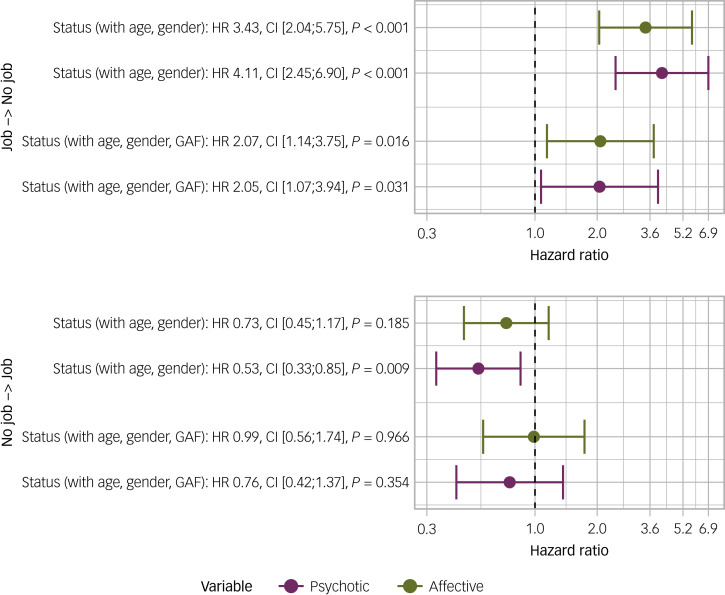
The clinical group had a higher hazard ratio of losing partner (hazard ratio 1.46, < 0.001) and job (hazard ratio 4.18, < 0.001) than the control group (corrected for age/gender). Compared with controls, clinical groups had a higher hazard of losing partner (affective group, hazard ratio 2.69, = 0.003; psychotic group, hazard ratio 3.06, = 0.001) and job (affective group, hazard ratio 3.43, < 0.001; psychotic group, hazard ratio 4.11, < 0.001). Adjusting for GAF, the hazard ratio of losing partner and job decreased in both clinical groups compared with controls.
Patients face an increased hazard of job loss and relationship dissolution compared with healthy controls, and this is partially conditioned by the diagnosis and functional level. These findings underscore a high demand for destigmatisation and support for individuals in managing their functional limitations.
就业和人际关系对社会融入至关重要。然而,患有严重精神疾病的个体在这些方面往往面临挑战。
我们调查了情感障碍和精神病谱系患者的就业和人际关系状况变化——与健康对照组相比,研究诊断类别或功能水平是否会影响这些转变。
纵向多中心PsyCourse研究的样本包括1260名情感障碍和精神病谱系障碍患者以及441名对照组(平均年龄±标准差,39.91±12.65岁;48.9%为女性)。采用多状态模型(马尔可夫模型)分析就业和人际关系状况的转变,重点关注转变强度。分析包含多个多状态模型,针对年龄、性别、工作或伴侣、诊断类别以及功能总体评定量表(GAF)进行不同组合的调整,以分析协变量对就业或人际关系状况变化风险比的影响。
与对照组相比(校正年龄/性别后),临床组失去伴侣(风险比1.46,<0.001)和失去工作(风险比4.18,<0.001)的风险比更高。与对照组相比,临床组失去伴侣(情感障碍组,风险比2.69,=0.003;精神病组,风险比3.06,=0.001)和失去工作(情感障碍组,风险比3.43,<0.001;精神病组,风险比4.11,<0.001)的风险更高。校正GAF后,与对照组相比,两个临床组失去伴侣和失去工作的风险比均降低。
与健康对照组相比,患者失去工作和关系破裂的风险增加,这部分受诊断和功能水平的影响。这些发现强调了消除污名化以及为个体应对功能限制提供支持的迫切需求。