Eriksson Thérèse, Tropp Hans, Wiréhn Ann-Britt, Levin Lars-Åke
Department of Health, Medicine and Caring Sciences (HMV), Linköping University, Linköping, Sweden.
Department of Biomedical and Clinical Sciences, Linköping University, Linköping, Sweden.
Front Public Health. 2024 Dec 11;12:1326067. doi: 10.3389/fpubh.2024.1326067. eCollection 2024.
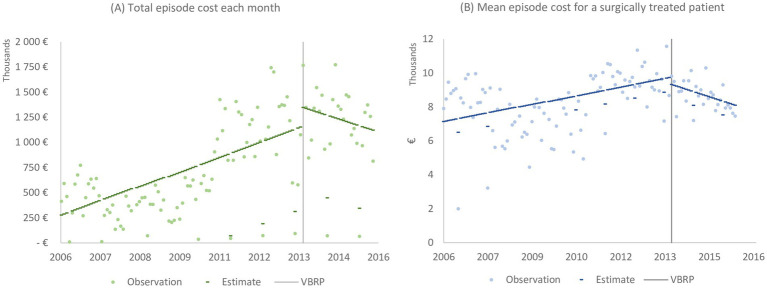
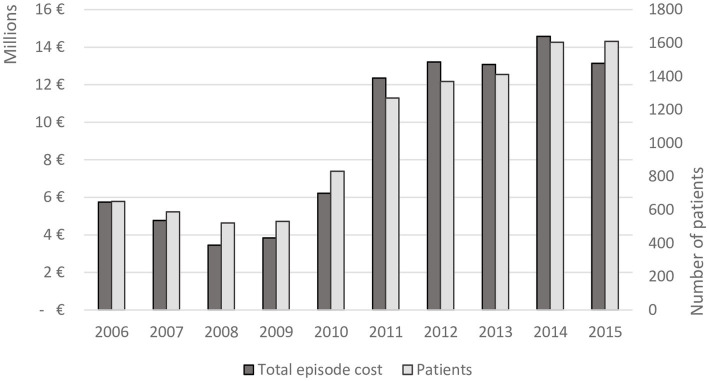
Value-based reimbursement programmes have become increasingly common in attempts to bend the cost curve of healthcare without negative effects on quality. The aim of this study was to analyse the effect of introducing a value-based reimbursement programme on the cost to third-party payer. We performed a retrospective observational study with a before and after design based on the introduction of a value-based reimbursement programme in Sweden. We analysed patient level cost data from inpatient and outpatient care of patients undergoing lumbar spine surgery, 2006-2015. The average 1-year episode cost decreased 11 percent during the first 2 years with the value-based reimbursement. The number of patients increased 22 percent during the same period, causing the total cost to increase by 8 percent. The value to third-party payer increased after the introduction of the value-based reimbursement since more patients were treated and attained a positive outcome. The decreased episode cost may be a result of better coordinated post-discharge care. Another explanation could be that costs previously borne by the third-party payer are shifted onto the healthcare providers. Thus, it is crucial that providers find a sustainable way of delivering care in the long term to retain value. Interlinking patient records facilitates a holistic perspective among healthcare providers raising awareness of health care utilization through the whole care chain.
基于价值的报销计划在试图控制医疗保健成本曲线且不对质量产生负面影响方面变得越来越普遍。本研究的目的是分析引入基于价值的报销计划对第三方支付者成本的影响。我们基于瑞典引入的一项基于价值的报销计划,采用前后设计进行了一项回顾性观察研究。我们分析了2006年至2015年接受腰椎手术患者的住院和门诊护理的患者层面成本数据。在实施基于价值的报销的前两年中,平均1年病程成本下降了11%。同期患者数量增加了22%,导致总成本增加了8%。引入基于价值的报销后,由于治疗的患者更多且取得了积极结果,第三方支付者的价值增加了。病程成本的降低可能是出院后护理协调改善的结果。另一种解释可能是,以前由第三方支付者承担的成本转嫁给了医疗服务提供者。因此,至关重要的是,医疗服务提供者要找到一种长期提供可持续护理的方式以保持价值。互连患者记录有助于医疗服务提供者形成整体视角,提高对整个护理链中医疗保健利用情况的认识。