Wang Changjian, Guo Haiqiao, Yu Peng, Huang Bo, Xin Zhikun, Zheng Xufan, Zhang Jinli, Tang Tao
CHN Energy BaoRiXiLe Energy Co., Ltd., Hulunbeier, China.
School of Civil and Resources Engineering, Graduate School of University of Science and Technology Beijing, Beijing, China.
Front Microbiol. 2024 Dec 11;15:1505542. doi: 10.3389/fmicb.2024.1505542. eCollection 2024.
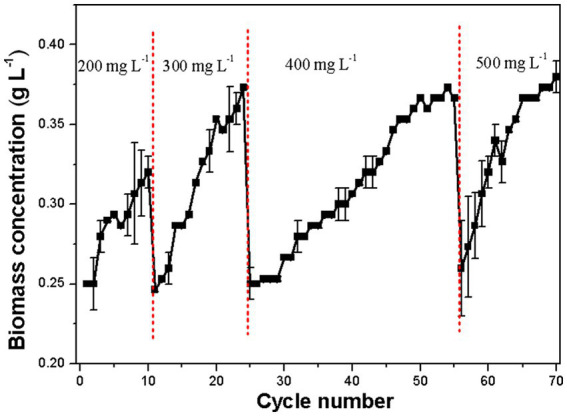
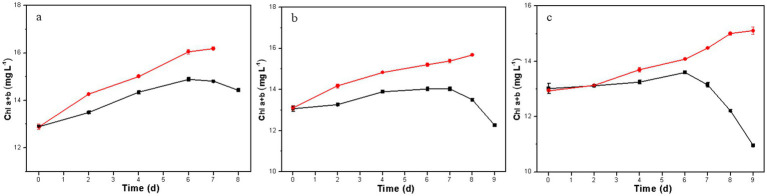
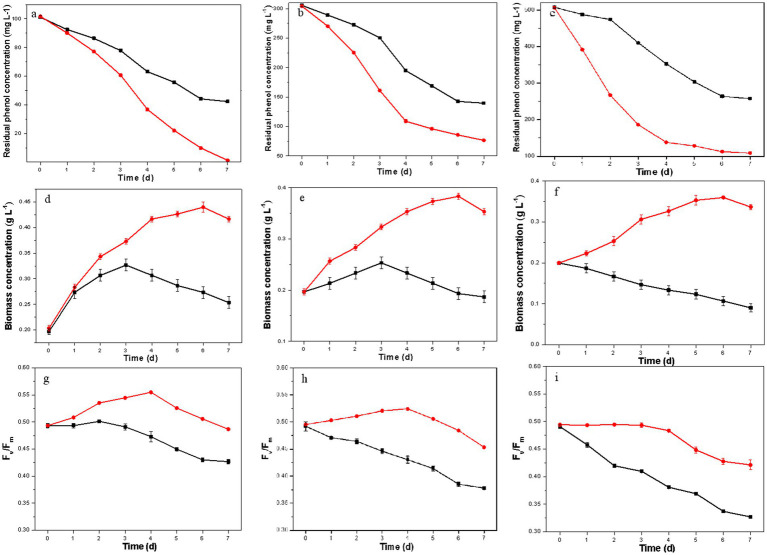
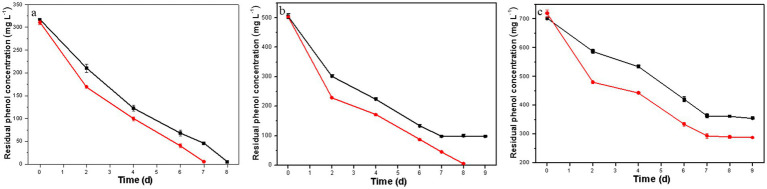
Phenol is one of the major organic pollutants in high salt industrial wastewater. The biological treatment method is considered to be a cost-effective and eco-friendly method, in which the co-culture of microalgae and bacteria shows a number of advantages. In the previous study, a co-culture system featuring () and () was established and could degrade 400 mg L phenol at 3% NaCl concentration. In order to enhance the performance of this system, strain was subjected to adaptive laboratory evolution (ALE) by gradually increasing the phenol concentration from 200 mg L to 500 mg L at 3% NaCl concentration. At a phenol concentration of 500 mg L, the phenol removal rate of the resulting was 78.4% within 7 days, while that of the original strain was only 49.2%. The SOD, POD, and MDA contents of the resulting strain were lower than those of the original strain, indicating that the high concentration of phenol was less harmful to the resulting strain. A co-culture system was established with the resulting and , which could complete degrade 500 mg L of phenol within 8 days, outperforming the original co-culture system. This study proved that ALE could improve the phenol tolerance and phenol degradation capability of , and then effectively improve the phenol degradation capability of and co-culture system.
苯酚是高盐工业废水中的主要有机污染物之一。生物处理方法被认为是一种经济高效且环保的方法,其中微藻和细菌的共培养显示出许多优势。在先前的研究中,建立了一种以()和()为特征的共培养系统,该系统在3%的NaCl浓度下能够降解400 mg/L的苯酚。为了提高该系统的性能,通过在3%的NaCl浓度下将苯酚浓度从200 mg/L逐渐提高到500 mg/L,对菌株进行了适应性实验室进化(ALE)。在苯酚浓度为500 mg/L时,所得菌株在7天内的苯酚去除率为78.4%,而原始菌株的去除率仅为49.2%。所得菌株的超氧化物歧化酶(SOD)、过氧化物酶(POD)和丙二醛(MDA)含量均低于原始菌株,这表明高浓度苯酚对所得菌株的危害较小。用所得菌株和建立了一个共培养系统,该系统能够在8天内完全降解500 mg/L的苯酚,性能优于原始的共培养系统。本研究证明,ALE可以提高菌株对苯酚的耐受性和苯酚降解能力,进而有效提高和共培养系统的苯酚降解能力。