Yang Mengye, Wang Xiaoyu, Zhang Yan, Qian Weina, Tang Yan
Reproductive Center, Suzhou Municipal Hospital, Suzhou, China.
Institute of Nursing, Nanjing Medical University, Nanjing, China.
Front Psychol. 2024 Dec 11;15:1499705. doi: 10.3389/fpsyg.2024.1499705. eCollection 2024.
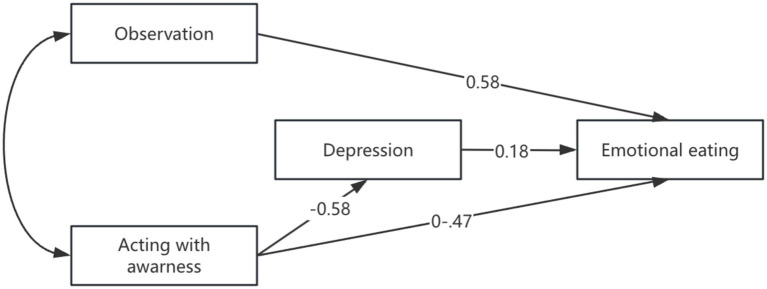
Emotional eating, characterized by the tendency to increase food intake in response to negative emotional states, is often linked to poor emotion regulation. While mindfulness-based interventions have been studied for their benefits in reducing emotional eating, less is known about how inherent mindfulness traits, relate to emotional regulation particularly among individuals with polycystic ovary syndrome (PCOS), a population known for high rates of psychological distress and disordered eating behaviors. This study investigates the associations between different facets of mindfulness, depressive symptoms, and emotional eating among individuals with PCOS and infertility who had not received any formal mindfulness intervention. A cross-sectional study was conducted involving 334 individuals. Participants completed the Five Facet Mindfulness Questionnaire-Short Form (FFMQ-SF), the Patient Health Questionnaire (PHQ-9) to assess depressive symptoms, and the Dutch Eating Behavior Questionnaire (DEBQ) to measure emotional eating. Structural Equation Modeling (SEM) was employed to examine the relationships between inherent mindfulness traits (i.e., observation, describing, acting with awareness, non-reactivity, and non-judgment), depressive symptoms, anxiety, and emotional eating. The findings indicated that the trait of acting with awareness may reduce emotional eating through its influence on depressive symptoms, while observational mindfulness was found to be associated with increased emotional eating without prior external mindfulness training. In conclusion, Mindfulness is a multidimensional construct, with its facets contributing differently to emotional regulation and eating behaviors in individuals with PCOS and infertility. Future research should explore these nuances to develop more targeted interventions.
情绪性进食的特点是倾向于在负面情绪状态下增加食物摄入量,它通常与不良的情绪调节有关。虽然基于正念的干预措施因其在减少情绪性进食方面的益处而受到研究,但对于内在的正念特质如何与情绪调节相关,尤其是在多囊卵巢综合征(PCOS)患者中,了解较少。PCOS患者群体以高心理困扰率和饮食紊乱行为而闻名。本研究调查了未接受任何正式正念干预的PCOS和不孕症患者中,正念的不同方面、抑郁症状和情绪性进食之间的关联。进行了一项横断面研究,涉及334名个体。参与者完成了五因素正念问卷简表(FFMQ-SF)、用于评估抑郁症状的患者健康问卷(PHQ-9)以及用于测量情绪性进食的荷兰饮食行为问卷(DEBQ)。采用结构方程模型(SEM)来检验内在正念特质(即观察、描述、有意识行动、不反应和不评判)、抑郁症状、焦虑和情绪性进食之间的关系。研究结果表明,有意识行动的特质可能通过对抑郁症状的影响来减少情绪性进食,而观察性正念被发现与在没有事先外部正念训练的情况下情绪性进食增加有关。总之,正念是一个多维度的概念,其各个方面对PCOS和不孕症患者的情绪调节和饮食行为的贡献各不相同。未来的研究应该探索这些细微差别,以制定更有针对性的干预措施。