Natsuga Ken
Department of Dermatology, Faculty of Medicine and Graduate School of Medicine, Hokkaido University, Sapporo, Japan.
J Dermatol. 2025 Mar;52(3):392-399. doi: 10.1111/1346-8138.17597. Epub 2024 Dec 26.
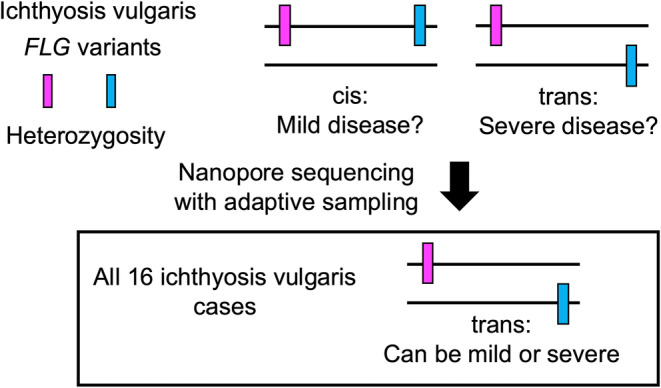
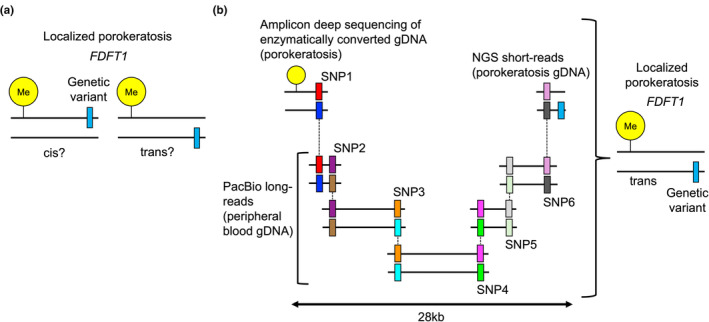
Phasing, the process of determining which alleles at different loci on homologous chromosomes belong together on the same chromosome, is crucial in the diagnosis and management of autosomal recessive diseases. Advances in long-read sequencing technologies have significantly enhanced our ability to accurately determine haplotypes. This review discusses the application of low-coverage long-read sequencing, nanopore Cas9-guided long-read sequencing, and adaptive sampling in phasing, highlighting their utility in complex clinical scenarios. Through clinical vignettes, we explore the importance of phasing in gene therapy design for recessive dystrophic epidermolysis bullosa and the role of revertant mosaicism in therapeutic epidermal autografts. Despite its promise, phasing with long-read sequencing faces challenges, including low efficiency in enriching target regions and the inherent error rate of nanopore sequencing. Future developments in long-read sequencing technologies will be critical in overcoming these limitations and expanding the applicability of phasing across various clinical settings.
定相,即确定同源染色体上不同基因座的哪些等位基因位于同一条染色体上的过程,在常染色体隐性疾病的诊断和管理中至关重要。长读长测序技术的进步显著提高了我们准确确定单倍型的能力。本文综述讨论了低覆盖长读长测序、纳米孔Cas9引导的长读长测序和适应性采样在定相中的应用,突出了它们在复杂临床场景中的实用性。通过临床案例,我们探讨了定相在隐性营养不良性大疱性表皮松解症基因治疗设计中的重要性以及回复性镶嵌现象在治疗性表皮自体移植中的作用。尽管长读长测序定相前景广阔,但仍面临挑战,包括富集目标区域效率低以及纳米孔测序的固有错误率。长读长测序技术的未来发展对于克服这些限制以及扩大定相在各种临床环境中的适用性至关重要。