Vazquez-Alejo Elena, De La Sierra Espinar-Buitrago María, Magro-Lopez Esmeralda, Tarancon-Diez Laura, Díez Cristina, Bernardino José Ignacio, Rull Anna, De Los Santos Ignacio, Alonso Roberto, Zamora Angielys, Jiménez José Luis, Muñoz-Fernández Mª Ángeles
Immunology Section, Molecular Immuno-Biology Laboratory, Hospital General Universitario Gregorio Marañón, Instituto de Investigación Sanitaria Gregorio Marañón (IiSGM), Madrid, Spain.
Centro de Investigación Biomédica en Red de Bioingeniería, Biomateriales y Nanomedicina (CIBER-BBN), Instituto de Salud Carlos III (ISCIII), Madrid, Spain.
Med Microbiol Immunol. 2024 Dec 26;214(1):4. doi: 10.1007/s00430-024-00813-z.
While the general immune response to Severe Acute Respiratory Syndrome-Coronavirus-2 (SARS-CoV-2) is well-understood, the long-term effects of Human Immunodeficiency Virus-1/Severe Acute Respiratory Syndrome-Coronavirus-2 (HIV-1/SARS-CoV-2) co-infection on the immune system remain unclear. This study investigates the immune response in people with HIV-1 (PWH) co-infected with SARS-CoV-2 to understand its long-term health consequences.
A retrospective longitudinal study of PWH with suppressed viral load and SARS-CoV-2 infection was conducted. Cryopreserved peripheral blood mononuclear cells and plasma samples were collected at three time-points: HIV-1/pre-SARS-CoV-2 (n = 18), HIV-1/SARS-CoV-2 (n = 46), and HIV-1/post-SARS-CoV-2 (n = 36). Plasma levels of 25 soluble cytokines and chemokines, and anti-S/anti-N-IgG-SARS-CoV-2 antibodies were measured. Immunophenotyping of innate and adaptive immune components and HIV-1 and SARS-CoV-2-specific T/B-cell responses were assessed by flow cytometry.
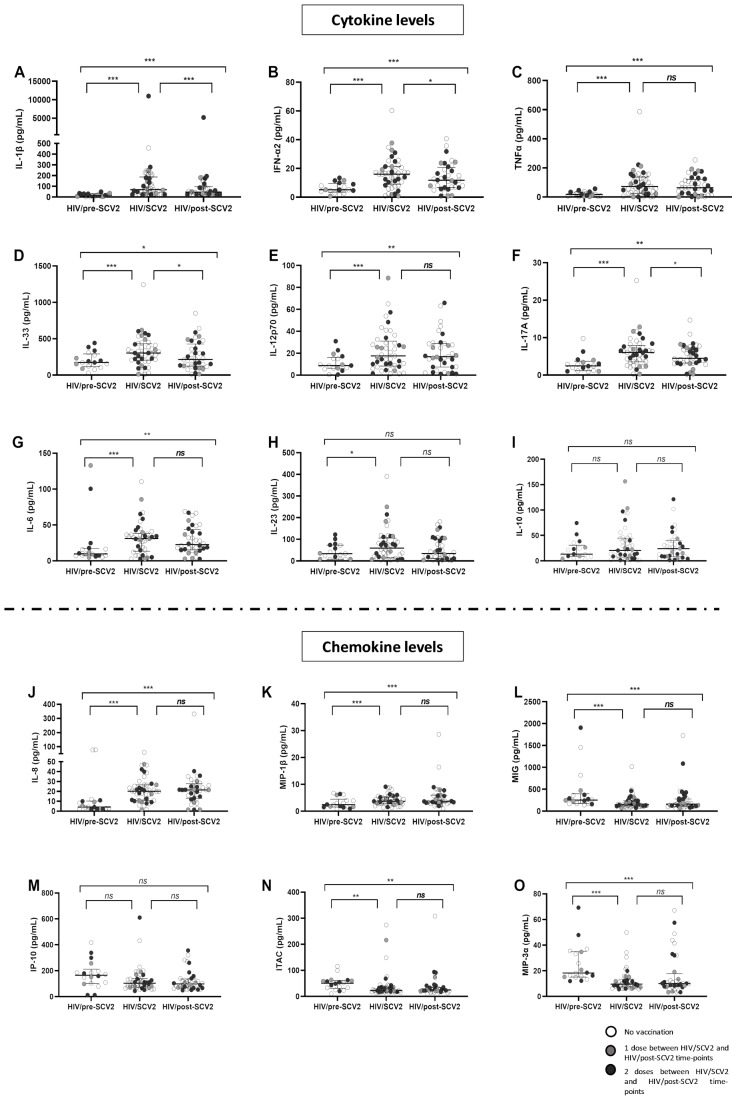
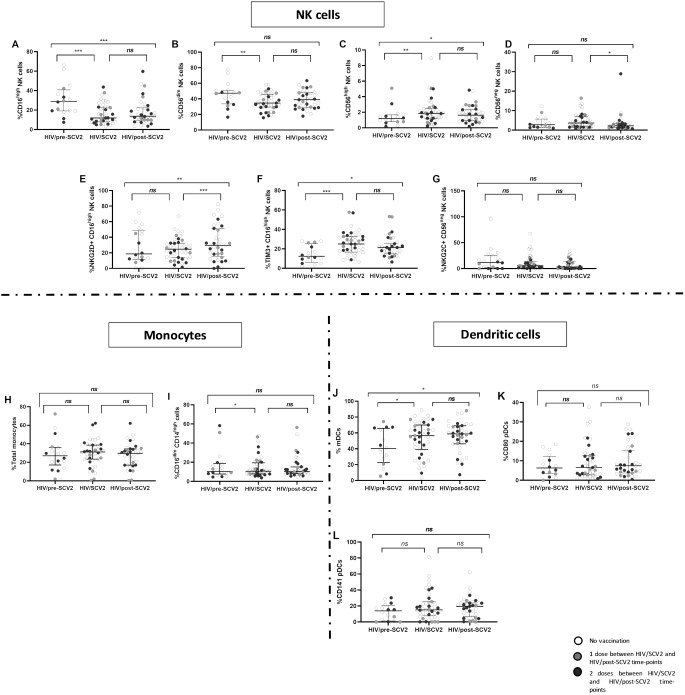
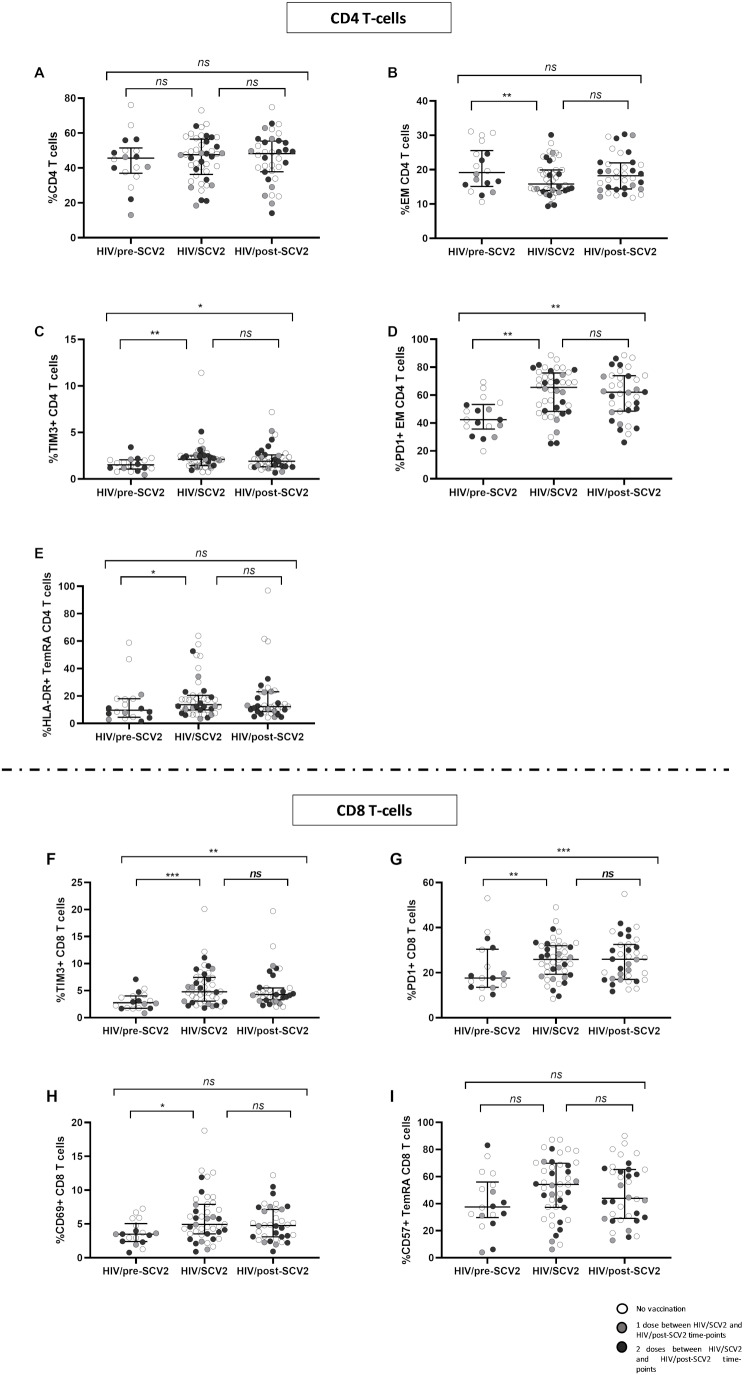
HIV-1/SARS-CoV-2 co-infection was associated with long-lasting immune dysfunction, characterized by elevated levels of pro-inflammatory cytokines and a decrease in the MIG-IP10-ITAC chemokine axis at the HIV/SARS-CoV-2 time-point, which persisted one year later. Additionally, alterations in the distribution of subsets and increased activation (NKG2D/NKG2C) and maturation (TIM3) markers of NK and dendritic cells were observed at the HIV-1/SARS-CoV-2 time-point, persisting throughout the study. Effector memory CD4 T-cell subsets were decreased, while exhaustion/senescence (PD1/TIM3/CD57) markers were elevated at all three time-points. SARS-CoV-2-specific T/B-cell responses remained stable throughout the study, while HIV-1-specific T-cell responses decreased at the HIV-1/SARS-CoV-2 time-point and remained so.
Persistent immune dysfunction in HIV-1/SARS-CoV-2 co-infection increases the risk of future complications, even in PWH with mild symptoms. Exacerbated inflammation and alterations in immune cells may contribute to reduce vaccine efficacy and potential reinfections.
虽然对严重急性呼吸综合征冠状病毒2(SARS-CoV-2)的一般免疫反应已得到充分了解,但人类免疫缺陷病毒1/严重急性呼吸综合征冠状病毒2(HIV-1/SARS-CoV-2)合并感染对免疫系统的长期影响仍不清楚。本研究调查了合并感染SARS-CoV-2的HIV-1感染者(PWH)的免疫反应,以了解其对长期健康的影响。
对病毒载量得到抑制且感染SARS-CoV-2的PWH进行了一项回顾性纵向研究。在三个时间点采集了冷冻保存的外周血单核细胞和血浆样本:HIV-1/感染SARS-CoV-2之前(n = 18)、HIV-1/感染SARS-CoV-2期间(n = 46)和HIV-1/感染SARS-CoV-2之后(n = 36)。检测了25种可溶性细胞因子和趋化因子的血浆水平以及抗S/抗N-IgG-SARS-CoV-2抗体。通过流式细胞术评估先天性和适应性免疫成分的免疫表型以及HIV-1和SARS-CoV-2特异性T/B细胞反应。
HIV-1/SARS-CoV-2合并感染与持久的免疫功能障碍相关,其特征是在HIV/SARS-CoV-2时间点促炎细胞因子水平升高以及MIG-IP10-ITAC趋化因子轴降低,这种情况在一年后仍然存在。此外,在HIV-1/SARS-CoV-2时间点观察到自然杀伤细胞和树突状细胞亚群分布的改变以及激活(NKG2D/NKG2C)和成熟(TIM3)标志物增加,并且在整个研究过程中持续存在。效应记忆CD4 T细胞亚群减少,而在所有三个时间点耗竭/衰老(PD1/TIM3/CD57)标志物均升高。在整个研究过程中,SARS-CoV-2特异性T/B细胞反应保持稳定,而HIV-1特异性T细胞反应在HIV-1/SARS-CoV-2时间点下降并持续如此。
即使在症状较轻的PWH中,HIV-1/SARS-CoV-2合并感染导致的持续免疫功能障碍也会增加未来并发症的风险。炎症加剧和免疫细胞改变可能会导致疫苗效力降低和潜在的再次感染。