Sahebihagh Mohammad Hasan, Hosseinzadeh Mina, Mirghafourvand Mojgan, Sarbakhsh Parvin, Nemati Hossein
Tabriz Health Services Management Research Center and Department of Community Health Nursing, Tabriz University of Medical Sciences, Tabriz, Iran.
Department of Community Health Nursing, Tabriz University of Medical Sciences, Tabriz, Iran.
BMJ Open. 2024 Dec 26;14(12):e091253. doi: 10.1136/bmjopen-2024-091253.
In recent years, non-invasive stimulation technologies such as repetitive transcranial magnetic stimulation, transcranial direct current stimulation, bioresonance and auriculotherapy have been used for smoking cessation. Individuals may face various challenges throughout the quitting process. This study aimed to explore the challenges of smoking cessation for users of non-invasive stimulation technologies in Iran.
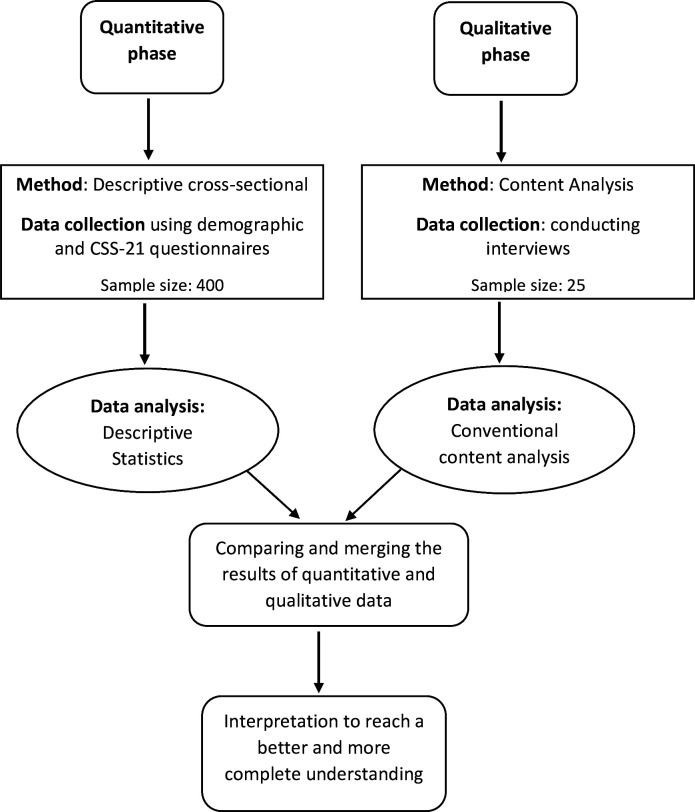
DESIGN, SETTING AND PARTICIPANTS: This parallel-convergent mixed-methods study was conducted using both quantitative and qualitative components. In the quantitative component, a cross-sectional study involved 400 participants, randomly and proportionally sampled from clinics offering non-invasive stimulation technologies for smoking cessation. Data were collected through questionnaires on sociodemographic characteristics and the Challenges to Stopping Smoking scale, with descriptive statistics used for analysis. Participants ranked the challenges based on a predetermined list in the quantitative component. In the qualitative component, 25 users from Tehran, Tabriz and Karaj were selected via purposive and snowball sampling. Data were gathered through in-depth, semistructured individual interviews and analysed using qualitative content analysis with a conventional approach. A merging strategy and convergence model were employed to combine the quantitative and qualitative data.
Quantitative results indicated that 71.5% of participants ranked fear of side effects as a major challenge, making it the most significant issue. Qualitative data also highlighted this, as the primary challenge in smoking cessation. 242 (60.5%) participants declared fear of failure as one of the main challenges. Qualitative data indicated that this often stems from previous unsuccessful quit attempts. The feeling of losing cigarettes was one of the major challenges for 129 (32.2%) participants, reflecting a deep emotional dependency on smoking. While the concern about the cost of using the technology was one of the major challenges for 76 (19.0%) of the participants, qualitative data provided a different perspective, with some participants assessing the high cost of quitting against potential future savings from not buying cigarettes. Fear of relapse was a notable challenge identified in the qualitative data, underscoring the importance of managing triggers and environments during the cessation process.
Fear of side effects and failure were the most significant challenges in smoking cessation using non-invasive stimulation technologies. Emotional dependency on cigarettes and concerns about the cost also played a role. Fear of relapse was highlighted in qualitative data. To overcome the challenges of smoking cessation with non-invasive stimulation technologies, supportive programmes that provide psychological counselling, financial aid and education are essential to improve success rates.
近年来,重复经颅磁刺激、经颅直流电刺激、生物共振和耳穴疗法等非侵入性刺激技术已被用于戒烟。在整个戒烟过程中,个人可能面临各种挑战。本研究旨在探讨伊朗非侵入性刺激技术使用者在戒烟方面面临的挑战。
设计、背景和参与者:本平行聚合混合方法研究同时使用了定量和定性成分。在定量部分,一项横断面研究涉及400名参与者,他们是从提供非侵入性戒烟刺激技术的诊所中随机且按比例抽样选取的。通过关于社会人口学特征和戒烟挑战量表的问卷收集数据,并使用描述性统计进行分析。在定量部分,参与者根据预先确定的列表对挑战进行排名。在定性部分,通过目的抽样和滚雪球抽样从德黑兰、大不里士和卡拉季选取了25名使用者。通过深入的半结构化个人访谈收集数据,并使用传统方法进行定性内容分析。采用合并策略和聚合模型将定量和定性数据结合起来。
定量结果表明,71.5%的参与者将对副作用的恐惧列为主要挑战,使其成为最显著的问题。定性数据也突出了这一点,将其作为戒烟的主要挑战。242名(60.5%)参与者宣称对失败的恐惧是主要挑战之一。定性数据表明,这通常源于之前不成功的戒烟尝试。对失去香烟的感觉是129名(32.2%)参与者的主要挑战之一,反映出对吸烟的深度情感依赖。虽然对使用该技术成本的担忧是76名(19.0%)参与者的主要挑战之一,但定性数据提供了不同的观点,一些参与者将戒烟的高成本与未来不购买香烟可能节省的费用进行了权衡。对复吸的恐惧是定性数据中确定的一个显著挑战,强调了在戒烟过程中管理触发因素和环境的重要性。
对副作用和失败的恐惧是使用非侵入性刺激技术戒烟时最显著的挑战。对香烟的情感依赖和对成本的担忧也起到了一定作用。定性数据中突出了对复吸的恐惧。为了克服使用非侵入性刺激技术戒烟的挑战,提供心理咨询、经济援助和教育的支持性项目对于提高成功率至关重要。