Luo Zhenni, Xu Weihong, Jiang Shijing, Zhou Qian, Guan Yan, Li Lu, Liu Siyuan, Zhou Haozheng, Yin Xuanhao, Wu Yibo, Chen Jiangyun
School of Health Management, Guangzhou Medical University, Guangzhou, China.
School of Health Management, Southern Medical University, Guangzhou, China.
Tob Induc Dis. 2023 Oct 16;21:135. doi: 10.18332/tid/171355. eCollection 2023.
Although the negative impact of smoking on health has been confirmed in various studies, few have explored psychological factors mediating the relationship between smoking and health-related quality of life (HRQOL). This study aimed to investigate the relationship between smoking and HRQOL in the Chinese population and the mediating role of negative emotions (NEs).
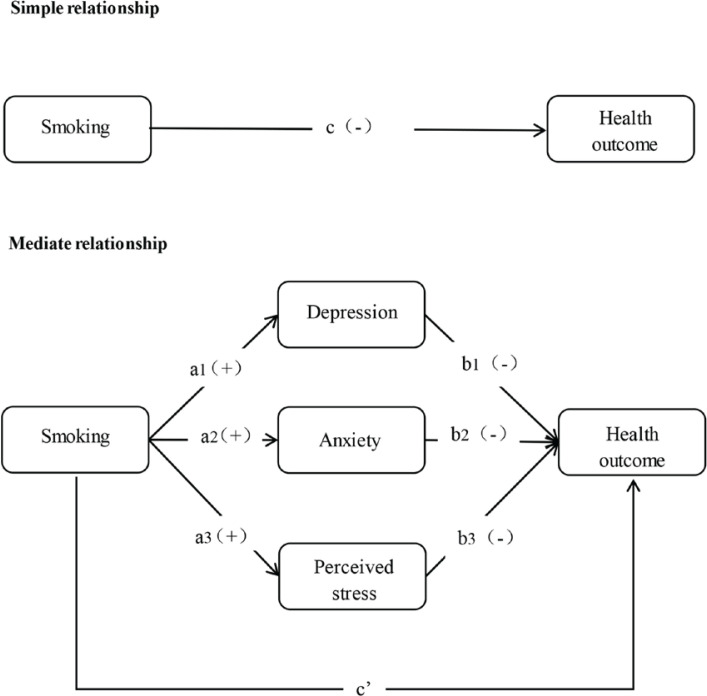
Survey data were derived from a cross-sectional study conducted in China from 20 June to 31 August 2022. We recruited participants from 148 cities across the country using a stratified multistage sampling method. The HRQOL of the dependent variable was measured using the Chinese version of European Quality of Life-5 Dimensions (EQ-5D-5L). The Patient Health Questionnaire (PHQ-9), Generalized Anxiety Disorder (GAD-7), and Perceived Stress Scale (PSS-4) were used to measure NE parameters including depression, anxiety, and perceived stress, as the intermediate variables. A multiple parallel mediation model was used to analyze the mediating role of NEs in smoking and HRQOL.
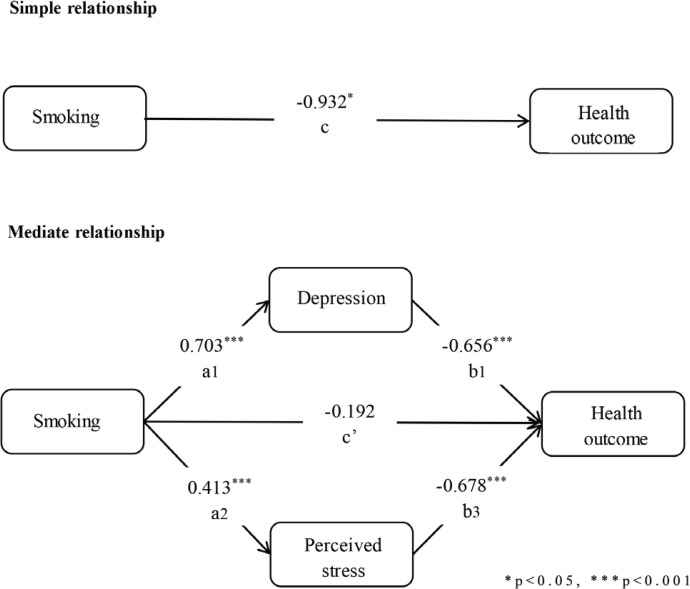
A total of 21916 valid questionnaires were collected, of which 3010 (13.7%) and 18906 (86.3%) were categorized into smokers and non-smokers, respectively. The HRQOL (EQ-VAS score) of smokers (71.70 ± 23.08) was lower than that of non-smokers (73.69 ± 21.32), whereas the depression and anxiety levels of smokers were higher than those of non-smokers (all p<0.001). Moreover, smoking, NEs (depression and anxiety), and HRQOL showed pairwise correlations. According to the mediation analysis, depression (β= -0.461; 95% BCa CI: -0.664 - -0.268) and anxiety (β= -0.279; 95% BCa CI: -0.435 - -0.138) mediated the relationship between smoking and HRQOL after adjusting for demographic and life factors.
These findings emphasize the necessity of studying the interaction between smoking, HRQOL, and Nes, and complementing the research on the impact of psychological factors on the HRQOL of smokers. Public health activities should focus on mental health and take targeted measures for the prevention, treatment, and rehabilitation of smokers.
尽管吸烟对健康的负面影响已在多项研究中得到证实,但很少有研究探讨介导吸烟与健康相关生活质量(HRQOL)之间关系的心理因素。本研究旨在调查中国人群中吸烟与HRQOL之间的关系以及负面情绪(NEs)的中介作用。
调查数据来自于2022年6月20日至8月31日在中国进行的一项横断面研究。我们采用分层多阶段抽样方法从全国148个城市招募参与者。使用欧洲生活质量五维度量表(EQ-5D-5L)中文版测量因变量HRQOL。使用患者健康问卷(PHQ-9)、广泛性焦虑障碍量表(GAD-7)和感知压力量表(PSS-4)测量包括抑郁、焦虑和感知压力在内的NE参数,作为中间变量。采用多重平行中介模型分析NEs在吸烟与HRQOL之间的中介作用。
共收集到21916份有效问卷,其中3010份(13.7%)和18906份(86.3%)分别被归类为吸烟者和非吸烟者。吸烟者的HRQOL(EQ-VAS评分)(71.70±23.08)低于非吸烟者(73.69±21.32),而吸烟者的抑郁和焦虑水平高于非吸烟者(均p<0.001)。此外,吸烟、NEs(抑郁和焦虑)与HRQOL之间存在两两相关性。根据中介分析,在调整人口统计学和生活因素后,抑郁(β=-0.461;95%BCa CI:-0.664--0.268)和焦虑(β=-0.279;95%BCa CI:-0.435--0.138)介导了吸烟与HRQOL之间的关系。
这些发现强调了研究吸烟、HRQOL和NEs之间相互作用以及补充心理因素对吸烟者HRQOL影响研究的必要性。公共卫生活动应关注心理健康,并针对吸烟者的预防、治疗和康复采取有针对性的措施。