Cooke Patrick, Linden David J
Solomon H. Snyder Department of Neuroscience, The Johns Hopkins University School of Medicine, Baltimore, Maryland 21205.
Solomon H. Snyder Department of Neuroscience, The Johns Hopkins University School of Medicine, Baltimore, Maryland 21205
eNeuro. 2025 Jan 10;12(1). doi: 10.1523/ENEURO.0418-24.2024. Print 2025 Jan.
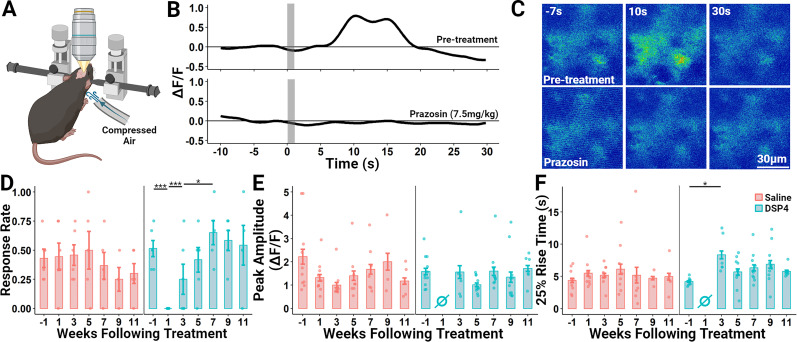
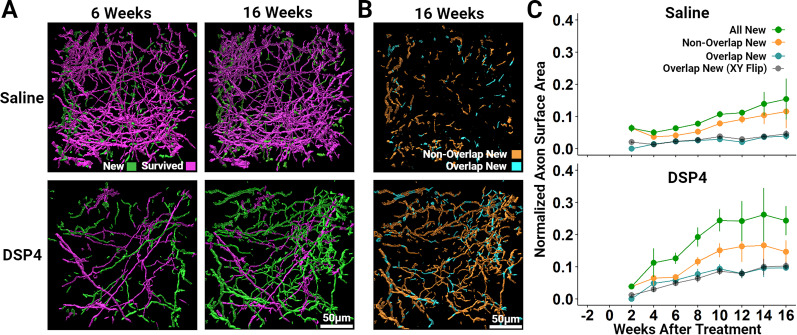
It is widely believed that axons in the central nervous system of adult mammals do not regrow following injury. This failure is thought, at least in part, to underlie the limited recovery of function following injury to the brain or spinal cord. Some studies of fixed tissue have suggested that, counter to dogma, norepinephrine (NE) axons regrow following brain injury. Here, we have used in vivo two-photon microscopy in layer 1 of the primary somatosensory cortex in transgenic mice harboring a fluorophore selectively expressed in NE neurons. This protocol allowed us to explore the dynamic nature of NE axons following injury with the selective NE axon toxin -(2-chloroethyl)--ethyl-2-bromobenzylamine (DSP4). Following DSP4, NE axons were massively depleted and then slowly and partially recovered their density over a period of weeks. This regrowth was dominated by new axons entering the imaged volume. There was almost no contribution from local sprouting from spared NE axons. Regrown axons did not appear to use either the paths of previously lesioned NE axons or NE axons that were spared and survived DSP4 as a guide. To measure NE release, GCaMP8s was selectively expressed in neocortical astrocytes and startle-evoked, NE receptor-mediated Ca transients were measured. These Ca transients were abolished soon after DSP4 lesion but returned to pre-lesion values after 3-5 weeks, roughly coincident with NE axon regrowth, suggesting that the regrown NE axons are competent to release NE in response to a physiological stimulus in the awake mouse.
人们普遍认为,成年哺乳动物中枢神经系统中的轴突在受伤后不会再生。这种功能障碍至少在一定程度上是脑或脊髓损伤后功能恢复有限的原因。一些对固定组织的研究表明,与传统观点相反,去甲肾上腺素(NE)轴突在脑损伤后会再生。在这里,我们在携带在NE神经元中选择性表达的荧光团的转基因小鼠的初级体感皮层第1层中使用了体内双光子显微镜。该方案使我们能够用选择性NE轴突毒素 -(2-氯乙基)-乙基-2-溴苄胺(DSP4)探索损伤后NE轴突的动态特性。给予DSP4后,NE轴突大量减少,然后在数周内缓慢并部分恢复其密度。这种再生主要由进入成像区域的新轴突主导。几乎没有来自未受损NE轴突的局部发芽的贡献。再生轴突似乎没有利用先前受损的NE轴突或在DSP4处理后存活的未受损NE轴突的路径作为引导。为了测量NE释放,在新皮质星形胶质细胞中选择性表达GCaMP8s,并测量惊吓诱发的、NE受体介导的钙瞬变。这些钙瞬变在DSP4损伤后很快消失,但在3-5周后恢复到损伤前的值,大致与NE轴突再生同时发生,这表明再生的NE轴突能够在清醒小鼠中对生理刺激做出反应而释放NE。