Cui Hong, Shan Wenhui, Na Quan, Liu Tong
Shengjing Hospital of China Medical University, Shenyang, China.
BMC Pregnancy Childbirth. 2024 Dec 26;24(1):869. doi: 10.1186/s12884-024-07101-x.
Women who are pregnant again after a prior cesarean section are faced with the choice between a vaginal trial and another cesarean section. Vaginal delivery is safer for mothers and babies, but face the risk of trial labor failure. Predictive models can evaluate the success rate of vaginal trial labor after cesarean section, which will help obstetricians and pregnant women choose the appropriate delivery method.
To review the existing prediction models of vaginal delivery after cesaean.
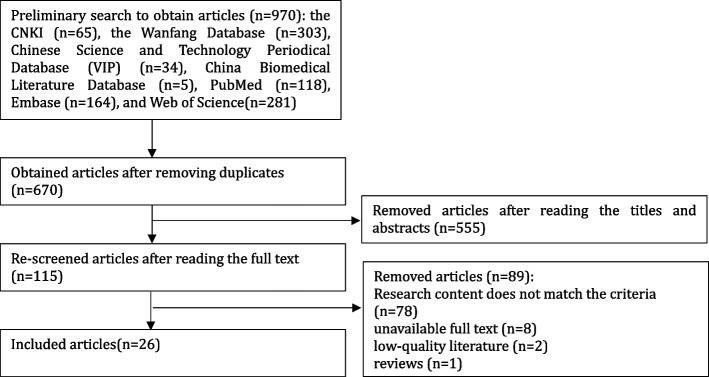
Seven databases, including CNKI, Wanfang Data, Chinese Science and Technology Periodical Database, China Biomedical Literature Database, PubMed, Embase, and Web of Science, were searched for studies on the predictive model of VBAC from inception to July 20, 2022. Two researchers independently screened the literature and extracted the data. The risk of bias and applicability of the included researches was evaluated using the Prediction model Risk of Bias Assessment Tool.
Twenty-six studies that covered 26 models were included. The overall property of the included models was good, but validation of the included models was insufficient. The methodological quality of the included studies was generally low, with 3 studies rated as having a low risk of bias and 23 studies rated as having a high risk of bias. The main predictors in the models were the Bishop score, history of vaginal delivery, neonatal weight, maternal age, and BMI.
Although a variety of prediction models have been developed globally, the methodology of these studies has limitations and the models have not been adequately validated. In the future, more prospective and high-quality research is needed to develop visual models to serve clinical work more effectively and conveniently. Obstetricians or midwives could use predictive models to help a woman choose the right delivery method.
有剖宫产史的女性再次怀孕时面临阴道试产和再次剖宫产的选择。阴道分娩对母婴更安全,但面临试产失败的风险。预测模型可评估剖宫产术后阴道试产的成功率,这将有助于产科医生和孕妇选择合适的分娩方式。
综述现有的剖宫产术后阴道分娩预测模型。
检索中国知网、万方数据、维普中文科技期刊数据库、中国生物医学文献数据库、PubMed、Embase和Web of Science这7个数据库,查找自数据库建库至2022年7月20日关于剖宫产术后阴道试产预测模型的研究。两名研究人员独立筛选文献并提取数据。采用预测模型偏倚风险评估工具对纳入研究的偏倚风险和适用性进行评估。
纳入26项研究,涵盖26个模型。纳入模型的整体性能良好,但纳入模型的验证不足。纳入研究的方法学质量普遍较低,3项研究被评为低偏倚风险,23项研究被评为高偏倚风险。模型中的主要预测因素为 Bishop 评分、阴道分娩史、新生儿体重、产妇年龄和BMI。
尽管全球已开发出多种预测模型,但这些研究的方法存在局限性,且模型未得到充分验证。未来需要更多前瞻性和高质量的研究来开发可视化模型,以便更有效、便捷地服务于临床工作。产科医生或助产士可使用预测模型帮助女性选择正确的分娩方式。