Zhang Yunwei, Wu Qiyong, Xie Qiaotao, Xu Zhimin, Yang Xiuhui, Luo Yashuang, Wan Lingshan, Yang Ya, Wang Yibo, Ding Hansheng
Shanghai Health Development Research Center (Shanghai Medical Information Center), Shanghai, China.
Department of Thoracic and Cardiac Surgery, The Affiliated Changzhou No. 2 People's Hospital of Nanjing Medical University, Changzhou, Jiangsu, China.
Front Psychol. 2024 Dec 11;15:1399061. doi: 10.3389/fpsyg.2024.1399061. eCollection 2024.
Effective health management is crucial for elderly patients with coronary heart disease (CHD). This study applied a Psycho-Cardiology model to CHD management, aiming to assess psychological stress among patients with mild CHD and identify potential influencing factors to provide substantiating evidence.
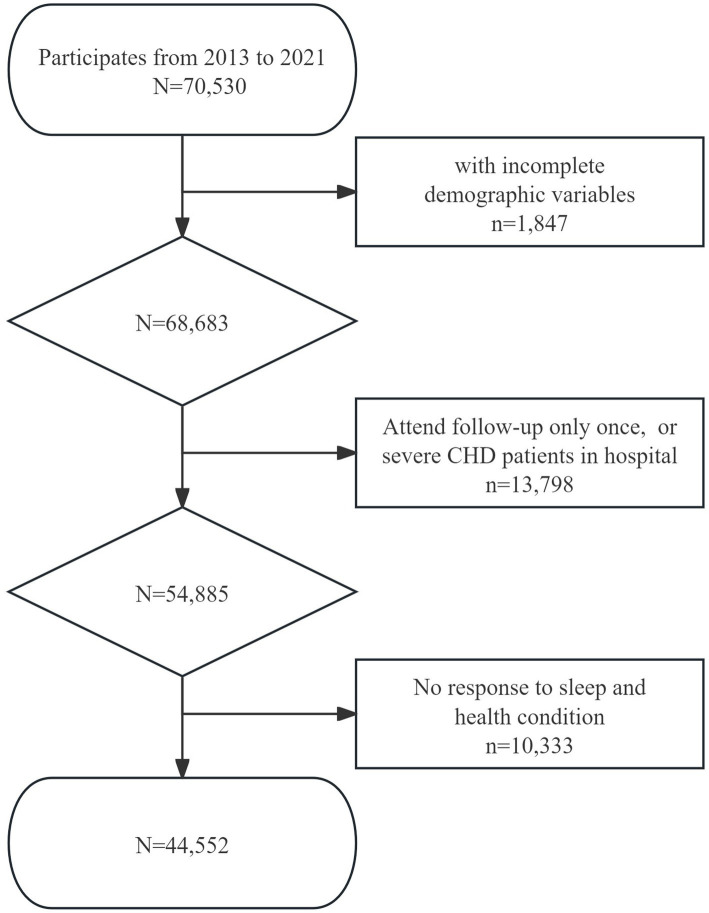
This longitudinal study was based on a 9-year follow-up program of a community population in Shanghai, China. A total of 44,552 elderly people were included, with the average age being 74.9 (±10.35) years, and the proportion of female participants being 56.5%. To evaluate and compare the effect of the disease, individuals were categorized into four groups based on their medical records from the past 6 months, these being (I) a CHD with other chronic diseases group, (II) a CHD only group, (III) non-CHD patients with one (or more) chronic disease group, and (IV) non-patient group. Demographic characteristics, sleep quality and health status of each participants were collected using the Unified Needs Assessment Form for Elderly Care Questionnaire. A multivariate logistic regression was used for statistic analysis.
Demographic characteristics differed significantly between the three chronic disease groups (Groups I, II and III) and the non-patient group. Participants in the CHD group reported poorer sleep quality, worse health status, and a more rapid health decline when compared to those with other chronic diseases. Factors such as age, gender, education level, disease duration, and family support were identified as potential influences on the self-reported subjective sleep quality in patients with mild CHD. While age, education level, living status and family support were potential factors influencing the self-assessed health status in participants without CHD (Groups III and IV).
Patients with mild CHD may experience lower subjective sleep quality, health status scores, and a faster health-sleep decline, indicating elevated psychological stress. Higher education levels offer a protective effect against this stress, highlighting the importance of psycho-emotional interventions and educational strategies. Additionally, it is important to prioritize early intervention for newly diagnosed cases to aid in illness acceptance. These findings provide crucial insights for managing patients with mild CHD and inform the efficient allocation of healthcare resources.
有效的健康管理对老年冠心病(CHD)患者至关重要。本研究将心理心脏病学模型应用于冠心病管理,旨在评估轻度冠心病患者的心理压力,并确定潜在影响因素以提供确凿证据。
本纵向研究基于对中国上海一个社区人群的9年随访项目。共纳入44552名老年人,平均年龄为74.9(±10.35)岁,女性参与者比例为56.5%。为评估和比较疾病的影响,根据过去6个月的病历将个体分为四组,分别为(I)患有冠心病及其他慢性病组,(II)仅患有冠心病组,(III)患有一种(或多种)慢性病的非冠心病患者组,以及(IV)非患者组。使用《老年护理统一需求评估表问卷》收集每位参与者的人口统计学特征、睡眠质量和健康状况。采用多因素逻辑回归进行统计分析。
三个慢性病组(I组、II组和III组)与非患者组之间的人口统计学特征存在显著差异。与患有其他慢性病的患者相比,冠心病组参与者报告睡眠质量较差、健康状况较差且健康下降更快。年龄、性别、教育水平、病程和家庭支持等因素被确定为轻度冠心病患者自我报告主观睡眠质量的潜在影响因素。而年龄、教育水平、生活状况和家庭支持是影响非冠心病参与者(III组和IV组)自我评估健康状况的潜在因素。
轻度冠心病患者可能经历较低的主观睡眠质量、健康状况评分以及更快的健康 - 睡眠下降,表明心理压力升高。较高的教育水平对这种压力具有保护作用,凸显了心理情绪干预和教育策略的重要性。此外,对新诊断病例优先进行早期干预以帮助患者接受疾病很重要。这些发现为管理轻度冠心病患者提供了关键见解,并为医疗资源的有效分配提供了依据。