Bartlett Amy, Christ Challian, Martins Bradford, Saxberg Kellen, Ching Terence H W
Department of Classics and Religious Studies, University of Ottawa, Ottawa, ON, Canada.
Department of Psychiatry, Yale University School of Medicine, New Haven, CT, United States.
Front Public Health. 2024 Dec 11;12:1472559. doi: 10.3389/fpubh.2024.1472559. eCollection 2024.
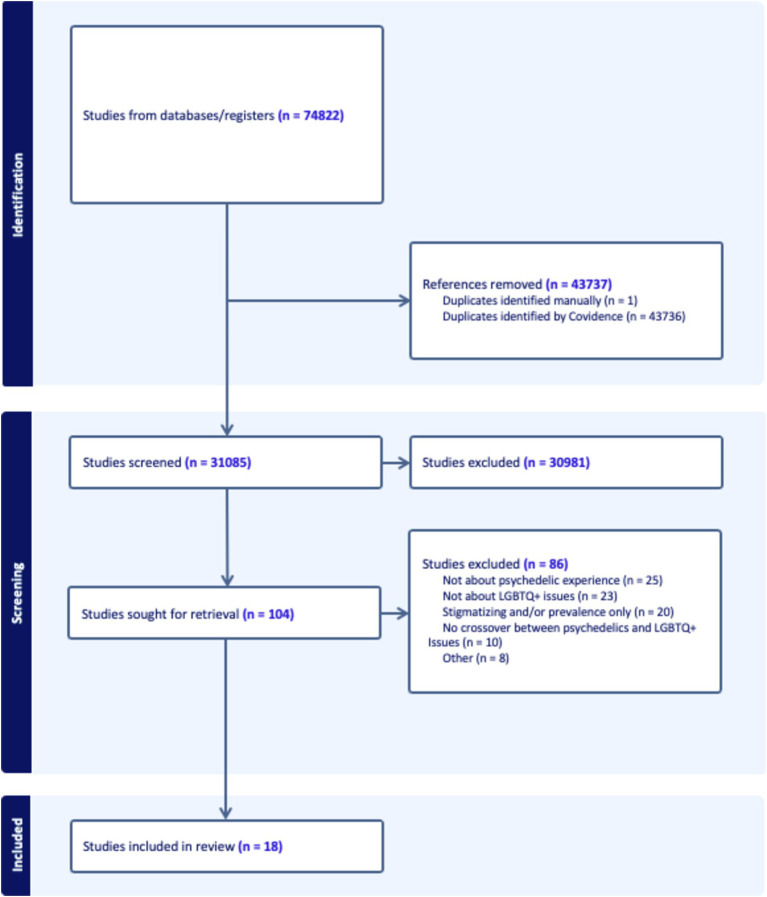
The intersection of queer identity and psychedelics has not been thoroughly explored by the research community, historically or in the present day. With growing access to legal psychedelic therapies, it is essential that queer psychedelic experiences are understood sufficiently by clinicians in order to provide the most safe and effective care possible. Psychedelics and queerness are intricately related, and there is strong interest in the use of psychedelics for healing and identity development among queer populations. However, the vast majority of the literature stigmatizes and problematizes queer psychedelic use. Therefore this scoping review seeks to explore the current and historical overlap between psychedelics and queerness in the academic literature. Specifically, this scoping review aims to understand the available academic literatures' treatment of the meaningful, non-pathologizing use of psychedelics within the queer community, and seeks to highlight the unique potential a queer lens and the queer experience can bring to the study of psychedelics. To do so, we asked what queer psychedelic experiences are reflected in the literature, who is being studied, what queer individuals' motivations are for using psychedelics, and a review of the impacts of queer psychedelic use discussed in the literature. Literature searches were performed in seven academic databases using a wide breadth of both queer-related and psychedelic-related keywords, which resulted in over thirty thousand resources being captured. After screening, a total of 18 resources were collected as representative of the meaningful overlap of psychedelics and queerness. Based on the findings and research gaps identified, this scoping review makes several recommendations regarding future directions psychedelic researchers and clinicians can pursue to better understand and benefit from the meaningful overlap of psychedelics and queerness. By reclaiming, redefining, and reimagining the meaningful relationship between psychedelics and the queer experience, this review helps move the scientific and clinical conversation into queerer spaces, centering queerness and queer experiences as an essential component of psychedelic research and practice.
无论是在历史上还是当今,研究界都尚未对酷儿身份与迷幻药的交叉领域进行过全面探索。随着合法迷幻疗法的可及性不断提高,临床医生充分了解酷儿群体的迷幻体验至关重要,以便提供尽可能安全有效的护理。迷幻药与酷儿身份紧密相关,酷儿群体对使用迷幻药进行疗愈和身份发展有着浓厚兴趣。然而,绝大多数文献都对酷儿使用迷幻药进行了污名化并将其视为问题。因此,本范围综述旨在探讨学术文献中迷幻药与酷儿身份在当前和历史上的重叠情况。具体而言,本范围综述旨在了解现有学术文献对酷儿群体中迷幻药有意义、非病态使用的论述,并试图突出酷儿视角和酷儿体验能为迷幻药研究带来的独特潜力。为此,我们探讨了文献中反映出的酷儿迷幻体验、研究对象、酷儿个体使用迷幻药的动机,以及对文献中讨论的酷儿使用迷幻药的影响进行综述。我们在七个学术数据库中进行了文献检索,使用了大量与酷儿相关和与迷幻药相关的关键词,共获取了三万多条资源。经过筛选,总共收集了18篇资源作为迷幻药与酷儿身份有意义重叠的代表。基于所发现的结果和研究空白,本范围综述就迷幻药研究人员和临床医生未来可采取的方向提出了若干建议,以便更好地理解迷幻药与酷儿身份的有意义重叠并从中受益。通过重新审视,并重新定义和重新构想迷幻药与酷儿体验之间的有意义关系,本综述有助于将科学和临床讨论带入更酷儿化的空间,将酷儿身份和酷儿体验作为迷幻药研究和实践的重要组成部分。