Zuniga-Montanez Cecilia, Davies Catherine, Ligoxygakis Laurie, Kašćelan Draško, Gonzalez-Gomez Nayeli
School of Languages, Cultures and Societies, University of Leeds, Leeds, UK.
Centre for Psychological Research, Oxford Brookes University, Oxford, UK.
J Child Psychol Psychiatry. 2025 Apr;66(4):569-587. doi: 10.1111/jcpp.14102. Epub 2024 Dec 27.
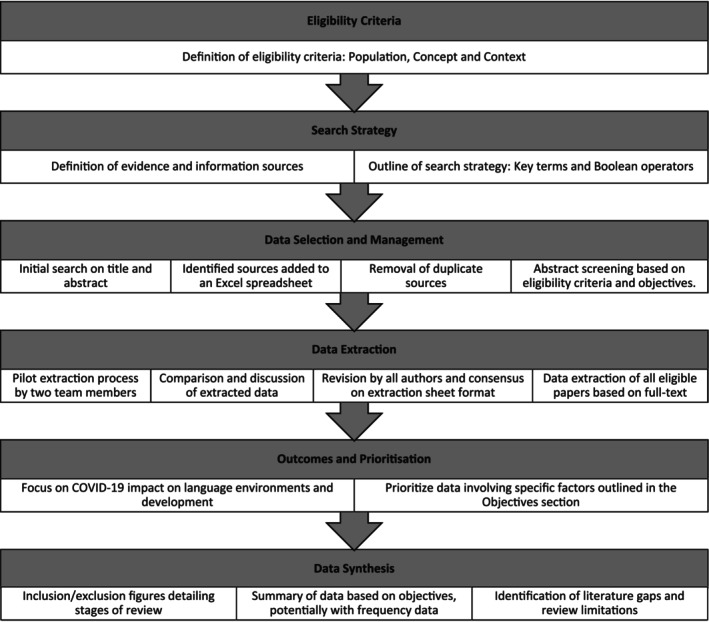
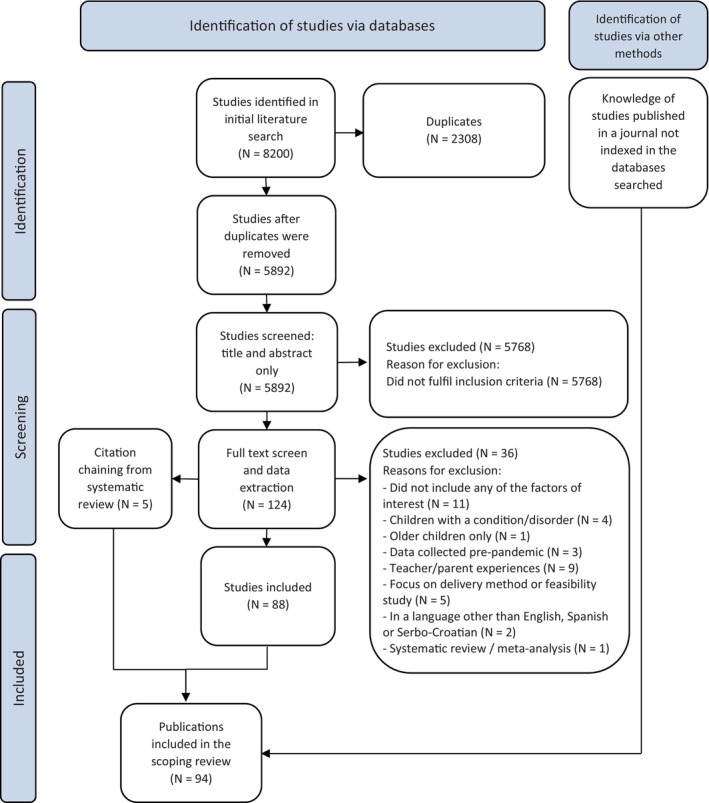
A diverse body of research conducted since the start of Covid-19 has investigated the impact of the pandemic on children's environments and their language development. This scoping review synthesises the peer-reviewed research literature on this topic between 2020 and 2023. Following the Joanna Briggs Institute methodology and the PRISMA extension for scoping reviews, we searched five databases for studies that fulfilled the following inclusion criteria: studies with neurotypical (monolingual or multilingual) 0-6-year-old children; studies focusing on any area of language development, including sources describing literacy or educational practices that impacted language development; studies focusing in the context of the COVID-19 pandemic, with no restrictions of geographical location or language used by participants. Ninety-four eligible studies were identified for review. The extracted data were synthesised using frequency tables and narrative descriptions. Eligible studies used a wide range of data collection periods, methods, research sites, sample ages, sizes, and roles to fulfil 15 broad aims. They show that children's language-learning environments were significantly impacted, with variability over time and across the socioeconomic spectrum. Together they investigated diverse language domains, as well as several home, educational, and demographic factors that were hypothesised to impact children's language development. Of those studies that focused on language outcomes, most converge to suggest a decline in typical expectations of children's language development, including their social communication, vocabulary, morphosyntax, literacy, and language of schooling, as well as general communication skills, school readiness, and other areas of academic progress. Our synthesis suggests that children's language and environment were significantly impacted by COVID-19. This scoping review will support families, researchers, practitioners, and policymakers working with pandemic-era children to further understand the effects of the pandemic on children's development.
自新冠疫情开始以来,大量不同的研究调查了疫情对儿童成长环境及其语言发展的影响。本综述性研究综合了2020年至2023年间关于该主题的同行评议研究文献。按照乔安娜·布里格斯研究所的方法以及综述性研究的PRISMA扩展版,我们在五个数据库中搜索符合以下纳入标准的研究:针对神经发育正常(单语或多语)的0至6岁儿童的研究;关注语言发展任何领域的研究,包括描述影响语言发展的读写能力或教育实践的资料来源;聚焦于新冠疫情背景下的研究,对地理位置或参与者使用的语言没有限制。共确定了94项符合条件的研究进行综述。提取的数据使用频率表和叙述性描述进行综合。符合条件的研究使用了广泛的数据收集时间段、方法、研究地点、样本年龄、规模和角色,以实现15个宽泛的目标。研究表明,儿童的语言学习环境受到了显著影响,且随着时间推移和社会经济层面存在差异。这些研究共同调查了不同的语言领域,以及一些被认为会影响儿童语言发展的家庭、教育和人口因素。在那些关注语言成果的研究中,大多数研究都趋于表明,儿童语言发展的典型预期有所下降,包括他们的社会沟通、词汇、形态句法、读写能力、学校语言,以及一般沟通技能、入学准备和其他学业进步领域。我们的综述表明,新冠疫情对儿童的语言和环境产生了重大影响。本综述性研究将有助于与疫情时期儿童打交道的家庭、研究人员、从业者和政策制定者进一步了解疫情对儿童发展的影响。