Ritter Daniel, Raiss Patric, Denard Patrick J, Werner Brian C, Müller Peter E, Woiczinski Matthias, Wijdicks Coen A, Bachmaier Samuel
Department of Orthopedic Research, Arthrex, 81249 Munich, Germany.
Department of Orthopaedics and Trauma Surgery, Musculoskeletal University Center Munich (MUM), University Hospital, LMU Munich, 80336 Munich, Germany.
J Imaging. 2024 Dec 23;10(12):334. doi: 10.3390/jimaging10120334.
This study evaluated the effect of three-dimensional (3D) volumetric humeral canal fill ratios (VFR) of reverse shoulder arthroplasty (RSA) short and standard stems on biomechanical stability and bone deformations in the proximal humerus.
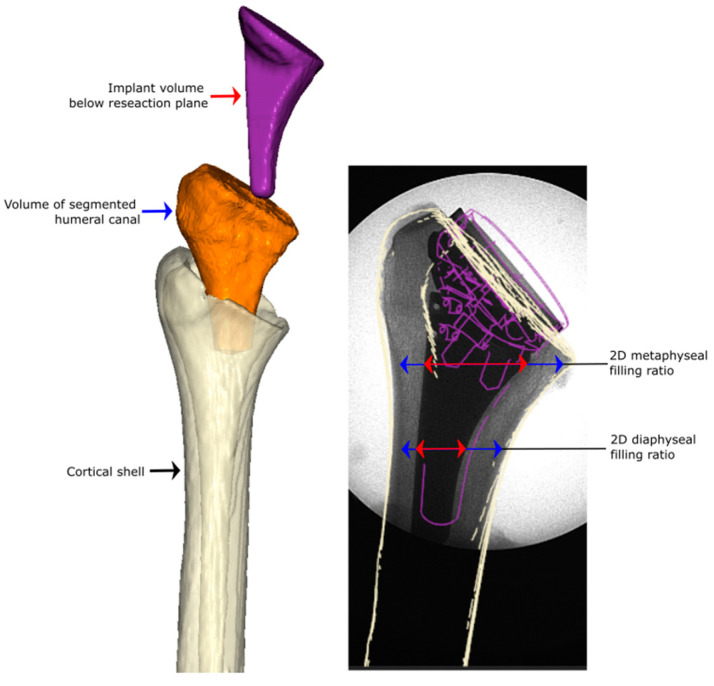
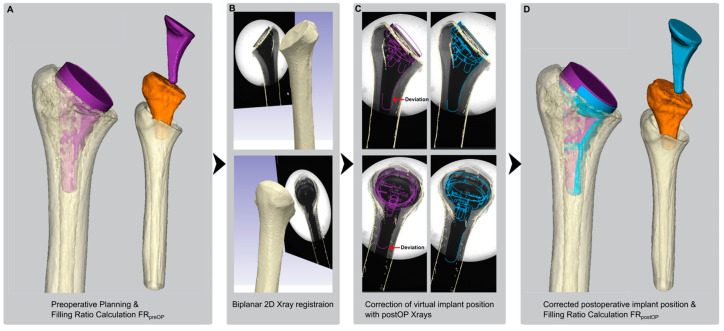
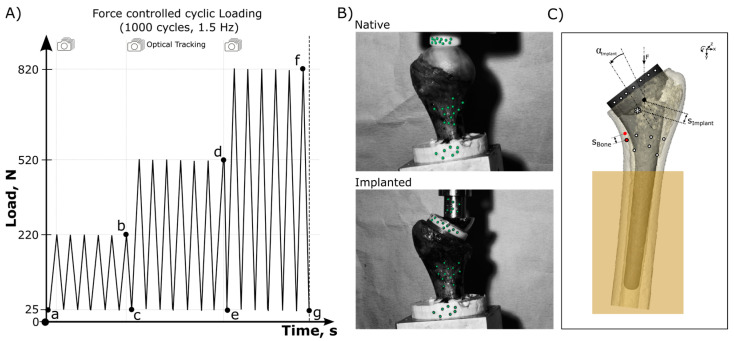
Forty cadaveric shoulder specimens were analyzed in a clinical computed tomography (CT) scanner allowing for segmentation of the humeral canal to calculate volumetric measures which were verified postoperatively with plain radiographs. Virtual implant positioning allowed for group assignment (VFR < 0.72): Standard stem with low ( = 10) and high ( = 10) filling ratios, a short stem with low ( = 10) and high filling ratios ( = 10). Biomechanical testing included cyclic loading of the native bone and the implanted humeral component. Optical recording allowed for spatial implant tracking and the quantification of cortical bone deformations in the proximal humerus.
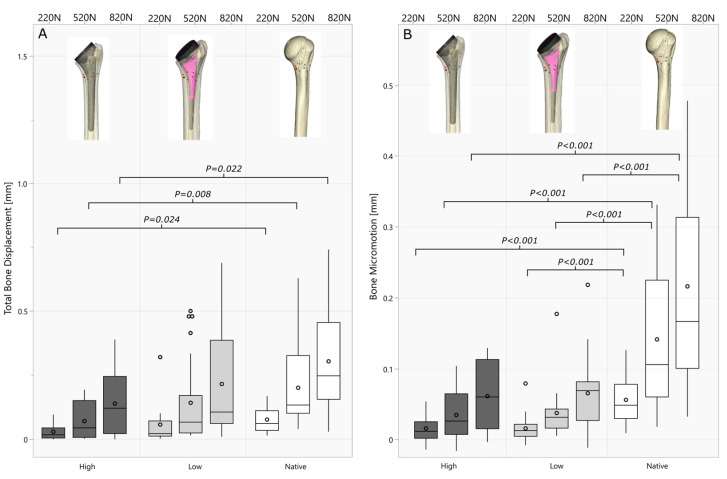
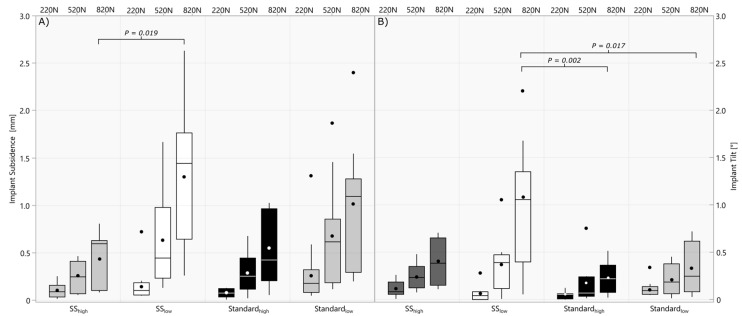
Planned filling ratios based on 3D volumetric measures had a good-to-excellent correlation (ICC = 0.835; < 0.001) with implanted filling ratios. Lower canal fill ratios resulted in significantly higher variability between short and standard stems regarding implant tilt (820 N: = 0.030) and subsidence (220 N: = 0.046, 520 N: = 0.007 and 820 N: = 0.005). Higher filling ratios resulted in significantly lower bone deformations in the medial calcar area compared to the native bone, while the bone deformations in lower filling ratios did not differ significantly ( > 0.177).
Lower canal filling ratios maintain dynamic bone loading in the medial calcar of the humerus similar to the native situation in this biomechanical loading setup. Short stems implanted with a low filling ratio have an increased risk for implant tilt and subsidence compared to high filling ratios or standard stems.
本研究评估了反向肩关节置换术(RSA)短柄和标准柄的三维(3D)肱骨骨髓腔填充率(VFR)对肱骨近端生物力学稳定性和骨变形的影响。
在临床计算机断层扫描(CT)扫描仪中分析40个尸体肩部标本,以分割肱骨骨髓腔来计算体积测量值,并在术后通过X线平片进行验证。虚拟植入物定位允许进行分组(VFR < 0.72):低填充率( = 10)和高填充率( = 10)的标准柄,低填充率( = 10)和高填充率( = 10)的短柄。生物力学测试包括对天然骨和植入的肱骨组件进行循环加载。光学记录允许对植入物进行空间跟踪并量化肱骨近端皮质骨的变形。
基于3D体积测量的计划填充率与植入填充率具有良好至极好的相关性(ICC = 0.835; < 0.001)。较低的骨髓腔填充率导致短柄和标准柄在植入物倾斜方面的变异性显著更高(820 N: = 0.030)以及下沉方面的变异性显著更高(220 N: = 0.046,520 N: = 0.007和820 N: = 0.005)。与天然骨相比,较高的填充率导致内侧距骨区域的骨变形显著更低,而较低填充率下的骨变形无显著差异( > 0.177)。
在这种生物力学加载设置中,较低的骨髓腔填充率可使肱骨内侧距骨维持与天然情况相似的动态骨负荷。与高填充率或标准柄相比,低填充率植入的短柄有更高的植入物倾斜和下沉风险。