Schulthess Clinic, Department of Shoulder and Elbow Surgery, Zurich, Switzerland.
Department of Research and Development, Upper Extremities, Schulthess Clinic, Zurich, Switzerland.
BMC Musculoskelet Disord. 2024 Mar 7;25(1):204. doi: 10.1186/s12891-024-07312-5.
The two major reverse shoulder arthroplasty (RSA) designs are the Grammont design and the lateralized design. Even if the lateralized design is biomechanically favored, the classic Grammont prosthesis continues to be used. Functional and subjective patient scores as well as implant survival described in the literature so far are comparable to the lateralized design. A pure comparison of how the RSA design influences outcome in patients has not yet been determined. The aim of this study was a comparison focused on patients with cuff tear arthropathy (CTA).
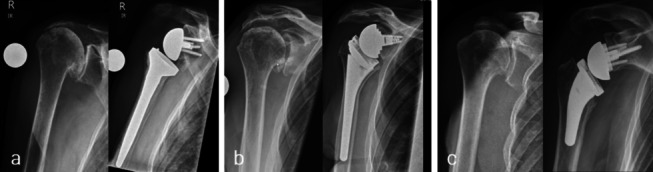
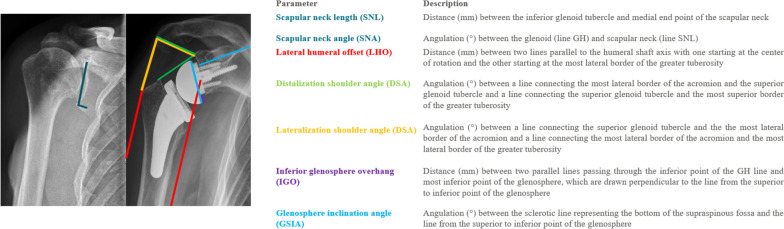
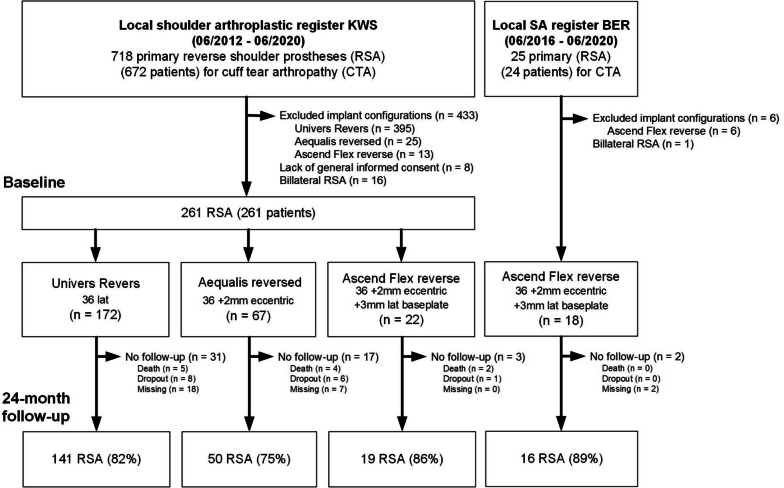
We analyzed registry data from 696 CTA patients prospectively collected between 2012 and 2020 in two specialized orthopedic centers up to 2 years post-RSA with the same follow-up time points (6,12 24 months). Complete teres minor tears were excluded. Three groups were defined: group 1 (inlay, 155° humeral inclination, 36 + 2 mm eccentric glenosphere (n = 50)), group 2 (inlay, 135° humeral inclination, 36 + 4 mm lateralized glenosphere (n = 141)) and group 3 (onlay, 145° humeral inclination, + 3 mm lateralized base plate, 36 + 2 mm eccentric glenosphere (n = 35)) We compared group differences in clinical outcomes (e.g., active and passive range of motion (ROM), abduction strength, Constant-Murley score (CS)), radiographic evaluations of prosthetic position, scapular anatomy and complications using mixed models adjusted for age and sex.
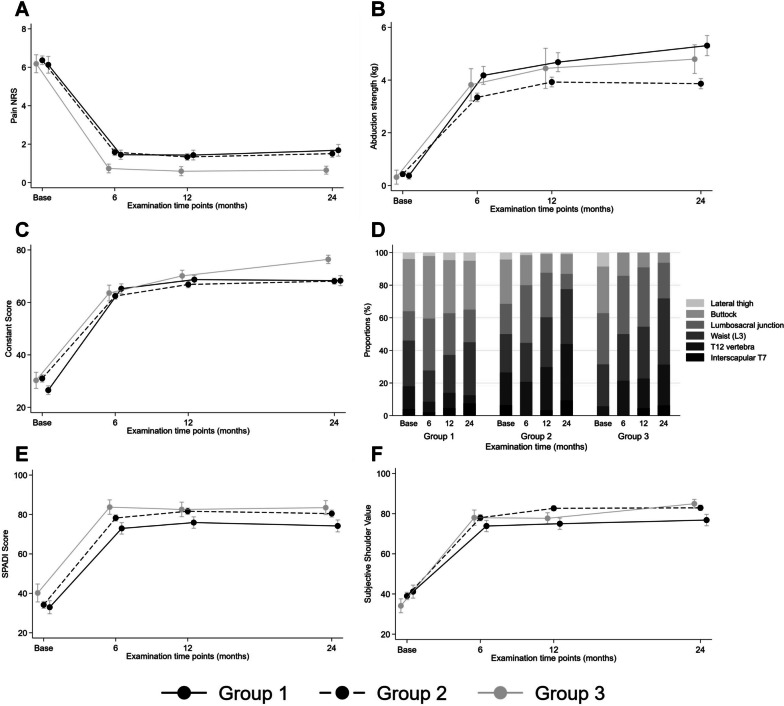
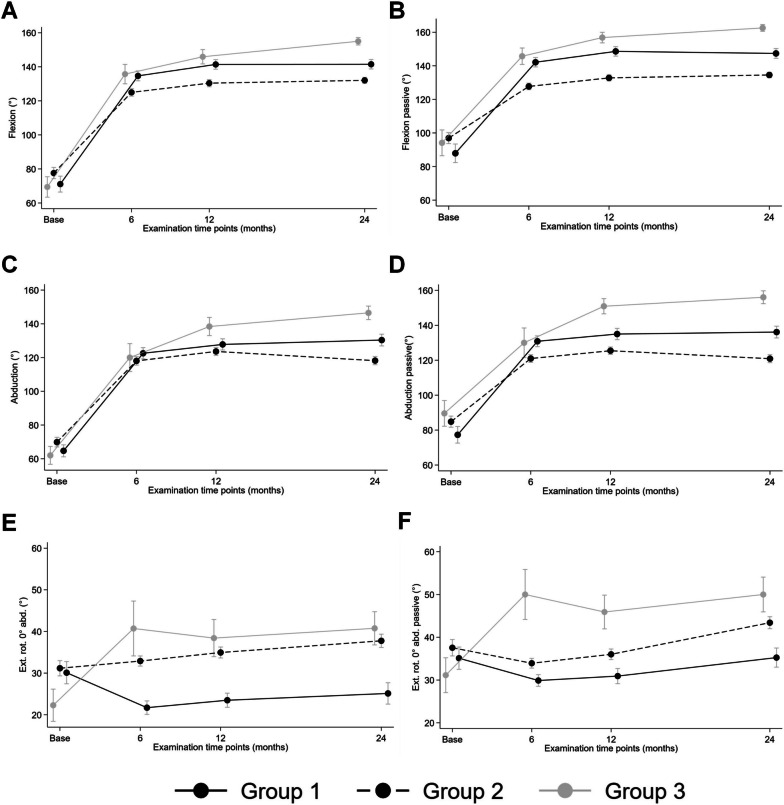
The final analysis included 226 patients. The overall adjusted p-value of the CS for all time-points showed no significant difference (p = 0.466). Flexion of group 3 (mean, 155° (SD 13)) was higher than flexion of group 1 (mean, 142° (SD 18) and 2 (mean, 132° (SD 18) (p < 0.001). Values for abduction of group 3 (mean, 145° (SD 23)) were bigger than those of group 1 (mean, 130° (SD 22)) and group 2 (mean, 118° (SD 25)) (p < 0.001). Mean external rotation for group 3 (mean, 41° (SD 23)) and group 2 (mean, 38° (SD 17)) was larger than external rotation of group 1 (mean, 24° (SD 16)) (p < 0.001); a greater proportion of group 2 (78%) and 3 (69%) patients reached L3 level on internal rotation compared to group 1 (44%) (p = 0.003). Prosthesis position measurements were similar, but group 3 had significantly less scapular notching (14%) versus 24% (group 2) and 50% (group 1) (p = 0.001).
Outcome scores of different RSA designs for CTA revealed comparable results. However, CTA patients with a lateralized and distalized RSA configuration were associated with achieving better flexion and abduction with less scapular notching. A better rotation was associated with either of the lateralized RSA designs in comparison with the classic Grammont prosthesis.
Therapeutic study, Level III.
两种主要的反肩置换术(RSA)设计是 Grammont 设计和外侧化设计。即使外侧化设计在生物力学上更具优势,经典的 Grammont 假体仍在继续使用。迄今为止,文献中描述的功能和主观患者评分以及植入物存活率与外侧化设计相当。尚未确定 RSA 设计如何影响患者结果的纯粹比较。本研究的目的是专注于肩袖撕裂性关节炎(CTA)患者的比较。
我们分析了 2012 年至 2020 年期间在两个专门的骨科中心前瞻性收集的 696 例 CTA 患者的登记数据,这些患者在 RSA 后 2 年内(6、12 和 24 个月)进行了相同的随访时间点。排除完全冈下肌撕裂。定义了三个组:组 1(镶嵌,155°肱骨倾斜,36+2mm 偏心肱骨头(n=50)),组 2(镶嵌,135°肱骨倾斜,36+4mm 外侧化肱骨头(n=141))和组 3(镶嵌,145°肱骨倾斜,+3mm 外侧化基底部,36+2mm 偏心肱骨头(n=35))。我们使用混合模型比较了各组在临床结果(例如主动和被动活动范围(ROM)、外展力量、Constant-Murley 评分(CS))、假体位置、肩胛骨解剖结构和并发症方面的差异,调整了年龄和性别。
最终分析包括 226 例患者。所有时间点的 CS 整体调整 p 值均无显著差异(p=0.466)。组 3 的屈曲(平均值,155°(SD 13))高于组 1(平均值,142°(SD 18)和 2(平均值,132°(SD 18)(p<0.001)。组 3(平均值,145°(SD 23))的外展值大于组 1(平均值,130°(SD 22))和组 2(平均值,118°(SD 25))(p<0.001)。组 3(平均值,41°(SD 23))和组 2(平均值,38°(SD 17))的平均外旋大于组 1(平均值,24°(SD 16))(p<0.001);与组 1(44%)相比,组 2(78%)和 3(69%)患者的内旋达到 L3 水平的比例更高(p=0.003)。假体位置测量值相似,但组 3的肩胛骨切迹(14%)明显少于组 2(24%)和组 1(50%)(p=0.001)。
不同 RSA 设计的 CTA 结果评分显示出相当的结果。然而,外侧化和远端 RSA 构型的 CTA 患者与更好的屈曲和外展相关,同时肩胛骨切迹较少。与经典 Grammont 假体相比,任何一种外侧化 RSA 设计都与更好的旋转相关。
治疗研究,III 级。