Muruganandam Anandanarayan, Migliorini Filippo, Jeyaraman Naveen, Vaishya Raju, Balaji Sangeetha, Ramasubramanian Swaminathan, Maffulli Nicola, Jeyaraman Madhan
Department of Orthopaedics, Faculty of Medicine-Sri Lalithambigai Medical College and Hospital, Dr MGR Educational and Research Institute, Chennai 600095, India.
Department of Orthopedics and Trauma Surgery, Academic Hospital of Bolzano (SABES-ASDAA), 39100 Bolzano, Italy.
Med Sci (Basel). 2024 Dec 12;12(4):72. doi: 10.3390/medsci12040072.
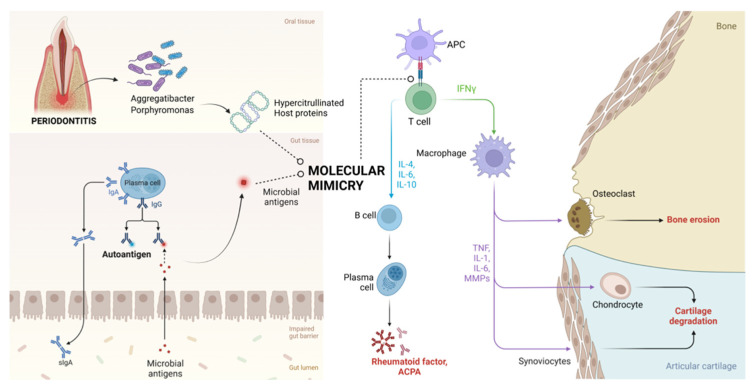
Rheumatoid arthritis (RA) represents an autoimmune condition impacted by a combination of genetic and environmental factors, with the gut microbiome (GMB) being one of the influential environmental factors. Patients with RA display notable modifications in the composition of their GMB, characterised by decreased diversity and distinct bacterial alterations. The GMB, comprising an extensive array of approximately 35,000 bacterial species residing within the gastrointestinal tract, has garnered considerable attention as a pivotal contributor to both human health and the pathogenesis of diseases. This article provides an in-depth exploration of the intricate involvement of the GMB in the context of RA. The oral-GMB axis highlights the complex role of bacteria in RA pathogenesis by producing antibodies to citrullinated proteins (ACPAs) through molecular mimicry. Dysbiosis affects Tregs, cytokine levels, and RA disease activity, suggesting that regulating cytokines could be a strategy for managing inflammation in RA. The GMB also has significant implications for drug responses and toxicity, giving rise to the field of pharmacomicrobiomics. The composition of the microbiota can impact the efficacy and toxicity of drugs, while the microbiota's metabolites can influence drug response. Recent research has identified specific bacteria, metabolites, and immune responses associated with RA, offering potential targets for personalised management. However, several challenges, including the variation in microbial composition, establishing causality, accounting for confounding factors, and translating findings into clinical practice, need to be addressed. Microbiome-targeted therapy is still in its early stages and requires further research and standardisation for effective implementation.
类风湿性关节炎(RA)是一种受遗传和环境因素共同影响的自身免疫性疾病,肠道微生物群(GMB)是其中一个有影响的环境因素。类风湿性关节炎患者的肠道微生物群组成有显著改变,其特征是多样性降低和明显的细菌变化。肠道微生物群由胃肠道内大约35000种细菌组成,作为人类健康和疾病发病机制的关键因素,已受到广泛关注。本文深入探讨了肠道微生物群在类风湿性关节炎中的复杂作用。口腔-肠道微生物群轴通过分子模拟产生抗瓜氨酸化蛋白抗体(ACPAs),突出了细菌在类风湿性关节炎发病机制中的复杂作用。生态失调会影响调节性T细胞、细胞因子水平和类风湿性关节炎疾病活动,这表明调节细胞因子可能是控制类风湿性关节炎炎症的一种策略。肠道微生物群对药物反应和毒性也有重要影响,由此产生了药物微生物组学领域。微生物群的组成会影响药物的疗效和毒性,而微生物群的代谢产物会影响药物反应。最近的研究已经确定了与类风湿性关节炎相关的特定细菌、代谢产物和免疫反应,为个性化治疗提供了潜在靶点。然而,仍有几个挑战需要解决,包括微生物组成的差异、确定因果关系、考虑混杂因素以及将研究结果转化为临床实践。针对微生物群的治疗仍处于早期阶段,需要进一步研究和标准化以有效实施。