Rödig Bastian, Funkner Diana, Frank Thomas, Schürmann Ulrich, Rieder Julian, Kienle Lorenz, Kunz Werner, Kellermeier Matthias
Institute of Physical and Theoretical Chemistry, University of Regensburg, D-93040 Regensburg, Germany.
Faculty of Engineering, Kiel University, Kaiserstr. 2, D-24143 Kiel, Germany.
Nanomaterials (Basel). 2024 Dec 23;14(24):2054. doi: 10.3390/nano14242054.
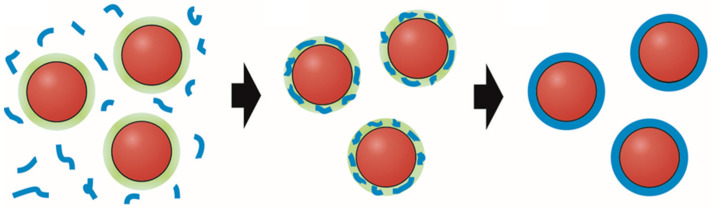
The controlled formation and stabilization of nanoparticles is of fundamental relevance for materials science and key to many modern technologies. Common synthetic strategies to arrest growth at small sizes and prevent undesired particle agglomeration often rely on the use of organic additives and require non-aqueous media and/or high temperatures, all of which appear critical with respect to production costs, safety, and sustainability. In the present work, we demonstrate a simple one-pot process in water under ambient conditions that can produce particles of various transition metal carbonates and sulfides with sizes of only a few nanometers embedded in a silica shell, similar to particles derived from more elaborate synthesis routes, like the sol-gel process. To this end, solutions of soluble salts of metal cations (e.g., chlorides) and the respective anions (e.g., sodium carbonate or sulfide) are mixed in the presence of different amounts of sodium silicate at elevated pH levels. Upon mixing, metal carbonate/sulfide particles nucleate, and their subsequent growth causes a sensible decrease of pH in the vicinity. Dissolved silicate species respond to this local acidification by condensation reactions, which eventually lead to the formation of amorphous silica layers that encapsulate the metal carbonate/sulfide cores and, thus, effectively inhibit any further growth. The as-obtained carbonate nanodots can readily be converted into the corresponding metal oxides by secondary thermal treatment, during which their nanometric size is maintained. Although the described method clearly requires optimization towards actual applications, the results of this study highlight the potential of bottom-up self-assembly for the synthesis of functional nanoparticles at mild conditions.
纳米颗粒的可控形成与稳定对于材料科学具有根本意义,也是许多现代技术的关键所在。常见的在小尺寸下阻止生长并防止颗粒意外团聚的合成策略通常依赖于有机添加剂的使用,并且需要非水介质和/或高温,所有这些在生产成本、安全性和可持续性方面似乎都至关重要。在本工作中,我们展示了一种在环境条件下于水中进行的简单一锅法工艺,该工艺能够制备出各种过渡金属碳酸盐和硫化物颗粒,其尺寸仅为几纳米,且嵌入在二氧化硅壳中,类似于通过更精细的合成路线(如溶胶 - 凝胶法)得到的颗粒。为此,将金属阳离子(如氯化物)的可溶性盐溶液和相应的阴离子(如碳酸钠或硫化物)在不同量的硅酸钠存在下于较高pH值水平混合。混合后,金属碳酸盐/硫化物颗粒成核,其随后的生长导致附近pH值明显降低。溶解的硅酸盐物种通过缩合反应对这种局部酸化做出响应,最终导致形成包裹金属碳酸盐/硫化物核的无定形二氧化硅层,从而有效抑制任何进一步的生长。所得到的碳酸盐纳米点可以通过二次热处理轻松转化为相应的金属氧化物,在此过程中其纳米尺寸得以保持。尽管所描述的方法显然需要针对实际应用进行优化,但本研究结果突出了自下而上自组装在温和条件下合成功能性纳米颗粒的潜力。