Timko Olson Erica R, Olson Anthony, Driscoll Megan, Bliss Donna Z
School of Nursing, University of Minnesota, Minneapolis, MN 55455, USA.
College of Saint Benedict and Saint John's University, Collegeville, MN 56321, USA.
Nurs Rep. 2024 Dec 14;14(4):4006-4021. doi: 10.3390/nursrep14040293.
BACKGROUND/OBJECTIVES: To identify and analyze what is known about the psychosocial factors affecting the wellbeing and sources of support of young adult (YA) cancer survivors.
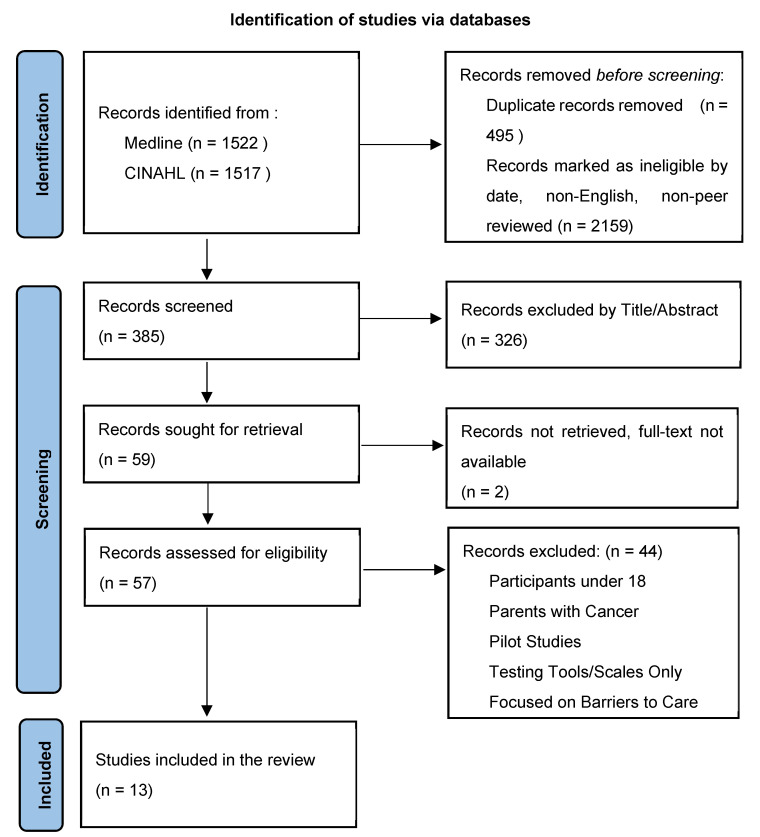
The search strategy included Neoplasms, young adults, psycho* or emotional well* or mental health. The OVID Medline and CINAHL databases were searched. Included were cancer survivors (YA) ages 18-39 at the time of the study. The studies included qualitative and quantitative designs, written in English, and published between January 2016 and October 2024. The results were recorded according to PRISMA-ScR guidelines.
Thirteen studies with 4992 participants found psychosocial factors to be the most important influence on life satisfaction with social support the most decisive factor. This expands the results of previous reviews by including a variety of study designs and data collection tools to provide a comprehensive understanding of the YA experience. Psychosocial concerns affecting wellbeing led to social isolation, low connectedness with family and friends, and significant distress. Consistent with previous reviews, the greatest challenges to wellbeing were psychosocial needs, which included seeking and delivering information that is easy to understand but detailed, which can decrease frustration and anger, and needs to be readily available and accessible. Unlike older adult cancer survivors, YA survivors are more likely to have reduced psychosocial functioning compared to their peers and suffer from higher distress than their adult peers and non-YA cancer survivors with anxiety as the most reported symptom.
Interventions need to be developed that lessen the impact of a cancer diagnosis and cancer treatments. The specific needs of YAs must be further researched and evaluated to determine specific interventions and the support needed during this crucial stage of cancer survivorship. Future research must also increase the focus on the racial and ethnic diversity of participants as well as prioritizing underserved populations and the impact of the COVID-19 pandemic.
背景/目的:识别并分析关于影响青年癌症幸存者幸福感及支持来源的社会心理因素的已知情况。
检索策略包括“肿瘤”“青年”“心理*”或“情绪健康*”或“心理健康”。检索了OVID Medline和CINAHL数据库。纳入的是研究时年龄在18 - 39岁的癌症幸存者。这些研究包括定性和定量设计,以英文撰写,发表于2016年1月至2024年10月之间。结果根据PRISMA - ScR指南记录。
13项研究共4992名参与者发现,社会心理因素是对生活满意度最重要的影响因素,社会支持是最具决定性的因素。这通过纳入多种研究设计和数据收集工具扩展了先前综述的结果,以全面了解青年的经历。影响幸福感的社会心理问题导致社会隔离、与家人和朋友联系减少以及严重困扰。与先前综述一致,幸福感面临的最大挑战是社会心理需求,其中包括寻求并提供易于理解但详细的信息,这可以减少挫败感和愤怒,且这些信息需要随时可得且易于获取。与老年癌症幸存者不同,青年幸存者与其同龄人相比,社会心理功能更可能下降,且比成年同龄人及非青年癌症幸存者遭受更高的困扰,焦虑是最常报告的症状。
需要制定干预措施以减轻癌症诊断和癌症治疗的影响。必须进一步研究和评估青年癌症幸存者的具体需求,以确定在此关键的癌症 survivorship阶段所需的具体干预措施和支持。未来的研究还必须更加关注参与者的种族和族裔多样性,以及优先考虑服务不足的人群和新冠疫情的影响。