Dinga Jerome Nyhalah, Anu Emmanuel Fondungallah, Feumba Romelle Dibanda, Qin Haowen, Ayah Flora, Ayiseh Rene Bilingwe, Shey Robert Adamu, Gamua Stanley Dobgima, Tufon Anthony Kukwah, Manyam Rameshbabu, Titanji Vincent P K
Michael Gahnyam Gbeugvat Foundation, Buea, Cameroon.
Biotechnology Unit, University of Buea, Buea, Cameroon.
Trop Med Infect Dis. 2024 Dec 10;9(12):303. doi: 10.3390/tropicalmed9120303.
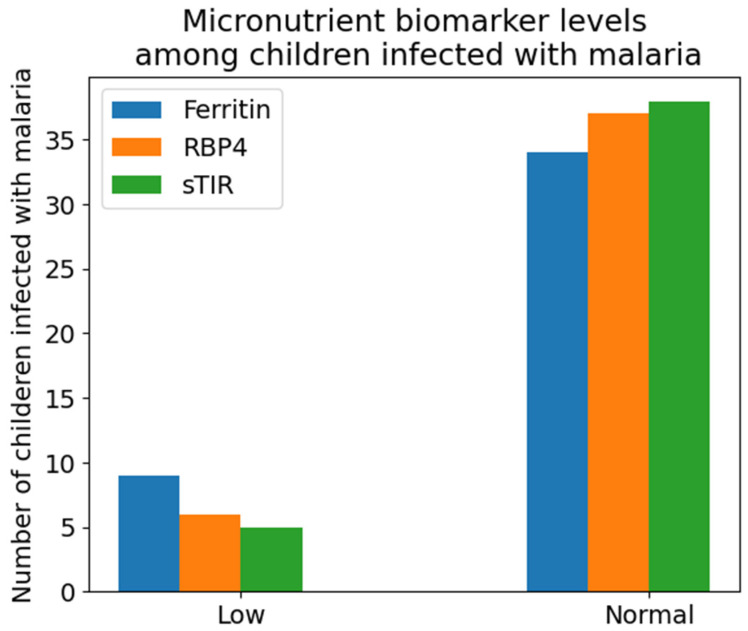
Recently malaria and micronutrient deficiencies have become a major worldwide public health problem, particularly in Africa and other endemic countries with children under 5 years old being the most vulnerable. Apart from nutritional problems that cause micronutrient deficiencies, studies have also reported that parasitic infections like malaria can affect the levels of micronutrients. Thus, this research was aimed at assessing the serum levels of micronutrient biomarkers and their association with malaria infection in children under 5 years old in the Buea Health District. Method: This cross-sectional study recruited 80 participants from February to April 2024. The micronutrient biomarkers levels were measured using a Q-7plex Human Micronutrient Measurement Kit. Results: There were changes in serum micronutrient biomarkers levels between malaria infected and healthy children. Ferritin was higher in sick children (23.53 μg/L ± 7.75) than in healthy children (19.07 μg/L ± 3.87), significantly ( < 0.002). The same trend was observed with the soluble transferrin receptor being higher ( < 0.049) in sick children (3.74 mg/L ± 1.92) compared to healthy ones (3.08 mg/L ± 0.64). In addition, the levels of retinol-binding protein 4 and thyroglobulin levels were not significantly different between the sick and healthy children. Therefore, this study revealed that malaria causes alterations in the serum levels of micronutrient biomarkers and consequently affects micronutrient levels in children below the age of 5 in the Buea Health District.
最近,疟疾和微量营养素缺乏已成为全球主要的公共卫生问题,特别是在非洲和其他流行国家,5岁以下儿童最为脆弱。除了导致微量营养素缺乏的营养问题外,研究还报告称,像疟疾这样的寄生虫感染会影响微量营养素的水平。因此,本研究旨在评估布埃亚健康区5岁以下儿童微量营养素生物标志物的血清水平及其与疟疾感染的关联。方法:这项横断面研究于2024年2月至4月招募了80名参与者。使用Q-7plex人类微量营养素测量试剂盒测量微量营养素生物标志物水平。结果:疟疾感染儿童和健康儿童的血清微量营养素生物标志物水平存在变化。患病儿童的铁蛋白水平(23.53μg/L±7.75)高于健康儿童(19.07μg/L±3.87),差异显著(<0.002)。可溶性转铁蛋白受体也呈现相同趋势,患病儿童(3.74mg/L±1.92)高于健康儿童(3.08mg/L±0.64),差异有统计学意义(<0.049)。此外,患病儿童和健康儿童之间视黄醇结合蛋白4和甲状腺球蛋白水平没有显著差异。因此,本研究表明,疟疾会导致布埃亚健康区5岁以下儿童血清微量营养素生物标志物水平发生改变,进而影响微量营养素水平。