Abbas Muhammad Zaeem, Ghafoor Muzafar, Hussain Muhammad Hammad, Alvi Mughees Aizaz, Jamil Tariq, Sajid Muhammad Sohail, Aslam Munazza, Hassan Ali, Hussain Shujaat, Hafeez Mian Abdul, Ullah Muhammad Irfan, Khan Iahtasham, Ashfaq Khurram, Muhammad Ghulam, Mertens-Scholz Katja, Neubauer Heinrich, El-Adawy Hosny, Saqib Muhammad
Department of Clinical Medicine and Surgery, Faculty of Veterinary Science, University of Agriculture, Faisalabad, Pakistan.
Department of Animal and Veterinary Sciences, College of Agricultural and Marine Sciences, Sultan Qaboos University, Muscat, Oman.
Vet Sci. 2024 Dec 16;11(12):657. doi: 10.3390/vetsci11120657.
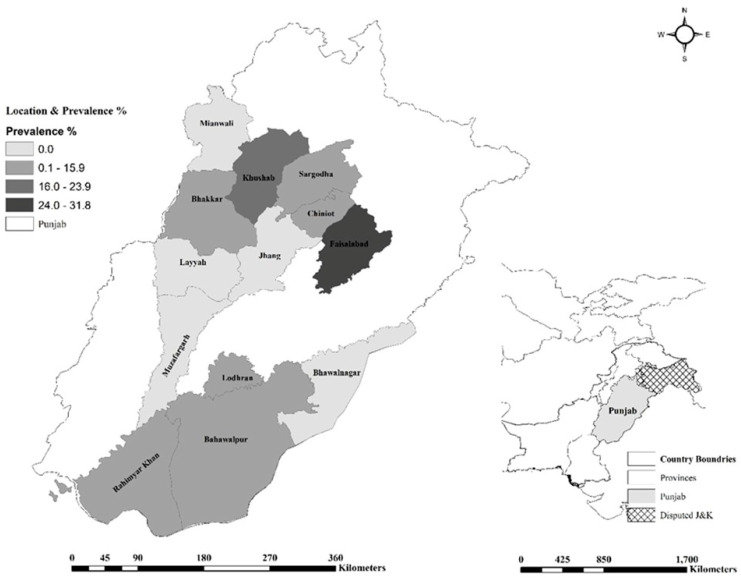
Anaplasmosis is an infectious disease transmitted by ticks and caused by obligate intracellular pathogen of belonging to genus Infections of one-humped camels () and llamas () have been reported previously. The aim of this study was to investigate the seroprevalence and risk factors of anti- spp. antibodies in of the Punjab, Pakistan. A cross-sectional study was conducted during 2017-2018 to study the seroprevalence of anaplasmosis in of 13 districts in Punjab province of Pakistan and to assess the associated risk factors including age, breed, gender, body condition score, tick infestation, location, season and management type. Serum samples from 728 camels (433 females and 295 males) were examined for anti- antibodies using a commercially available competitive enzyme-linked immunosorbent assay (cELISA) test kit. A univariable analysis was conducted and extended to multivariate logistic regression to find potential risk factors associated with the disease. Overall, the seroprevalence of anti- antibodies was 8.5% (8.5%, CI 6.6-10.8) with 62 positives in 728 camels. The highest seroprevalence was recorded for camels of the Central Punjab districts (16.1%, CI 11.5-21.7) followed by those of the Northwestern (5.4%, 2.8-9.3) and Southern Punjab (5.2%, 2.9-8.4) districts ( < 0.001). Multivariable analysis showed that location (Central Punjab: OR 2.78, = 0.004), season (summer: OR 7.94, = 0.009), body condition score (BCS 2: OR 14.81, = 0.029) and tick infestation (OR 38.59, < 0.001) are potential risk factors in the corresponding camel populations. The results showed that the camel population in Pakistan is seropositive for spp. The geographical zone, season, body condition and tick infestation were identified as significantly associated risk factors for seroprevalence of anaplasmosis in dromedary camels. To the best of our knowledge, the results of this current study provide the first evidence of exposure of camels to anaplasmosis in Pakistan. Molecular investigations in the future are highly recommended to determine the dynamics of the disease in camels.
无形体病是一种由蜱传播的传染病,由无形体属的专性细胞内病原体引起。此前已有单峰骆驼()和美洲驼()感染的报道。本研究的目的是调查巴基斯坦旁遮普邦骆驼中抗无形体属抗体的血清流行率及危险因素。2017年至2018年期间进行了一项横断面研究,以研究巴基斯坦旁遮普省13个区骆驼的无形体病血清流行率,并评估相关危险因素,包括年龄、品种、性别、身体状况评分、蜱感染情况、地点、季节和管理类型。使用市售的竞争酶联免疫吸附测定(cELISA)试剂盒对728头骆驼(433头雌性和295头雄性)的血清样本进行抗无形体抗体检测。进行单变量分析并扩展至多变量逻辑回归,以找出与该疾病相关的潜在危险因素。总体而言,抗无形体抗体的血清流行率为8.5%(8.5%,置信区间6.6 - 10.8),728头骆驼中有62头呈阳性。旁遮普省中部地区的骆驼血清流行率最高(16.1%,置信区间11.5 - 21.7),其次是西北部地区(5.4%,2.8 - 9.3)和旁遮普省南部地区(5.2%,2.9 - 8.4)(<0.001)。多变量分析表明,地点(旁遮普省中部:比值比2.78,=0.004)、季节(夏季:比值比7.94,=0.009)、身体状况评分(身体状况评分2:比值比14.81,=0.029)和蜱感染情况(比值比38.59,<0.001)是相应骆驼群体中的潜在危险因素。结果表明,巴基斯坦的骆驼群体对无形体属呈血清阳性。地理区域、季节、身体状况和蜱感染被确定为单峰骆驼无形体病血清流行率的显著相关危险因素。据我们所知,本研究结果首次提供了巴基斯坦骆驼接触无形体病的证据。强烈建议未来进行分子研究,以确定骆驼中该疾病的动态情况。