Zhang Qirui, Ye Xuyang, Shi Shuqing, Zhou Songhua, Ma Daqing, Ouyang Wen, Tong Jianbin, Le Yuan
Department of Anesthesiology and Hunan Province Key Laboratory of Brain Homeostasis, Third Xiangya Hospital, Central South University, Changsha, Hunan, China.
Department of Anesthesiology, Third Xiangya Hospital, Central South University, Changsha, Hunan, China.
Anesthesiology. 2025 Apr 1;142(4):655-665. doi: 10.1097/ALN.0000000000005354. Epub 2024 Dec 27.
Postoperative nausea and vomiting are common complications after gynecologic laparoscopic surgery. Pyridoxine has been recommended as a first-line drug to prevent and treat nausea and vomiting during pregnancy; however, its efficacy in preventing postoperative nausea and vomiting remains unclear.
Patients of 18 to 65 yr old who received elective gynecologic laparoscopic surgery under general anesthesia were randomized into either the pyridoxine group or the control group. The pyridoxine group received 0.2 g of vitamin B 6 before anesthesia induction, and the control group received normal saline intravenously. Both groups received a similar regimen of combined intravenous and inhalation general anesthesia. All patients received dexamethasone (intravenous) after anesthesia induction and ondansetron (intravenous) before surgery completion. Postoperative nausea and vomiting occurrence was recorded according to the patients' self-reported data. Other clinical data were collected from hospital system, and concentrations of blood interleukin-6 and substance P were measured by enzyme-linked immunosorbent assay.
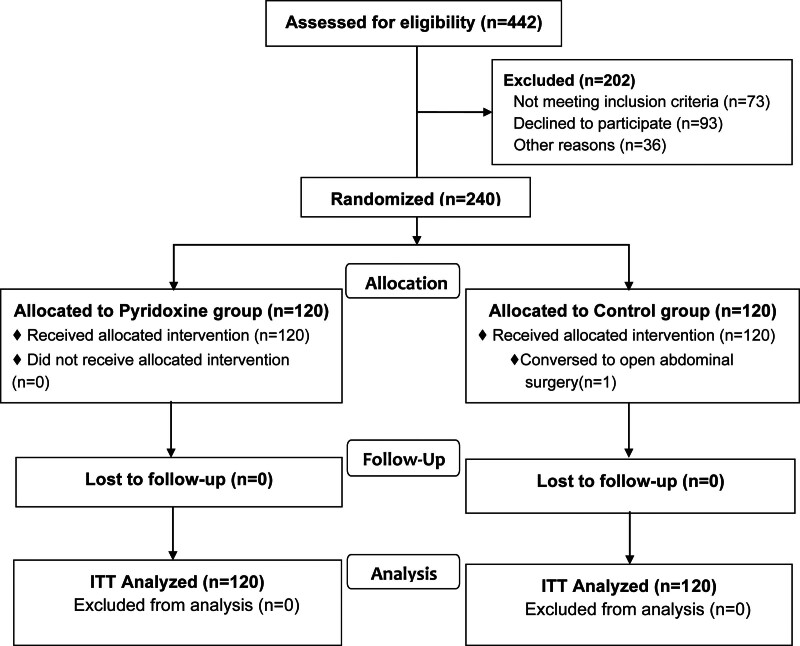
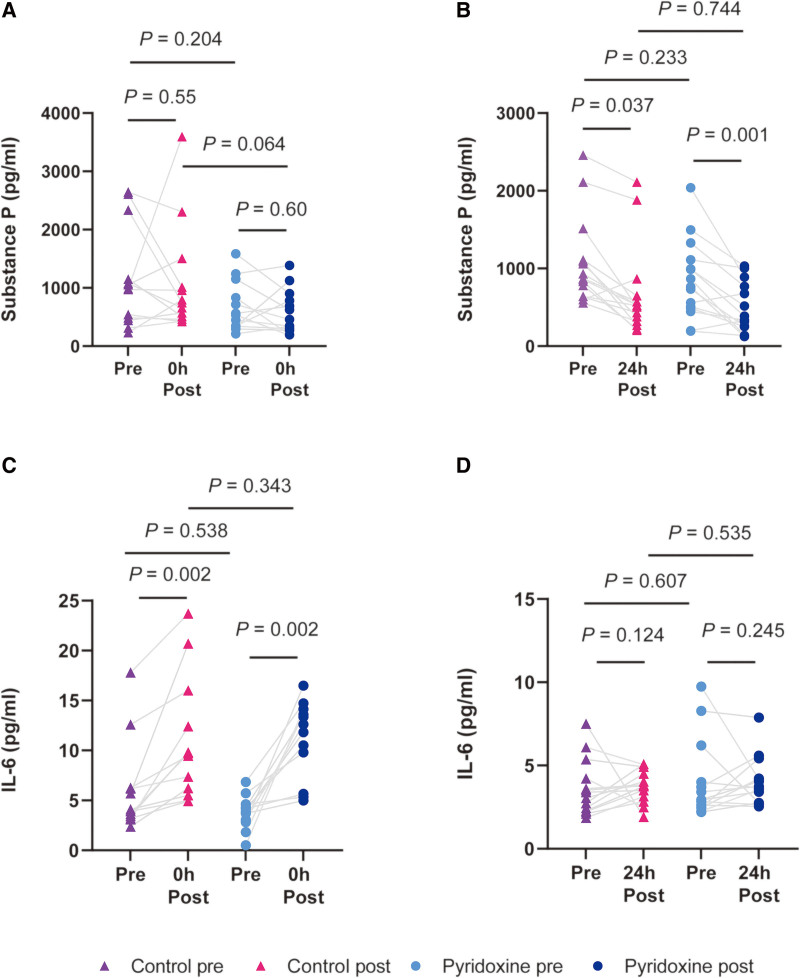
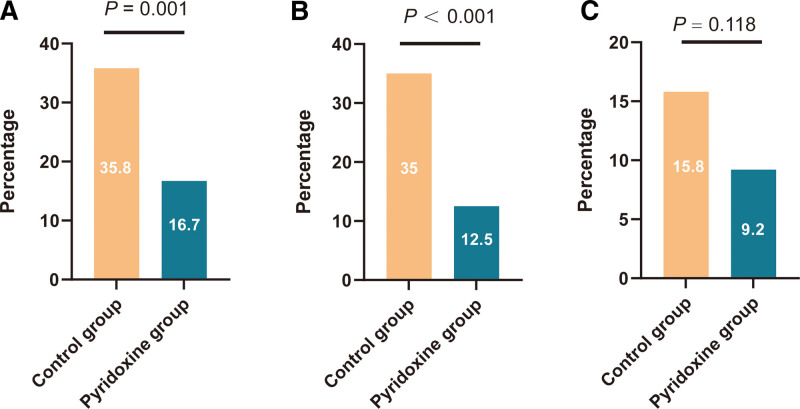
A total of 442 patients were screened, and 240 patients were equally randomized to the pyridoxine or control group. The incidence of postoperative nausea and vomiting was statistically significant lower in the pyridoxine group than in the control group (16.7% [20 of 120] vs . 35.8% [43 of 120]; relative risk = 0.47 [95% CI, 0.29 to 0.74]; absolute risk reduction = 0.20 [95% CI, 0.08 to 0.30]; P = 0.001), and pyridoxine decreased the incidence of postoperative nausea (12.5% [15 of 120] vs . 35% [42 of 120]; relative risk = 0.36 [95% CI, 0.21 to 0.61]; absolute risk reduction = 0.23 [95% CI, 0.12 to 0.33]; P < 0.001). There were no statistical differences in postoperative vomiting, time to the first postoperative nausea and vomiting occurrence, pain, serum interleukin-6 and substance P, and leukocyte and neutrophil counts.
In this single-center randomized trial, pyridoxine plus dexamethasone and ondansetron reduced the incidence of postoperative nausea and vomiting in patients undergoing elective gynecologic laparoscopic surgery under general anesthesia. These findings need to be validated in multicenter studies in diverse populations to ensure generalizability.
术后恶心呕吐是妇科腹腔镜手术后常见的并发症。维生素B6已被推荐作为预防和治疗孕期恶心呕吐的一线药物;然而,其预防术后恶心呕吐的疗效仍不明确。
将年龄在18至65岁之间、接受全身麻醉下择期妇科腹腔镜手术的患者随机分为维生素B6组和对照组。维生素B6组在麻醉诱导前给予0.2g维生素B6,对照组静脉输注生理盐水。两组均采用相似的静脉和吸入复合全身麻醉方案。所有患者在麻醉诱导后接受地塞米松(静脉注射),手术结束前接受昂丹司琼(静脉注射)。根据患者自我报告的数据记录术后恶心呕吐的发生情况。从医院系统收集其他临床数据,并通过酶联免疫吸附测定法测量血液中白细胞介素-6和P物质的浓度。
共筛选出442例患者,240例患者被等比例随机分为维生素B6组或对照组。维生素B6组术后恶心呕吐的发生率显著低于对照组(16.7%[120例中的20例]对35.8%[120例中的43例];相对危险度=0.47[95%CI,0.29至0.74];绝对危险度降低=0.20[95%CI,0.08至0.30];P=0.001),维生素B6降低了术后恶心的发生率(12.5%[120例中的15例]对35%[120例中的42例];相对危险度=0.36[95%CI,0.21至0.61];绝对危险度降低=0.23[95%CI,0.12至0.33];P<0.001)。术后呕吐、首次术后恶心呕吐发生时间、疼痛、血清白细胞介素-6和P物质以及白细胞和中性粒细胞计数方面无统计学差异。
在这项单中心随机试验中,维生素B6联合地塞米松和昂丹司琼降低了全身麻醉下接受择期妇科腹腔镜手术患者术后恶心呕吐的发生率。这些发现需要在不同人群的多中心研究中得到验证,以确保其普遍性。