Li Huirong, Sharma Ruchi, Bharti Kapil
NEI/OSCTRS/OGVFB, Bethesda, MD, United States.
Stem Cells Transl Med. 2025 Mar 18;14(3). doi: 10.1093/stcltm/szae097.
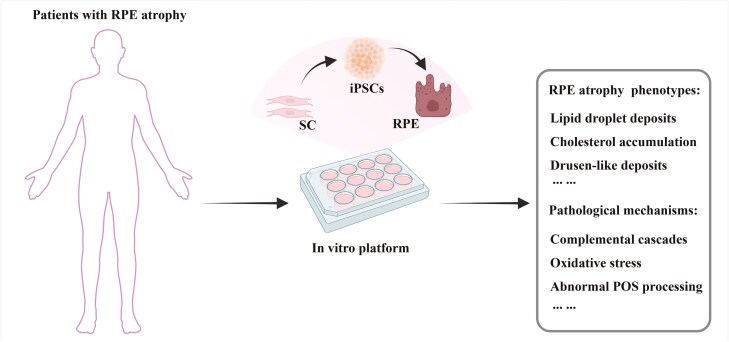
Retinal pigment epithelium (RPE) atrophy is a significant cause of human blindness worldwide, occurring in polygenic diseases such as age-related macular degeneration (AMD) and monogenic diseases such as Stargardt diseases (STGD1) and late-onset retinal degeneration (L-ORD). The patient-induced pluripotent stem cells (iPSCs)-derived RPE (iRPE) model exhibits many advantages in understanding the cellular basis of pathological mechanisms of RPE atrophy. The iRPE model is based on iPSC-derived functionally mature and polarized RPE cells that reproduce several features of native RPE cells, such as phagocytosis of photoreceptor outer segments (POS) and replenishment of visual pigment. When derived from patients, iRPE are able to recapitulate critical cellular phenotypes of retinal degenerative diseases, such as the drusen-like sub-RPE deposits in the L-ORD and AMD models; lipid droplets and cholesterol accumulation in the STGD1 and AMD models. The iRPE model has helped discover the unexpected role of RPE in understanding retinal degenerative diseases, such as a cell-autonomous function of ABCA4 in STGD1. The iRPE model has helped uncover the pathological mechanism of retinal degenerative diseases, including the roles of alternate complement cascades and oxidative stress in AMD pathophysiology, abnormal POS processing in STGD1 and L-ORD, and its association with lipid accumulation. These studies have helped better understand-the role of RPE in retinal degenerative diseases, and molecular mechanisms underlying RPE atrophy, and have provided a basis to discover therapeutics to target RPE-associated diseases.
视网膜色素上皮(RPE)萎缩是全球人类失明的一个重要原因,发生于多基因疾病如年龄相关性黄斑变性(AMD)以及单基因疾病如斯特格黄斑变性(STGD1)和迟发性视网膜变性(L-ORD)。患者诱导多能干细胞(iPSC)来源的RPE(iRPE)模型在理解RPE萎缩病理机制的细胞基础方面具有许多优势。iRPE模型基于iPSC来源的功能成熟且极化的RPE细胞,这些细胞重现了天然RPE细胞的若干特征,如光感受器外段(POS)的吞噬作用和视觉色素的补充。当来源于患者时,iRPE能够重现视网膜退行性疾病的关键细胞表型,如L-ORD和AMD模型中的类玻璃膜疣样RPE下沉积物;STGD1和AMD模型中的脂滴和胆固醇积累。iRPE模型有助于发现RPE在理解视网膜退行性疾病中的意外作用,如ABCA4在STGD1中的细胞自主功能。iRPE模型有助于揭示视网膜退行性疾病的病理机制,包括替代补体级联反应和氧化应激在AMD病理生理学中的作用、STGD1和L-ORD中异常的POS处理及其与脂质积累的关联。这些研究有助于更好地理解RPE在视网膜退行性疾病中的作用以及RPE萎缩的分子机制,并为发现针对RPE相关疾病的治疗方法提供了基础。