Vieira Ana Rita, de Sousa Filipe, Bilro João, Viegas Mariana Bray, Svanbäck Richard, Gordo Leonel S, Paulo Octávio S
MARE - Marine and Environmental Sciences Centre & ARNET - Aquatic Research Network, Faculdade de Ciências, Universidade de Lisboa, Campo Grande, 1749-016, Lisboa, Portugal.
Departamento de Biologia Animal, Faculdade de Ciências, Universidade de Lisboa, Campo Grande, 1749-016, Lisboa, Portugal.
Sci Rep. 2024 Dec 28;14(1):30977. doi: 10.1038/s41598-024-82054-x.
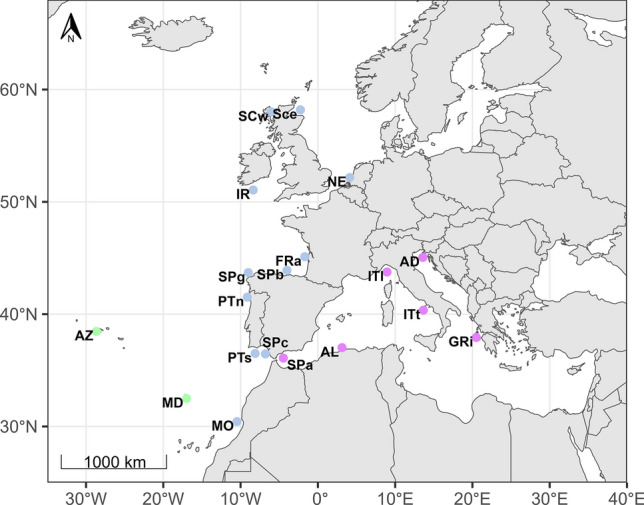
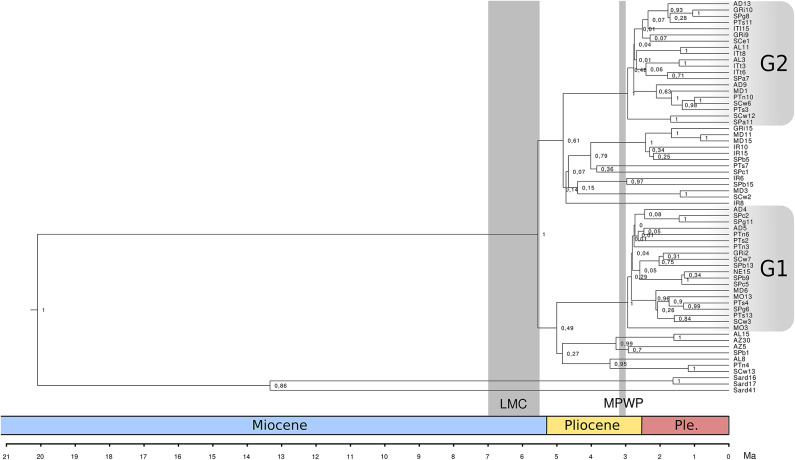
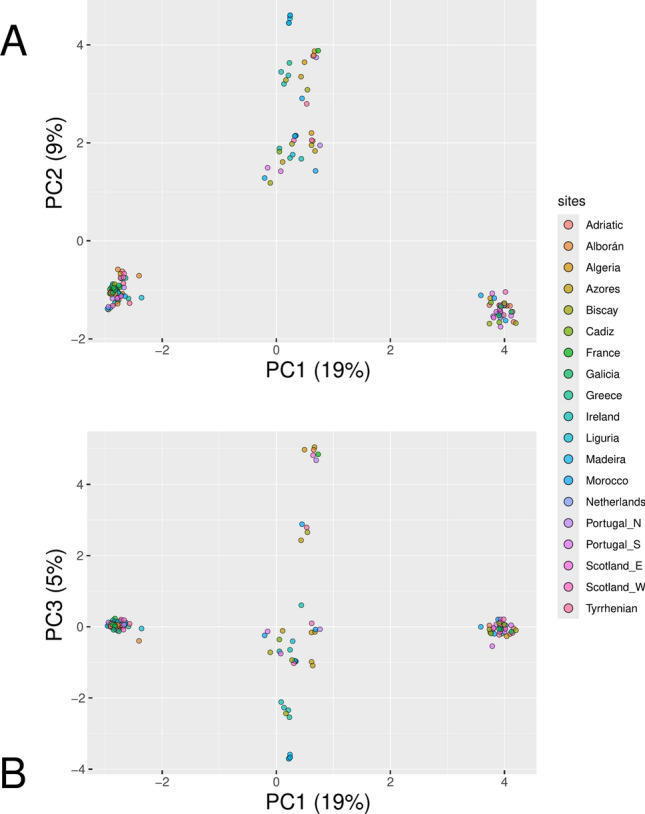
The development of management strategies for the promotion of sustainable fisheries relies on a deep knowledge of ecological and evolutionary processes driving the diversification and genetic variation of marine organisms. Sustainability strategies are especially relevant for marine species such as the European sardine (Sardina pilchardus), a small pelagic fish with high ecological and socioeconomic importance, especially in Southern Europe, whose stock has declined since 2006, possibly due to environmental factors. Here, we generated sequences for 139 mitochondrial genomes from individuals from 19 different geographical locations across most of the species distribution range, which was used to assess genetic diversity, diversification history and genomic signatures of selection. Our data supported an extensive gene flow in European sardine. However, phylogenetic analyses of mitogenomes revealed diversification patterns related to climate shifts in the late Miocene and Pliocene that may indicate past divergence related to rapid demographic expansion. Tests of selection showed a significant signature of purifying selection, but positive selection was also detected in different sites and specific mitochondrial lineages. Our results showed that European sardine diversification has been strongly driven by climate shifts, and rapid changes in marine environmental conditions are likely to strongly affect the distribution and stock size of this species.
促进可持续渔业发展的管理策略的制定依赖于对推动海洋生物多样性和遗传变异的生态与进化过程的深入了解。可持续性策略对于欧洲沙丁鱼(Sardina pilchardus)等海洋物种尤为重要,欧洲沙丁鱼是一种小型中上层鱼类,具有很高的生态和社会经济重要性,特别是在南欧地区,自2006年以来其种群数量有所下降,这可能是环境因素所致。在此,我们从该物种分布范围大部分地区的19个不同地理位置的个体中生成了139个线粒体基因组序列,用于评估遗传多样性、多样化历史和选择的基因组特征。我们的数据支持欧洲沙丁鱼存在广泛的基因流动。然而,对线粒体基因组的系统发育分析揭示了与中新世晚期和上新世气候变化相关的多样化模式,这可能表明过去的分化与快速的种群扩张有关。选择测试显示出明显的纯化选择特征,但在不同位点和特定线粒体谱系中也检测到了正选择。我们的结果表明,欧洲沙丁鱼的多样化受到气候变化的强烈驱动,海洋环境条件的快速变化可能会强烈影响该物种的分布和种群规模。