Shen Shang-Po, Lin Hung-Chih, Chen Jui-Fen, Wang Hui-Shan, Huang Yen-Yu, Hsia Ko-Chiang, Lin Jia-Hung, Kuo Yi-Wei, Li Ching-Min, Hsu Yu-Chieh, Tsai Shin-Yu, Ho Hsieh-Hsun
Division of Neonatology, China Medical University Children's Hospital, Taichung City, Taiwan.
School of Chinese Medicine, China Medical University, Taichung City, Taiwan.
BMC Pediatr. 2024 Dec 27;24(1):840. doi: 10.1186/s12887-024-05289-7.
Breast milk is a natural treasure for infants, and its microbiota contains a rich array of bacterial species. When breastfeeding is not possible, infant formula with probiotics can be used as a sole source or as a breast milk supplement. The main aim of this study was to evaluate the growth outcomes and tolerance of infants consuming an infant formula containing Bifidobacterium animalis ssp. lactis CP-9 (B. animalis CP-9) or Lactobacillus salivarius AP-32 (L. salivarius AP-32), which were isolated from breast milk and the guts of healthy infants. The safety of these strains in terms of antibiotic resistance and their ability to modulate the gut microbiota were also evaluated.
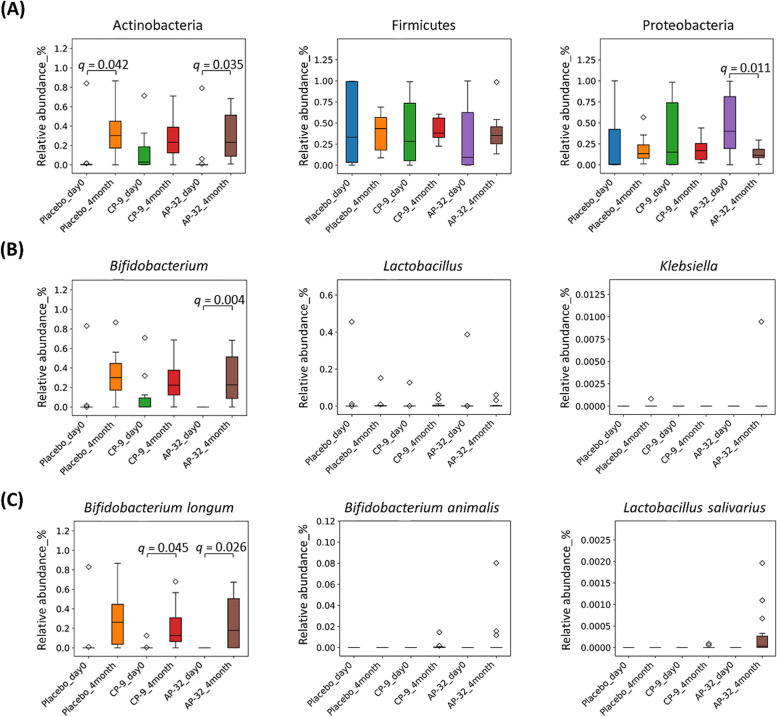
One hundred eighty healthy infants were included in this study and separated into three groups: the control group, the L. salivarius AP-32 group, and the B. animalis CP-9 group. In this clinical study, adverse events, growth effects, and the incidence of allergies and gastrointestinal disorders in infants consuming infant formula containing B. animalis CP-9 or L. salivarius AP-32 were evaluated. Finally, the impact of the probiotic infant formula on the gut microbiota was elucidated via next-generation sequencing (NGS) analysis.
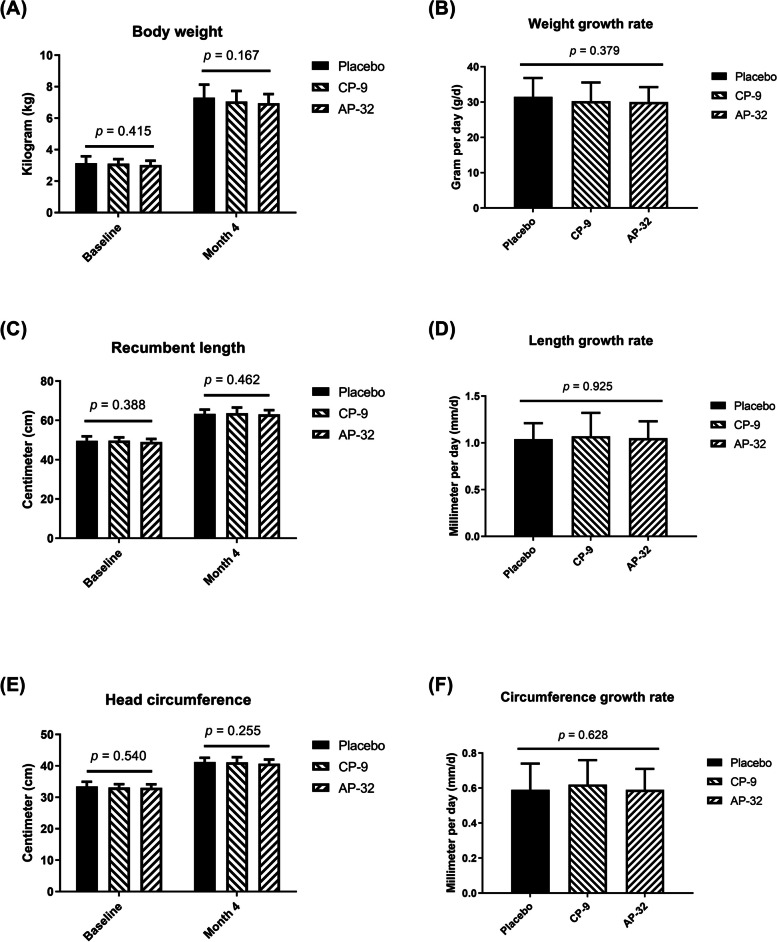
The 4-month interventional study revealed that body weight, recumbent length, and head circumference were similar among the three groups. No adverse events related to the intervention were observed. The microbiota composition was more diverse on day 0 and became more uniform by month 4. B. animalis CP-9 and L. salivarius AP-32 were found to be susceptible to streptomycin, tetracycline, erythromycin, clindamycin, chloramphenicol, and ampicillin.
The use of infant formula containing B. animalis CP-9 and L. salivarius AP-32 was considered safe and well tolerated, with no adverse events observed during the study. While these strains showed low antibiotic resistance and no immediate concerns related to antibiotic resistance genes, further research is needed to comprehensively assess their long-term safety and efficacy and the potential risk of horizontal gene transfer in broader contexts.
The trial was registered with the US Library of Medicine (clinicaltrials.gov) with the number NCT03993301 on 20/06/2019.
母乳是婴儿的天然宝藏,其微生物群包含丰富多样的细菌种类。当无法进行母乳喂养时,含益生菌的婴儿配方奶粉可作为唯一来源或母乳补充剂。本研究的主要目的是评估食用含有从健康婴儿母乳和肠道中分离出的动物双歧杆菌乳酸亚种CP-9(动物双歧杆菌CP-9)或唾液乳杆菌AP-32(唾液乳杆菌AP-32)的婴儿配方奶粉的婴儿的生长结果和耐受性。还评估了这些菌株在抗生素耐药性方面的安全性及其调节肠道微生物群的能力。
本研究纳入了180名健康婴儿,并将其分为三组:对照组、唾液乳杆菌AP-32组和动物双歧杆菌CP-9组。在这项临床研究中,评估了食用含有动物双歧杆菌CP-9或唾液乳杆菌AP-32的婴儿配方奶粉的婴儿的不良事件、生长效应以及过敏和胃肠道疾病的发生率。最后,通过下一代测序(NGS)分析阐明了益生菌婴儿配方奶粉对肠道微生物群的影响。
为期4个月的干预研究表明,三组婴儿的体重、身长和头围相似。未观察到与干预相关的不良事件。第0天微生物群组成更加多样化,到第4个月时变得更加均匀。发现动物双歧杆菌CP-9和唾液乳杆菌AP-32对链霉素、四环素、红霉素、克林霉素、氯霉素和氨苄西林敏感。
食用含有动物双歧杆菌CP-9和唾液乳杆菌AP-32的婴儿配方奶粉被认为是安全且耐受性良好的,研究期间未观察到不良事件。虽然这些菌株显示出低抗生素耐药性且没有与抗生素耐药基因直接相关的问题,但需要进一步研究以全面评估其长期安全性和有效性以及在更广泛背景下水平基因转移的潜在风险。
该试验于2019年6月20日在美国国立医学图书馆(clinicaltrials.gov)注册,编号为NCT03993301。