Choi Hea Lim, Jeong Su Min, Jeon Keun Hye, Kim Bongseong, Jung Wonyoung, Jeong Ansuk, Han Kyungdo, Shin Dong Wook
Department of Family Medicine/Executive Healthcare Clinic, Severance Hospital, Yonsei University College of Medicine, Seoul, Republic of Korea.
Department of Clinical Research Design and Evaluation, The Samsung Advanced Institute for Health Sciences & Technology (SAIHST), Sungkyunkwan University, 81 Irwon-ro, Gangnam-gu, Seoul, 06351, Republic of Korea.
Breast Cancer Res. 2024 Dec 27;26(1):188. doi: 10.1186/s13058-024-01948-w.
Depression among breast cancer survivors is a significant concern affecting their long-term survivorship and quality of life. This study investigates the incidence of depression among breast cancer survivors and identifies associated risk factors.
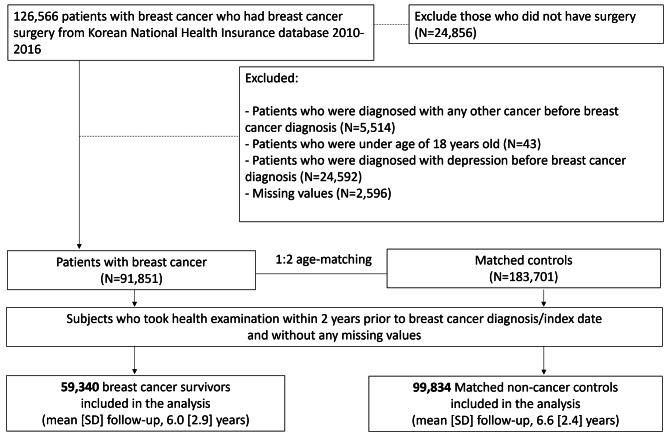
This retrospective cohort study used data from the Korean National Health Insurance Service database and included 59,340 breast cancer patients without a history of depression who underwent surgery between January 1, 2010, and December 31, 2016. They were individually matched 1:2 by age with a general population without cancer (n = 99,834). The mean follow-up period was 6.4 ± 2.6 years. Sub-distribution hazard ratios (sHRs) and 95% confidence intervals (CIs) were calculated considering death as a competing risk and adjusting for sociodemographic factors and comorbidities.
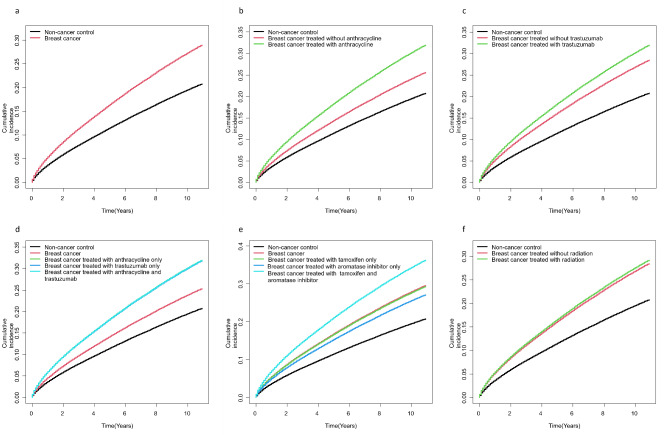
Breast cancer survivors with a mean (standard deviation) age of 51.5 (9.2) years had a 39% increased risk of depression compared to non-cancer controls (sHR 1.39, 95% CI 1.36-1.42). During the first year post-diagnosis, breast cancer survivors across all ages exhibited a significantly elevated risk of depression, with a sHR of 3.23 (95% CI 3.08-3.37). Notably, younger survivors had a sHR of 4.51 (95% CI 4.19-4.85), and older survivors had a sHR of 2.56 (95% CI 2.42-2.71). One year post-surgery, younger survivors (age ≤ 50 years) showed a 1.16-fold increase in depression risk (sHR 1.16, 95% CI 1.11-1.20), while older survivors (age > 50 years) showed no significant change in risk, which decreased over time. Use of anthracycline, taxane, or endocrine therapy was associated with an increased depression risk (sHR 1.17, 95% CI 1.13-1.22; sHR 1.12, 95% CI 1.07-1.16; and sHR 1.27, 95% CI 1.14-1.41, respectively), with endocrine therapy showing a 41% increased depression risk in older survivors (sHR 1.41, 95% CI 1.23-1.61).
This study demonstrates a significant association between breast cancer and depression, with a particularly heightened risk in younger survivors within the first year post-diagnosis. Special attention is needed to meticulously screen for depressive symptoms during the early follow-up years for breast cancer survivors who are premenopausal or have undergone chemotherapy and endocrine therapy.
乳腺癌幸存者的抑郁是一个重大问题,影响着他们的长期生存和生活质量。本研究调查了乳腺癌幸存者中抑郁的发生率,并确定相关风险因素。
这项回顾性队列研究使用了韩国国民健康保险服务数据库中的数据,纳入了59340例无抑郁病史且在2010年1月1日至2016年12月31日期间接受手术的乳腺癌患者。他们按年龄以1:2的比例与无癌症的普通人群(n = 99834)进行个体匹配。平均随访期为6.4±2.6年。计算亚分布风险比(sHRs)和95%置信区间(CIs),将死亡视为竞争风险,并对社会人口学因素和合并症进行调整。
平均(标准差)年龄为51.5(9.2)岁的乳腺癌幸存者患抑郁症的风险比非癌症对照组高39%(sHR 1.39,95% CI 1.36 - 1.42)。在诊断后的第一年,所有年龄段的乳腺癌幸存者患抑郁症的风险均显著升高,sHR为3.23(95% CI 3.08 - 3.37)。值得注意的是,年轻幸存者的sHR为4.51(95% CI 4.19 - 4.85),年长幸存者的sHR为2.56(95% CI 2.42 - 2.71)。术后一年,年轻幸存者(年龄≤50岁)患抑郁症的风险增加了1.16倍(sHR 1.16,95% CI 1.11 - 1.20),而年长幸存者(年龄>50岁)的风险无显著变化,且随时间降低。使用蒽环类药物、紫杉烷或内分泌治疗与抑郁症风险增加相关(sHR分别为1.17,95% CI 1.13 - 1.22;sHR 1.12,95% CI 1.07 - 1.16;sHR 1.27,95% CI 1.14 - 1.41),内分泌治疗在年长幸存者中使抑郁症风险增加41%(sHR 1.41,95% CI 1.23 - 1.61)。
本研究表明乳腺癌与抑郁症之间存在显著关联,在诊断后的第一年,年轻幸存者的风险尤其高。对于绝经前或接受过化疗和内分泌治疗的乳腺癌幸存者,在早期随访期间需要特别注意仔细筛查抑郁症状。