Department of Surgery, Division of Public Health Sciences, and Siteman Cancer Center, Washington University School of Medicine, St Louis, Missouri.
School of Medicine, University College Dublin, Belfield, Dublin, Ireland.
JAMA Netw Open. 2024 Jan 2;7(1):e2353331. doi: 10.1001/jamanetworkopen.2023.53331.
Breast cancer in young women has a less favorable prognosis compared with older women. Yet, comprehensive data on recent trends and how period and cohort effects may affect these trends among young women are not well-known.
To evaluate breast cancer incidence among young women in the US over a 20-year period by race and ethnicity, hormone receptor status (estrogen receptor [ER] and progesterone receptor [PR]), tumor stage, and age at diagnosis, as well as how period and cohort effects may affect these trends.
DESIGN, SETTING, AND PARTICIPANTS: This cross-sectional study used data from Surveillance, Epidemiology, and End Results 17 registries (2000-2019). Women aged 20 to 49 years with a primary invasive breast cancer were included. Data were analyzed between February and June 2023.
Age-standardized incidence rates (ASIR), incidence rate ratios (IRR), and average annual percent changes (AAPC) stratified by race and ethnicity, hormone receptor status, tumor stage, and age at diagnosis.
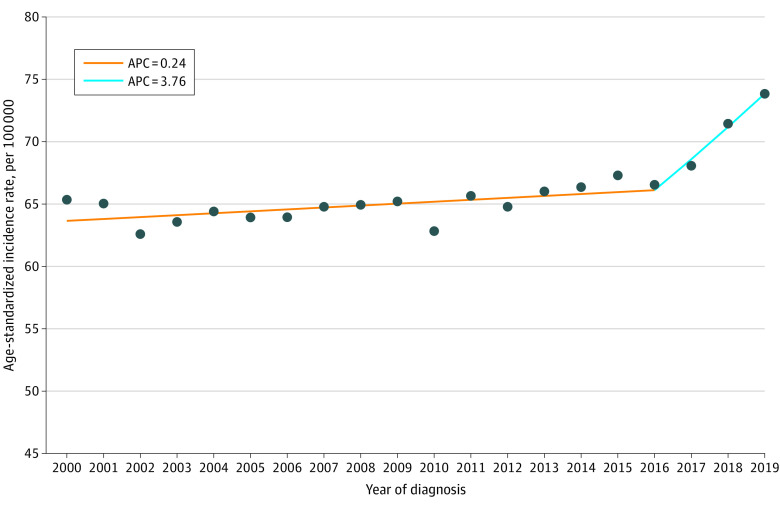
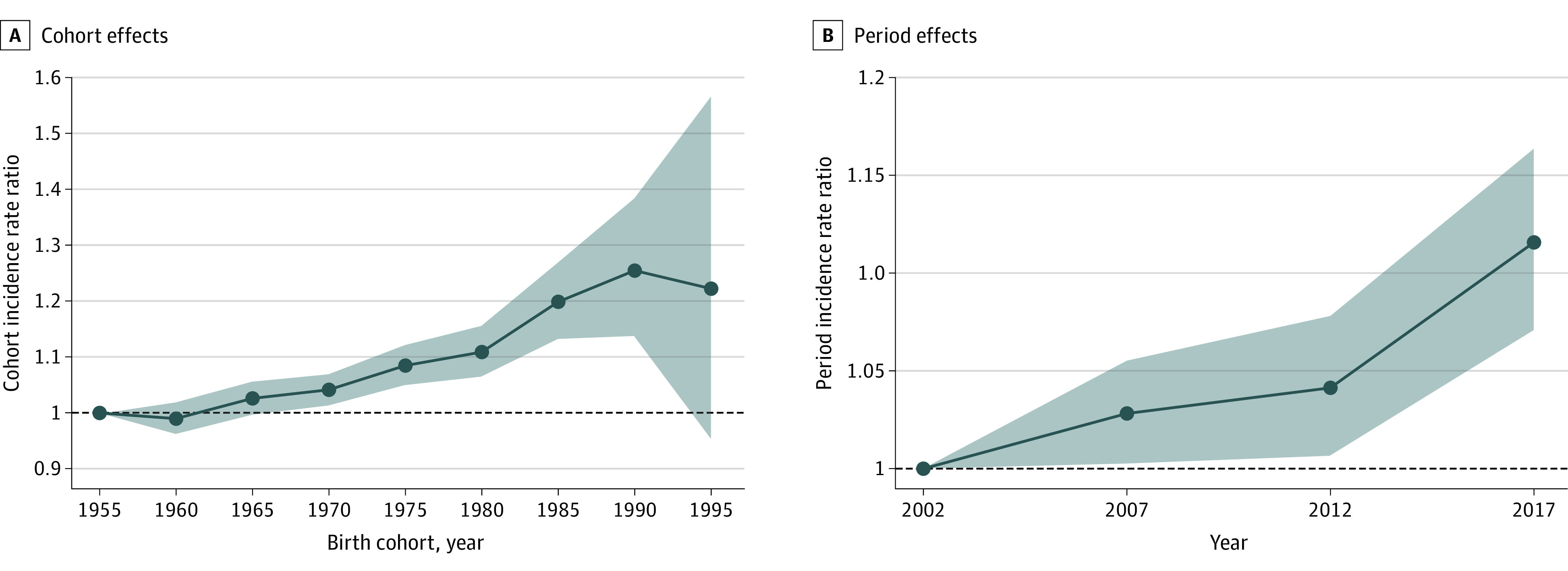
Out of 217 815 eligible women (1485 American Indian or Alaska Native [0.7%], 25 210 Asian or Pacific Islander [11.6%], 27 112 non-Hispanic Black [12.4%], 37 048 Hispanic [17.0%], 126 960 non-Hispanic White [58.3%]), the majority were diagnosed with an ER+/PR+ tumor (134 024 [61.5%]) and were diagnosed with a stage I tumor (81 793 [37.6%]). Overall, invasive breast cancer incidence increased (AAPC, 0.79; 95% CI, 0.42 to 1.15), with increasing trends across almost all racial and ethnic groups. ASIR increased for ER+/PR+ (AAPC, 2.72; 95% CI, 2.34 to 3.12) and ER+/PR- tumors (AAPC, 1.43; 95% CI, 1.00 to 1.87), and decreased for ER-/PR+ (AAPC, -3.25; 95% CI, -4.41 to -2.07) and ER-/PR- tumors (AAPC, -0.55; 95% CI, -1.68 to 0.60). For women aged 20 to 29 and 30 to 39 years, ASIRs were highest among non-Hispanic Black women (age 20-29 years: IRR, 1.53; 95% CI, 1.43 to 1.65; age 30-39 years: IRR, 1.15; 95% CI, 1.12 to 1.18). For women aged 40 to 49 years, ASIR was lower for non-Hispanic Black women (IRR, 0.96; 95% CI, 0.94 to 0.97) compared with non-Hispanic White women. Incidence rates increased for stages I and IV tumors but decreased for stage II and III tumors. Age-period-cohort analysis demonstrated both cohort and period effects on breast cancer incidence (P < .001).
In this population-based cross-sectional analysis, an increase in breast cancer incidence rates among young US women and age-related crossover between non-Hispanic White and Black women were observed. Prevention efforts in young women need to adopt a targeted approach to address racial disparities in incidence rates observed at different age phases.
与老年女性相比,年轻女性的乳腺癌预后较差。然而,关于年轻女性中这些趋势的近期趋势以及时期和队列效应对这些趋势的影响的综合数据尚不清楚。
通过种族和族裔、激素受体状态(雌激素受体 [ER] 和孕激素受体 [PR])、肿瘤分期和诊断时的年龄,评估美国年轻女性乳腺癌的发病率在 20 年期间的变化,并评估时期和队列效应对这些趋势的影响。
设计、地点和参与者:这是一项使用监测、流行病学和最终结果 17 个登记处(2000-2019 年)数据的横断面研究。纳入年龄在 20 至 49 岁之间的原发性浸润性乳腺癌女性。数据于 2023 年 2 月至 6 月间进行分析。
按种族和族裔、激素受体状态、肿瘤分期和诊断时的年龄分层的年龄标准化发病率 (ASIR)、发病率比 (IRR) 和平均年百分比变化 (AAPC)。
在 217815 名符合条件的女性中(1485 名美国印第安人或阿拉斯加原住民 [0.7%]、25210 名亚洲或太平洋岛民 [11.6%]、27112 名非西班牙裔黑人 [12.4%]、37048 名西班牙裔 [17.0%]、126960 名非西班牙裔白人 [58.3%]),大多数女性被诊断为 ER+/PR+肿瘤(134024 [61.5%])和 I 期肿瘤(81793 [37.6%])。总体而言,浸润性乳腺癌发病率呈上升趋势(AAPC,0.79;95%CI,0.42 至 1.15),几乎所有种族和族裔群体的发病率都呈上升趋势。ER+/PR+(AAPC,2.72;95%CI,2.34 至 3.12)和 ER+/PR-肿瘤(AAPC,1.43;95%CI,1.00 至 1.87)的 ASIR 增加,而 ER-/PR+(AAPC,-3.25;95%CI,-4.41 至-2.07)和 ER-/PR-肿瘤(AAPC,-0.55;95%CI,-1.68 至 0.60)的 ASIR 降低。对于 20 至 29 岁和 30 至 39 岁的女性,非西班牙裔黑人女性的 ASIR 最高(年龄 20-29 岁:IRR,1.53;95%CI,1.43 至 1.65;年龄 30-39 岁:IRR,1.15;95%CI,1.12 至 1.18)。对于 40 至 49 岁的女性,与非西班牙裔白人女性相比,非西班牙裔黑人女性的 ASIR 较低(IRR,0.96;95%CI,0.94 至 0.97)。I 期和 IV 期肿瘤的发病率增加,但 II 期和 III 期肿瘤的发病率降低。年龄-时期-队列分析表明,乳腺癌发病率存在队列和时期效应(P<0.001)。
在这项基于人群的横断面分析中,观察到美国年轻女性乳腺癌发病率的增加以及非西班牙裔白人和黑人女性之间年龄相关的交叉。需要针对年轻女性采取有针对性的预防措施,以解决不同年龄阶段观察到的发病率种族差异。