Sharafabad Behrouz Ebadi, Abdoli Asghar, Jamour Parisa, Dilmaghani Azita
Department of Pharmaceutical Biotechnology, Faculty of Pharmacy, Tabriz University of Medical Sciences, Tabriz, Iran.
Department of Hepatitis and HIV, Pasteur Institute of Iran (IPI), Tehran, Iran.
BMC Complement Med Ther. 2024 Dec 28;24(1):427. doi: 10.1186/s12906-024-04742-5.
A precise observation is that the cervix's solid tumors possess hypoxic regions where the oxygen concentration drops below 1.5%. Hypoxia negatively impacts the host's immune system and significantly diminishes the effectiveness of several treatments, including radiotherapy and chemotherapy. Utilizing oncolytic spores of Clostridium novyi-NT to target the hypoxic regions of solid tumors has emerged as a noteworthy treatment strategy.
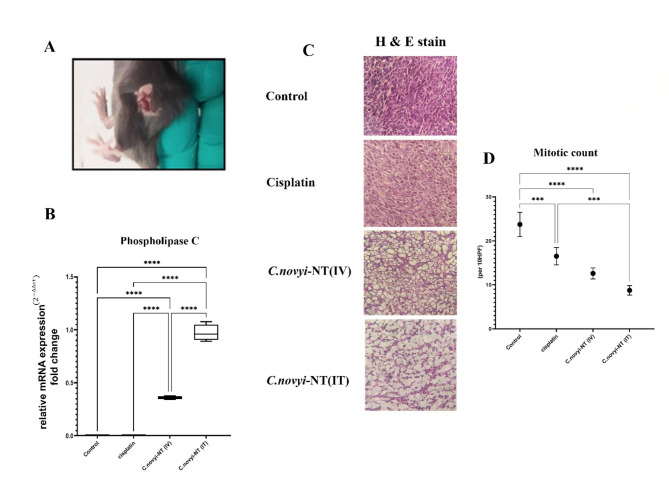
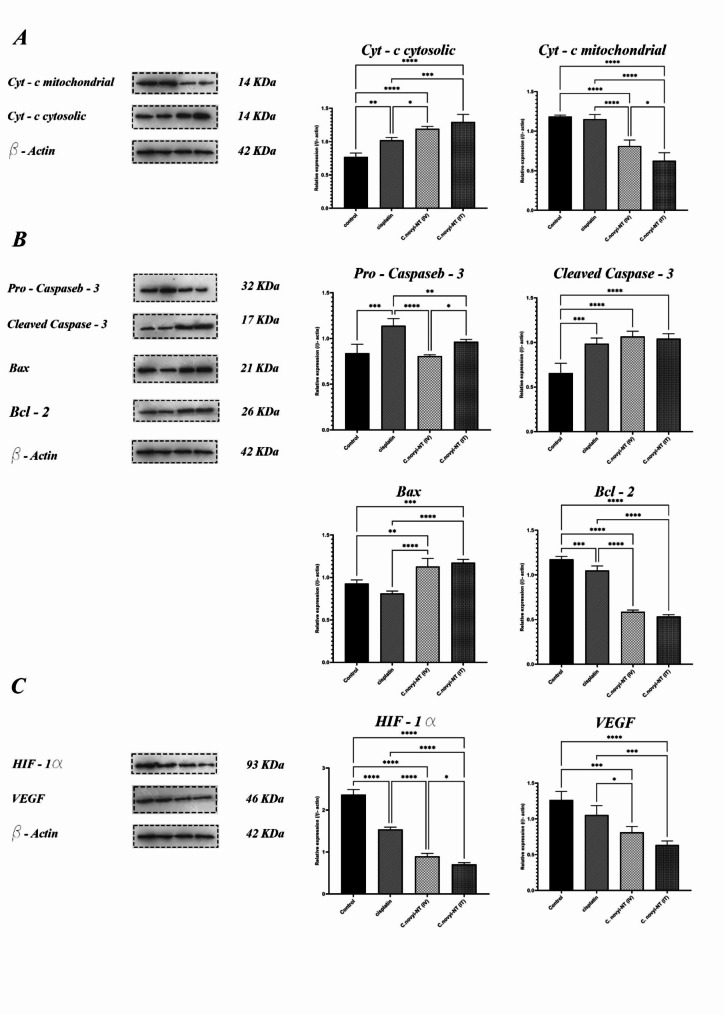
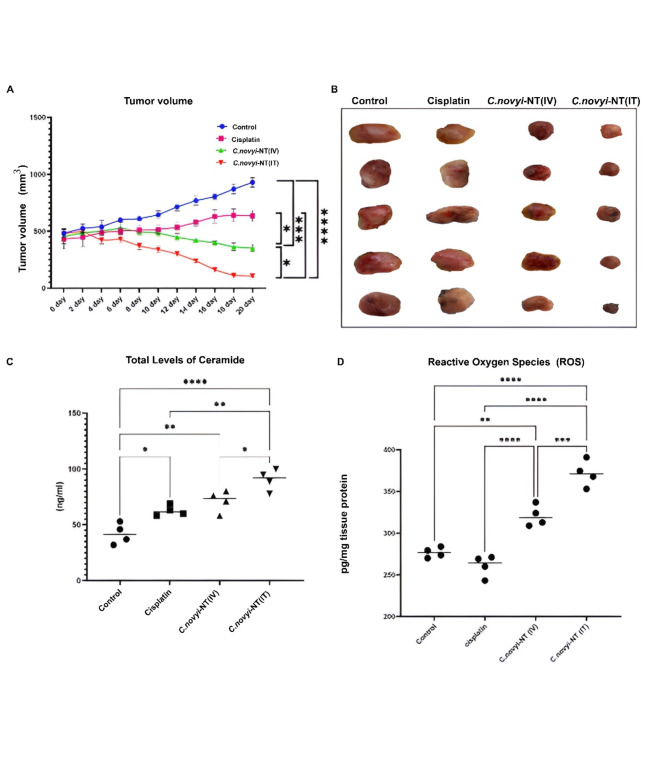
The transplantation procedure involved injecting TC-1 cells, capable of expressing HPV-16 E6/7 oncoproteins, into the subcutaneous layer of 6-8-week-old female C57/BL6 mice. The TC-1 cell line, was subcutaneously transplanted into 6-8-week-old female C57/BL6 mice. The tumor-bearing mice were randomly divided into 4 groups, and after selecting the control group, they were treated with different methods. Group 1- control without treatment (0.1 ml sterile PBS intratumor) Group 2- received cisplatin intraperitoneally (10 mg/kg) Group 3- received 10Clostridium novyi-NT spores systemically through the tail vein Group 4-tumor mice received 10Clostridium novyi-NT spores intratumorally. 20 days after the start of treatment, the mice were sacrificed and tumor tissues were isolated. In order to clarify the mechanism of the therapeutic effect with spores, the amount of ROS and ceramide was measured by ELISA technique, and the expression level of cytochrome c, cleaved caspase- 3, Bax, Bcl-2, HIF-1α, and VEGF proteins was measured by western blotting.
Our results clearly showed that the injection of Clostridium novyi-NT spores (either intratumorally or intravenously) causes the regression of mouse cervical tumors. Spore germination induces internal apoptosis in cancer cells by inducing ROS production and increasing total cell ceramide, releasing cytochrome c and damaging mitochondria. Additionally, the results provided clear evidence of a significant decrease in the expression of HIF-1 alpha and VEGF proteins among the tumor groups that received spores, when compared to both the cisplatin-treated group and the control group.
The study's outcomes demonstrated that the introduction of Clostridium novyi-NT spores triggered apoptosis in cervical cancer cells (derived from the TC-1 cell line) via the mitochondrial pathway, subsequently resulting in tumor regression in a mouse model.
确切观察发现,宫颈实体瘤存在缺氧区域,其中氧浓度降至1.5%以下。缺氧对宿主免疫系统产生负面影响,并显著降低包括放疗和化疗在内的多种治疗方法的疗效。利用诺维氏梭菌-NT溶瘤孢子靶向实体瘤的缺氧区域已成为一种值得关注的治疗策略。
移植过程包括将能够表达HPV-16 E6/7癌蛋白的TC-1细胞注射到6-8周龄雌性C57/BL6小鼠的皮下层。将TC-1细胞系皮下移植到6-8周龄雌性C57/BL6小鼠体内。将荷瘤小鼠随机分为4组,选定对照组后,采用不同方法进行处理。第1组-未处理对照组(瘤内注射0.1 ml无菌PBS);第2组-腹腔注射顺铂(10 mg/kg);第3组-通过尾静脉全身注射10个诺维氏梭菌-NT孢子;第4组-荷瘤小鼠瘤内注射10个诺维氏梭菌-NT孢子。治疗开始20天后,处死小鼠并分离肿瘤组织。为阐明孢子治疗效果的机制,采用ELISA技术检测ROS和神经酰胺的含量,采用蛋白质印迹法检测细胞色素c、裂解的半胱天冬酶-3、Bax、Bcl-2、HIF-1α和VEGF蛋白的表达水平。
我们的结果清楚地表明,注射诺维氏梭菌-NT孢子(瘤内或静脉注射)可导致小鼠宫颈肿瘤消退。孢子萌发通过诱导ROS产生和增加细胞总神经酰胺诱导癌细胞内凋亡,释放细胞色素c并损伤线粒体。此外,结果提供了明确证据,与顺铂治疗组和对照组相比,接受孢子治疗的肿瘤组中HIF-1α和VEGF蛋白的表达显著降低。
该研究结果表明,引入诺维氏梭菌-NT孢子通过线粒体途径触发宫颈癌细胞(源自TC-1细胞系)凋亡,随后在小鼠模型中导致肿瘤消退。