Park Dae Jin, Joo Young Bin, Nam Eunwoo, Lee Jiyoung, Bang So-Young, Lee Hye-Soon, Bae Sang-Cheol
Department of Rheumatology, Hanyang University Hospital for Rheumatic Diseases, 222-1 Wangsimni-ro, Seongdong-Gu, Seoul, 04763, Korea.
Hanyang University Institute for Rheumatology Research and Hanyang Institute of Bioscience and Biotechnology, Seoul, Korea.
Sci Rep. 2024 Dec 28;14(1):31422. doi: 10.1038/s41598-024-83057-4.
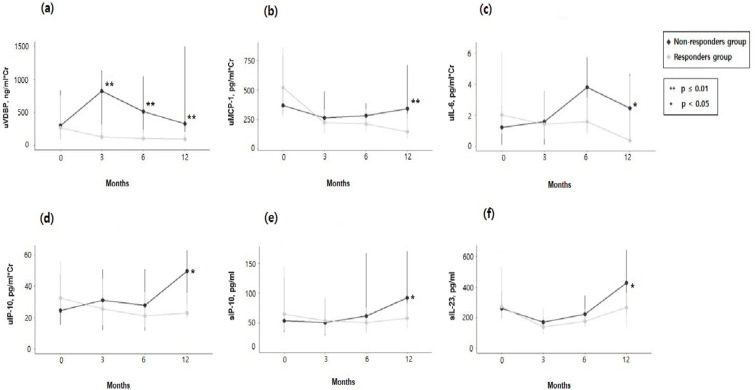
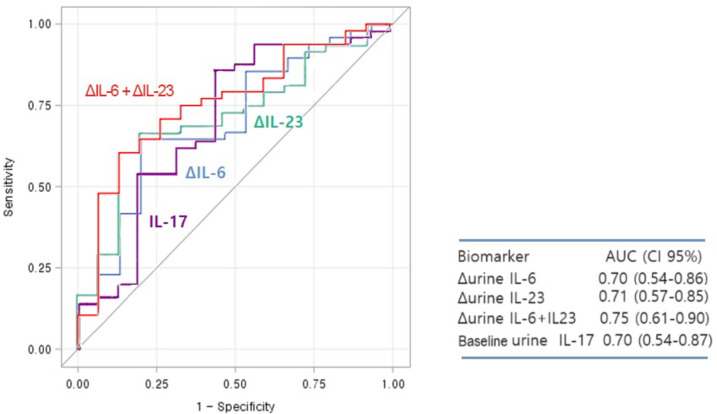
Limited knowledge exists regarding biomarkers that predict treatment response in Lupus nephritis (LN). We aimed to identify potential molecular biomarkers to predict treatment response in patients with LN. We enrolled 66 patients with active LN who underwent renal biopsy upon enrollment. Serum and urine samples were collected longitudinally, and we measured 12 biomarkers in each sample using a multiplex immunofluorescence assay. These biomarkers included monocyte chemoattractant protein-1 (MCP-1), interferon gamma-induced protein 10 (IP-10), interferon-γ (IFN-γ), interleukin 6 (IL-6), interleukin 16 (IL-16), interleukin 17 (IL-17), interleukin 23 (IL-23), tumor necrosis factor receptor II (TNF-RII), vascular cell adhesion molecule 1 (VCAM-1), retinol-binding protein 4 (RBP 4), vitamin D binding protein (VDBP), and neutrophil gelatinase-associated lipocalin (NGAL). Patients were categorized into two groups based on their 1-year treatment response to Mycophenolate mofetil (MMF)-based therapy: 50 responders and 16 non-responders. Only urine IL-17 (uIL-17) showed baseline level differences between the two groups, with higher in responders. In ROC curve analyses assessing the predictive performance of biomarkers, baseline uIL-17 and changes in uIL-6 and uIL-23 levels at 3 months could predict the 1-year treatment response, showing AUC values of 0.70 (95% CI 0.54-0.87), 0.70 (0.54-0.86), and 0.71 (0.57-0.85), respectively. Combining uIL-6 and uIL-23 into a model improved predictability, achieving an AUC of 0.75 (0.61-0.90). Baseline uIL-17 levels and early changes in uIL-6 and uIL-23 could serve as potential biomarkers to predict 1-year treatment response in lupus nephritis patients receiving MMF-based therapy.
关于预测狼疮性肾炎(LN)治疗反应的生物标志物,目前所知有限。我们旨在识别预测LN患者治疗反应的潜在分子生物标志物。我们招募了66例活动性LN患者,这些患者在入组时接受了肾活检。纵向收集血清和尿液样本,并使用多重免疫荧光测定法在每个样本中测量12种生物标志物。这些生物标志物包括单核细胞趋化蛋白-1(MCP-1)、干扰素γ诱导蛋白10(IP-10)、干扰素-γ(IFN-γ)、白细胞介素6(IL-6)、白细胞介素16(IL-16)、白细胞介素17(IL-17)、白细胞介素23(IL-23)、肿瘤坏死因子受体II(TNF-RII)、血管细胞粘附分子1(VCAM-1)、视黄醇结合蛋白4(RBP 4)、维生素D结合蛋白(VDBP)和中性粒细胞明胶酶相关脂质运载蛋白(NGAL)。根据患者对霉酚酸酯(MMF)为基础的治疗的1年治疗反应,将患者分为两组:50例反应者和16例无反应者。只有尿液白细胞介素17(uIL-17)在两组之间显示出基线水平差异,反应者中更高。在评估生物标志物预测性能的ROC曲线分析中,基线uIL-17以及3个月时uIL-6和uIL-23水平的变化可以预测1年治疗反应,AUC值分别为0.70(95%CI 0.54-0.87)、0.70(0.54-0.86)和0.71(0.57-0.85)。将uIL-6和uIL-23纳入一个模型可提高预测能力,AUC达到0.75(0.61-0.90)。基线uIL-17水平以及uIL-6和uIL-23的早期变化可作为预测接受MMF为基础治疗的狼疮性肾炎患者1年治疗反应的潜在生物标志物。