Yiangou Kristia, Mavaddat Nasim, Dennis Joe, Zanti Maria, Wang Qin, Bolla Manjeet K, Abubakar Mustapha, Ahearn Thomas U, Andrulis Irene L, Anton-Culver Hoda, Antonenkova Natalia N, Arndt Volker, Aronson Kristan J, Augustinsson Annelie, Baten Adinda, Behrens Sabine, Bermisheva Marina, de Gonzalez Amy Berrington, Białkowska Katarzyna, Boddicker Nicholas, Bodelon Clara, Bogdanova Natalia V, Bojesen Stig E, Brantley Kristen D, Brauch Hiltrud, Brenner Hermann, Camp Nicola J, Canzian Federico, Castelao Jose E, Cessna Melissa H, Chang-Claude Jenny, Chenevix-Trench Georgia, Chung Wendy K, Colonna Sarah V, Couch Fergus J, Cox Angela, Cross Simon S, Czene Kamila, Daly Mary B, Devilee Peter, Dörk Thilo, Dunning Alison M, Eccles Diana M, Eliassen A Heather, Engel Christoph, Eriksson Mikael, Evans D Gareth, Fasching Peter A, Fletcher Olivia, Flyger Henrik, Fritschi Lin, Gago-Dominguez Manuela, Gentry-Maharaj Aleksandra, González-Neira Anna, Guénel Pascal, Hahnen Eric, Haiman Christopher A, Hamann Ute, Hartikainen Jaana M, Ho Vikki, Hodge James, Hollestelle Antoinette, Honisch Ellen, Hooning Maartje J, Hoppe Reiner, Hopper John L, Howell Sacha, Howell Anthony, Jakovchevska Simona, Jakubowska Anna, Jernström Helena, Johnson Nichola, Kaaks Rudolf, Khusnutdinova Elza K, Kitahara Cari M, Koutros Stella, Kristensen Vessela N, Lacey James V, Lambrechts Diether, Lejbkowicz Flavio, Lindblom Annika, Lush Michael, Mannermaa Arto, Mavroudis Dimitrios, Menon Usha, Murphy Rachel A, Nevanlinna Heli, Obi Nadia, Offit Kenneth, Park-Simon Tjoung-Won, Patel Alpa V, Peng Cheng, Peterlongo Paolo, Pita Guillermo, Plaseska-Karanfilska Dijana, Pylkäs Katri, Radice Paolo, Rashid Muhammad U, Rennert Gad, Roberts Eleanor, Rodriguez Juan, Romero Atocha, Rosenberg Efraim H, Saloustros Emmanouil, Sandler Dale P, Sawyer Elinor J, Schmutzler Rita K, Scott Christopher G, Shu Xiao-Ou, Southey Melissa C, Stone Jennifer, Taylor Jack A, Teras Lauren R, van de Beek Irma, Willett Walter, Winqvist Robert, Zheng Wei, Vachon Celine M, Schmidt Marjanka K, Hall Per, MacInnis Robert J, Milne Roger L, Pharoah Paul D P, Simard Jacques, Antoniou Antonis C, Easton Douglas F, Michailidou Kyriaki
Biostatistics Unit, The Cyprus Institute of Neurology and Genetics, 6 Iroon Avenue, 2371 Ayios Dometios, Nicosia, Cyprus.
Department of Public Health and Primary Care, Centre for Cancer Genetic Epidemiology, University of Cambridge, Cambridge, UK.
Breast Cancer Res. 2024 Dec 29;26(1):189. doi: 10.1186/s13058-024-01947-x.
The 313-variant polygenic risk score (PRS) provides a promising tool for clinical breast cancer risk prediction. However, evaluation of the PRS across different European populations which could influence risk estimation has not been performed.
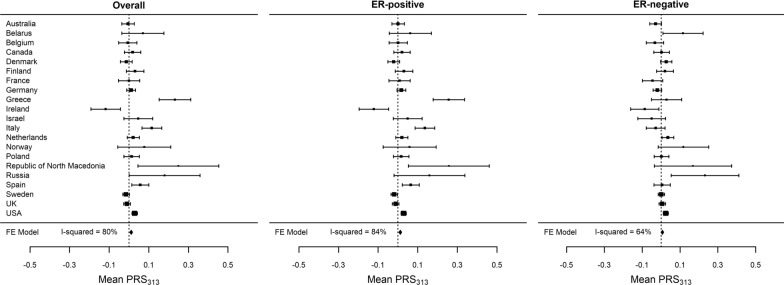
We explored the distribution of PRS across European populations using genotype data from 94,072 females without breast cancer diagnosis, of European-ancestry from 21 countries participating in the Breast Cancer Association Consortium (BCAC) and 223,316 females without breast cancer diagnosis from the UK Biobank. The mean PRS was calculated by country in the BCAC dataset and by country of birth in the UK Biobank. We explored different approaches to reduce the observed heterogeneity in the mean PRS across the countries, and investigated the implications of the distribution variability in risk prediction.
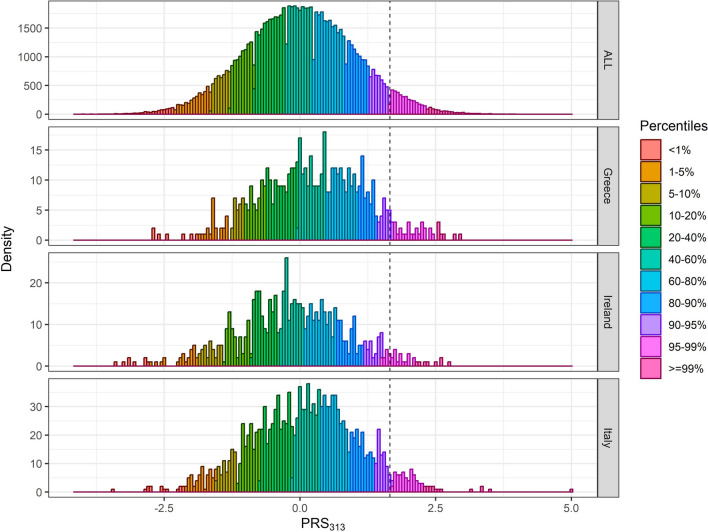
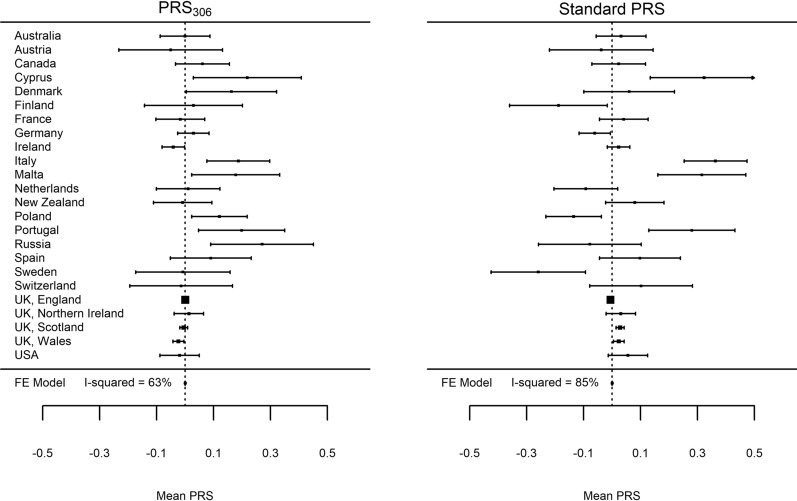
The mean PRS differed markedly across European countries, being highest in individuals from Greece and Italy and lowest in individuals from Ireland. Using the overall European PRS distribution to define risk categories, leads to overestimation and underestimation of risk in some individuals from these countries. Adjustment for principal components explained most of the observed heterogeneity in the mean PRS. The mean estimates derived when using an empirical Bayes approach were similar to the predicted means after principal component adjustment.
Our results demonstrate that PRS distribution differs even within European ancestry populations leading to underestimation or overestimation of risk in specific European countries, which could potentially influence clinical management of some individuals if is not appropriately accounted for. Population-specific PRS distributions may be used in breast cancer risk estimation to ensure predicted risks are correctly calibrated across risk categories.
313 变异多基因风险评分(PRS)为临床乳腺癌风险预测提供了一个有前景的工具。然而,尚未对可能影响风险估计的不同欧洲人群的 PRS 进行评估。
我们利用来自参与乳腺癌协会联盟(BCAC)的 21 个国家的 94,072 名无乳腺癌诊断的欧洲血统女性的基因型数据,以及来自英国生物银行的 223,316 名无乳腺癌诊断的女性的数据,探索了欧洲人群中 PRS 的分布。在 BCAC 数据集中按国家计算平均 PRS,在英国生物银行中按出生国家计算平均 PRS。我们探索了不同方法来减少各国平均 PRS 中观察到的异质性,并研究了风险预测中分布变异性的影响。
欧洲各国的平均 PRS 差异显著,希腊和意大利个体的 PRS 最高,爱尔兰个体的 PRS 最低。使用整个欧洲 PRS 分布来定义风险类别,会导致这些国家一些个体的风险被高估或低估。对主成分进行调整解释了平均 PRS 中观察到的大部分异质性。使用经验贝叶斯方法得出的平均估计值与主成分调整后的预测均值相似。
我们的结果表明,即使在欧洲血统人群中,PRS 分布也存在差异,导致特定欧洲国家的风险被低估或高估,如果不适当考虑,这可能会潜在地影响一些个体的临床管理。特定人群的 PRS 分布可用于乳腺癌风险估计,以确保跨风险类别正确校准预测风险。