Marshall Anne, Burgess Jamie, Goebel Andreas, Frank Bernhard, Alam Uazman, Marshall Andrew
Pain Research Institute, Institute of Life Course and Medical Sciences, University of Liverpool, Liverpool, United Kingdom.
University Hospital Aintree, Liverpool University Hospitals NHS Foundation Trust, Liverpool, United Kingdom.
Pain Rep. 2024 Dec 26;10(1):e1236. doi: 10.1097/PR9.0000000000001236. eCollection 2025 Feb.
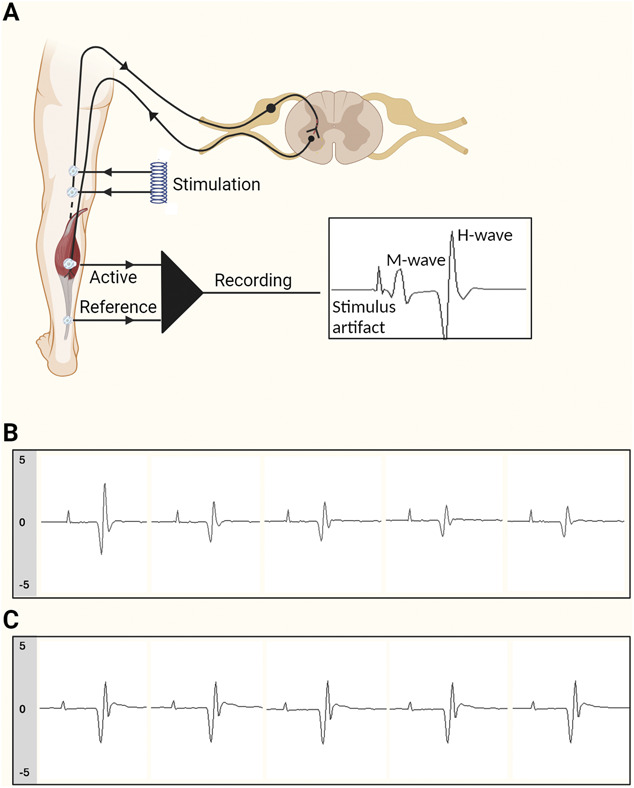
Pain phenomenology in patients with fibromyalgia syndrome (FMS) shows considerable overlap with neuropathic pain. Altered neural processing leading to symptoms of neuropathic pain can occur at the level of the spinal cord, and 1 potential mechanism is spinal disinhibition. A biomarker of spinal disinhibition is impaired H-reflex rate-dependent depression (HRDD).
This study investigated whether patients with FMS exhibit evidence of spinal disinhibition.
Thirty-one individuals with FMS and 20 healthy volunteers underwent testing of Hoffman reflex including HRDD, along with assessment of clinical signs and symptoms, pressure pain thresholds, temporal summation of pain (wind-up), and conditioned pain modulation (CPM). Small nerve fibre structure was quantified using intraepidermal nerve fibre density and corneal confocal microscopy.
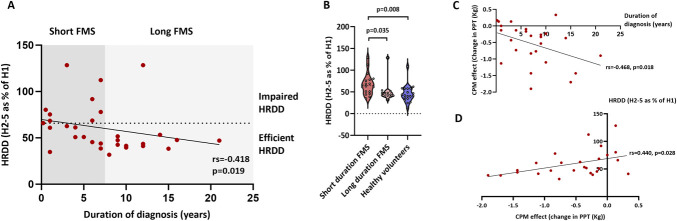
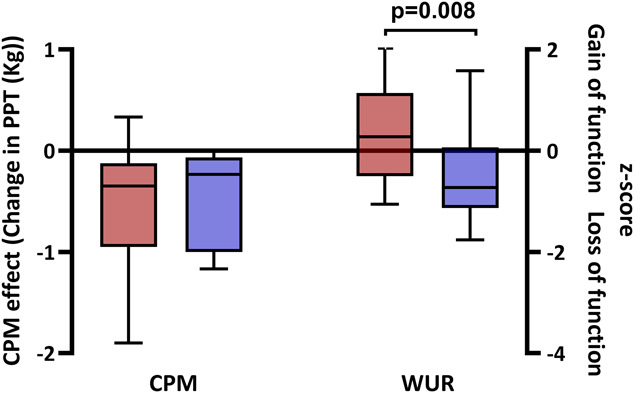
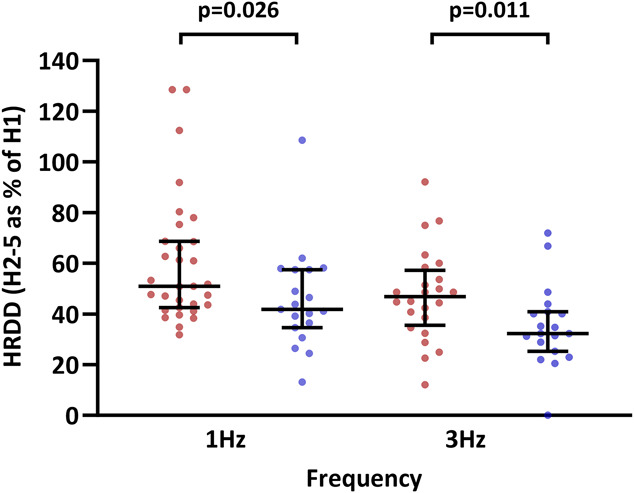
Patients with FMS had significantly impaired HRDD at 1 Hz ( = 0.026) and 3 Hz ( = 0.011) and greater wind-up ratio ( = 0.008) compared with healthy controls. Patients with the most impaired HRDD also had the most inefficient CPM but HRDD was not associated with wind-up. Both HRDD and CPM were most impaired in patients with a shorter duration of disease.
We demonstrate for the first time that people with FMS show evidence of spinal disinhibition, which is most dominant in shorter duration of disease and may represent a putative mechanism of pain generation in FMS. Identifying people with impairment of central pain processing at an early stage may provide opportunities for targeted mechanistically directed interventions. Longitudinal studies are warranted to tease out the precise contribution of these mechanisms.
纤维肌痛综合征(FMS)患者的疼痛现象学与神经性疼痛有相当大的重叠。导致神经性疼痛症状的神经加工改变可发生在脊髓水平,一种潜在机制是脊髓去抑制。脊髓去抑制的一个生物标志物是H反射率依赖性抑制受损(HRDD)。
本研究调查FMS患者是否表现出脊髓去抑制的证据。
31名FMS患者和20名健康志愿者接受了包括HRDD在内的霍夫曼反射测试,同时评估了临床体征和症状、压痛阈值、疼痛的时间总和(wind-up)以及条件性疼痛调制(CPM)。使用表皮内神经纤维密度和角膜共聚焦显微镜对小神经纤维结构进行量化。
与健康对照组相比,FMS患者在1Hz(P = 0.026)和3Hz(P = 0.011)时HRDD显著受损,且wind-up比率更高(P = 0.008)。HRDD受损最严重的患者CPM效率也最低,但HRDD与wind-up无关。HRDD和CPM在病程较短的患者中受损最严重。
我们首次证明FMS患者表现出脊髓去抑制的证据,这在病程较短时最为明显,可能代表FMS疼痛产生的一种假定机制。早期识别中枢性疼痛加工受损的患者可能为有针对性的机制导向干预提供机会。有必要进行纵向研究以明确这些机制的确切作用。