Zhang Wenlan, Tang Hongmei, Yan Yaping, Ma Jiachen, Ferro Letícia M M, Merces Leandro, Karnaushenko Dmitriy D, Karnaushenko Daniil, Schmidt Oliver G, Zhu Minshen
Research Center for Materials, Architectures and Integration of Nanomembranes (MAIN), Chemnitz University of Technology, 09107 Chemnitz, Germany.
Material Systems for Nanoelectronics, TU Chemnitz, 09107 Chemnitz, Germany.
ACS Appl Energy Mater. 2024 May 31;7(24):11256-11268. doi: 10.1021/acsaem.4c00702. eCollection 2024 Dec 23.
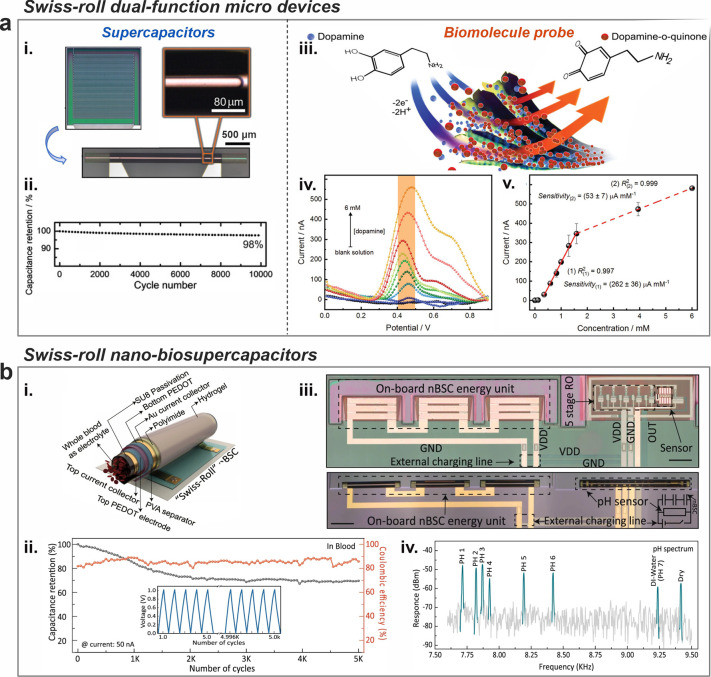
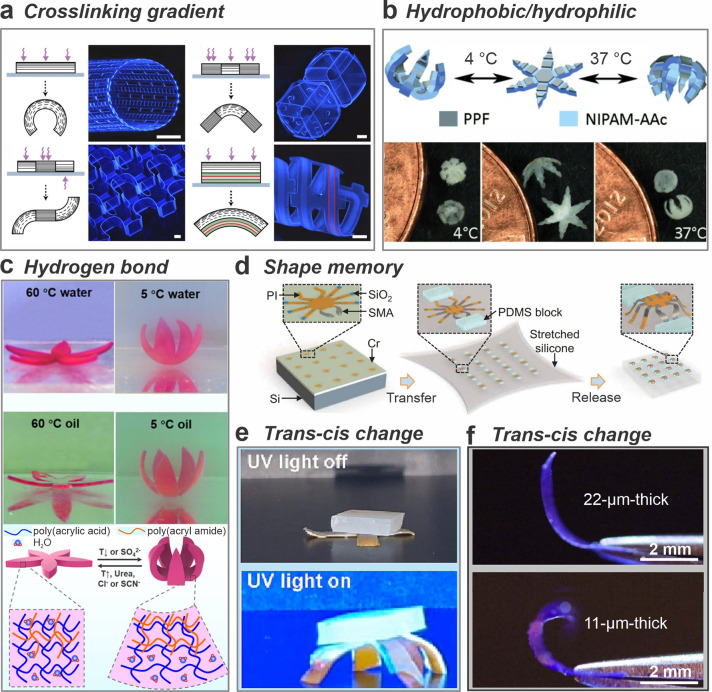
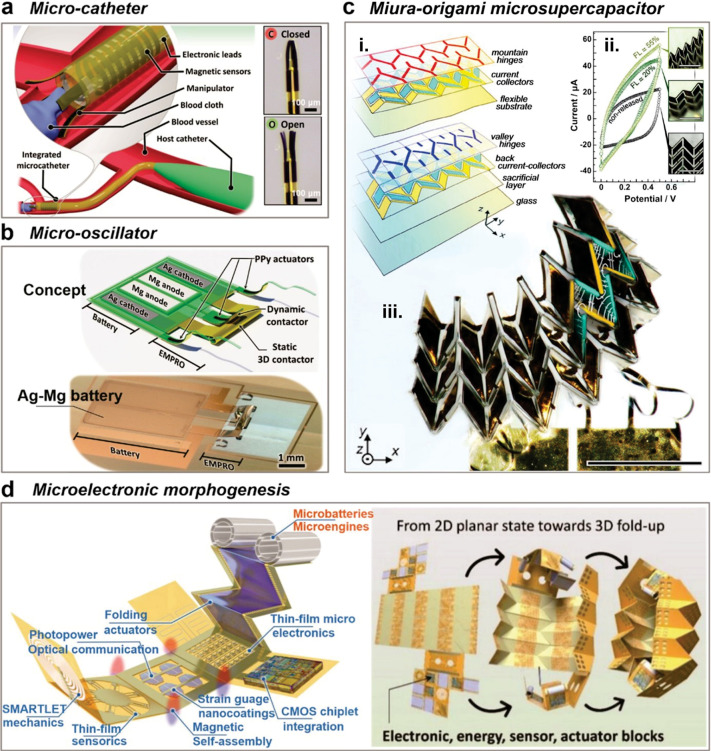
Transforming thin films into high-order stacks has proven effective for robust energy storage in macroscopic configurations like cylindrical, prismatic, and pouch cells. However, the lack of tools at the submillimeter scales has hindered the creation of similar high-order stacks for micro- and nanoscale energy storage devices, a critical step toward autonomous intelligent microsystems. This Spotlight on Applications article presents recent advancements in micro-origami technology, focusing on shaping nano/micrometer-thick films into three-dimensional architectures to achieve folded or rolled structures for microscale energy storage devices. Micro-Swiss-rolls, created through a roll-up process actuated by inherent strain in multiple layer stacks, have been employed to develop on-chip microbatteries and microsupercapacitors with superior performance compared to their planar counterparts. The technology allows additional functionalities to be integrated into the same device using multifunctional materials. Despite significant progress, the key challenge for micro-origami technology in creating microscale energy storage devices lies in diversifying shape-morphing mechanisms to expand material choices, improve process reliability, and enhance reproducibility. Additionally, developing a universal microscale energy storage device that can cater to various tiny devices is intricate. Therefore, considering the integration of energy storage into final applications during the development phase is crucial. Micro-origami energy storage systems are poised to significantly impact the future of autonomous tiny devices, such as smart dust and microrobots.
事实证明,将薄膜转变为高阶堆叠结构对于圆柱、棱柱和软包电池等宏观结构中的稳健能量存储是有效的。然而,亚毫米尺度工具的缺乏阻碍了为微纳尺度能量存储设备创建类似的高阶堆叠结构,而这是迈向自主智能微系统的关键一步。这篇应用聚焦文章介绍了微折纸技术的最新进展,重点是将纳米/微米厚的薄膜塑造成三维结构,以实现用于微尺度能量存储设备的折叠或卷曲结构。通过多层堆叠中固有应变驱动的卷绕过程制造的微瑞士卷,已被用于开发片上微电池和微超级电容器,与平面同类产品相比,它们具有卓越的性能。该技术允许使用多功能材料将额外功能集成到同一设备中。尽管取得了重大进展,但微折纸技术在创建微尺度能量存储设备方面的关键挑战在于使形状变形机制多样化,以扩大材料选择范围、提高工艺可靠性并增强可重复性。此外,开发一种能满足各种微小设备需求的通用微尺度能量存储设备非常复杂。因此,在开发阶段考虑将能量存储集成到最终应用中至关重要。微折纸能量存储系统有望对自主微小设备的未来产生重大影响,如智能尘埃和微型机器人。