Tan Tinghong, Peng Yu, An Biling, Gao Fan, Sun Yanni, Yang Chuandong, Yang Hong, Lu Zhihong
School of Agriculture and Forestry Engineering and Planning, Tongren University, Tongren, China.
Guizhou Key Laboratory of Biodiversity Conservation and Utilization in the Fanjing Mountain Region, Tongren University, Tongren, China.
PeerJ. 2024 Dec 24;12:e18768. doi: 10.7717/peerj.18768. eCollection 2024.
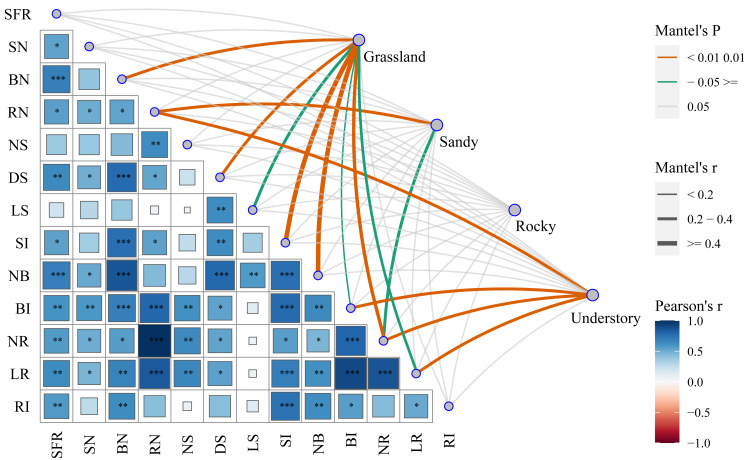
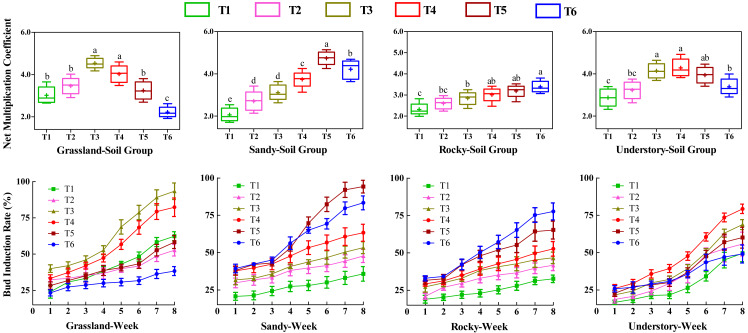
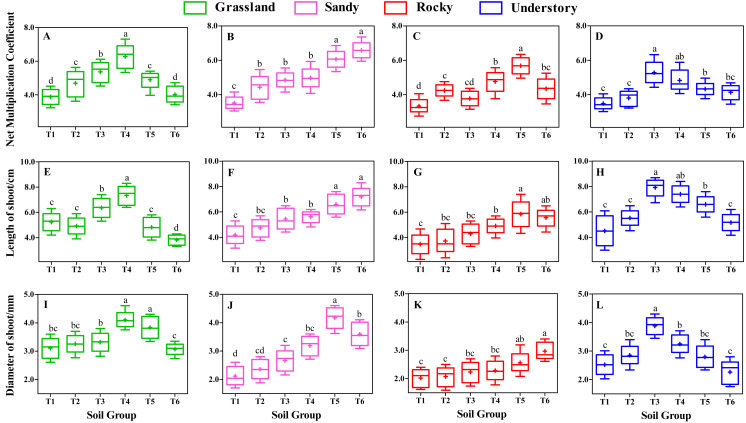
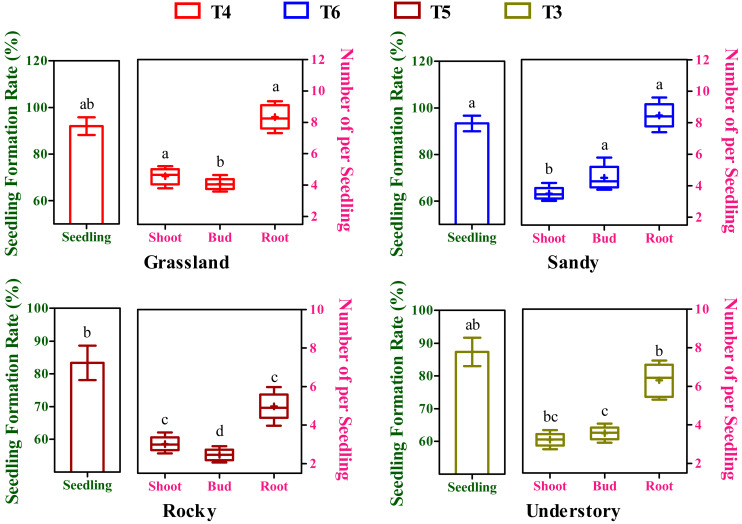
Bur., a versatile plant with medicinal, edible, landscaping, and ecological applications, holds significant economic value and boasts a long-standing history of utilization in China. Despite its robust adaptability, rapid growth, and extensive distribution, the current research gap concerning the physiological mechanisms underlying stem cutting propagation hampers the development of efficient strategies for commercial-scale propagation of , particularly for large-scale cultivation. To address this, we investigated the effects of habitat heterogeneity, physiological indicators, and environmental factors on the cutting propagation of . Stem segments were collected from grassland, sandy, rocky and understory habitats in the field and subjected to comprehensive analyses using a two-factor mixed experimental design and progressive group experiments. Our findings indicate that stem segments of with a length of 10 cm and a diameter of 0.5∼0.7 cm exhibited the highest shoot induction rate and total multiplication coefficient. Optimal results were achieved with a vertical burial depth of 5∼7 cm. Stem segments aged 2∼3 years produced the highest number of seedlings, and the most suitable propagation period for cuttings was from March to April. The best substrate-habitat combinations for overall seeding yield were grassland-T4 (loam: light substrate: humus = 2:1:1), sandy-T6 (loam: light substrate: humus = 2:3:1), rocky-T5 (loam: light substrate: humus = 2:2:1), understory-T3 (loam: light substrate: humus = 1:1:1), respectively. Mantel test analyses revealed that the ability of cuttings from different habitats to form adventitious roots (ARs) largely determined the functional traits associated with cutting propagation. Overall, our results suggest that stem segment from grassland habitat are the most suitable for cutting propagation, with a loam: light substrate: humus ratio of 2:1:1 being the most favorable substrate. In contrast, from rocky habitat is not suitable for cutting propagation, particularly for large-scale seedling production.
bur.是一种具有药用、食用、景观美化和生态应用的多功能植物,在中国具有重要的经济价值,且有着悠久的利用历史。尽管它适应性强、生长迅速且分布广泛,但目前关于其扦插繁殖生理机制的研究空白阻碍了其商业化规模繁殖高效策略的发展,尤其是大规模种植方面。为解决这一问题,我们研究了生境异质性、生理指标和环境因素对bur.扦插繁殖的影响。从野外的草地、沙地、岩石地和林下生境采集茎段,并采用双因素混合实验设计和递进分组实验进行综合分析。我们的研究结果表明,长度为10厘米、直径为0.5至0.7厘米的bur.茎段表现出最高的芽诱导率和总增殖系数。垂直埋深5至7厘米可获得最佳结果。2至3年生的茎段产生的幼苗数量最多,最适合扦插繁殖的时期是3月至4月。总体播种产量最佳的基质-生境组合分别是草地-T4(壤土:轻质基质:腐殖质 = 2:1:1)、沙地-T6(壤土:轻质基质:腐殖质 = 2:3:1)、岩石地-T5(壤土:轻质基质:腐殖质 = 2:2:1)、林下-T3(壤土:轻质基质:腐殖质 = 1:1:1)。Mantel检验分析表明,来自不同生境的bur.插条形成不定根的能力在很大程度上决定了与扦插繁殖相关的功能性状。总体而言,我们的结果表明,草地生境的茎段最适合bur.扦插繁殖,壤土:轻质基质:腐殖质比例为2:1:1是最适宜的基质。相比之下,岩石地生境的bur.不适合扦插繁殖,尤其是大规模育苗生产。