Fernandes Dias Jose Diego, Vieira Douglas Henrique, Serghiou Theodoros, Rivas Carlos J, Constantino Carlos J L, Jimenez Liliana B, Alves Neri, Kettle Jeff
Department of Physics, School of Sciences and Technology, São Paulo State University (UNESP), Presidente Prudente 15385-000, São Paulo, Brazil.
James Watt School of Engineering, University of Glasgow, G12 8QQ Glasgow, Scotland, U.K.
ACS Appl Electron Mater. 2024 Nov 22;6(12):9142-9153. doi: 10.1021/acsaelm.4c01773. eCollection 2024 Dec 24.
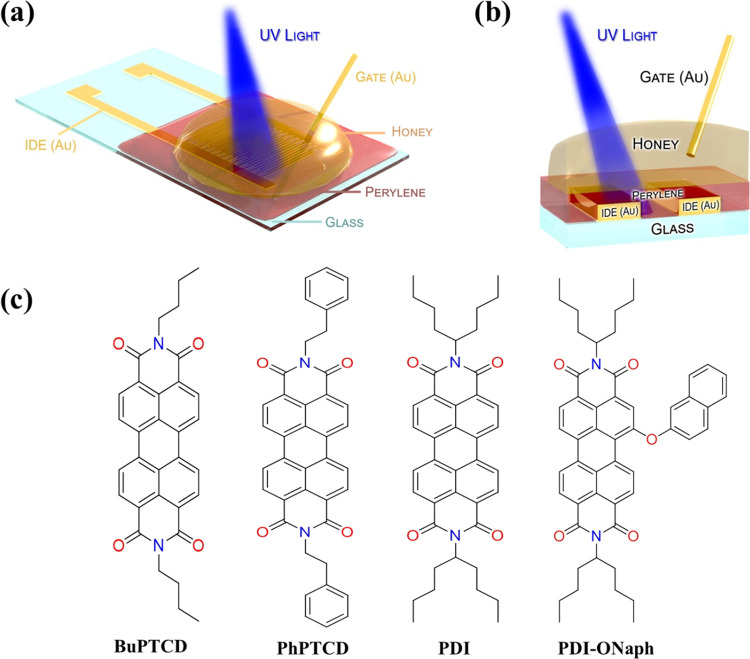
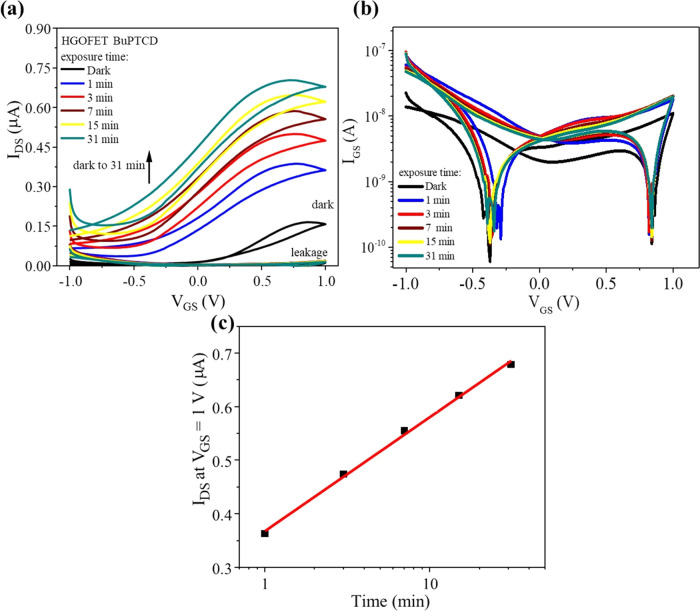
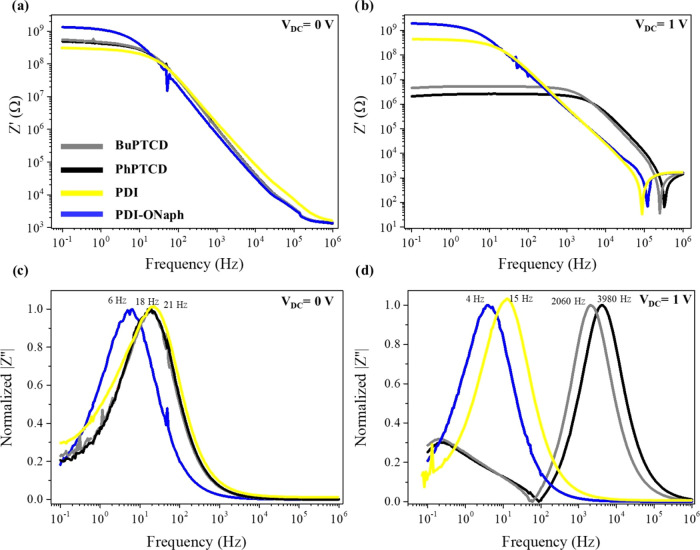
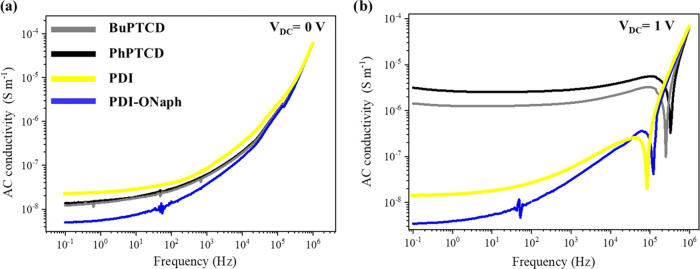
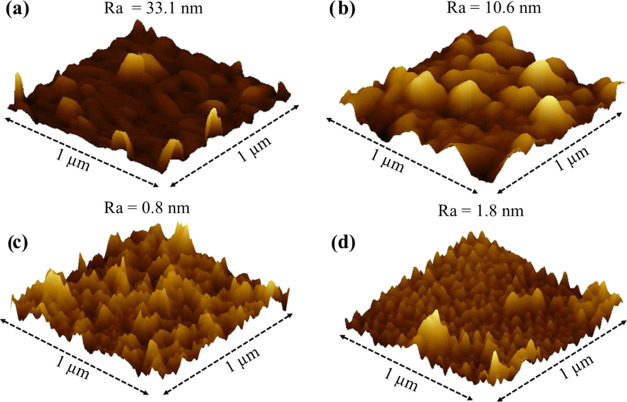
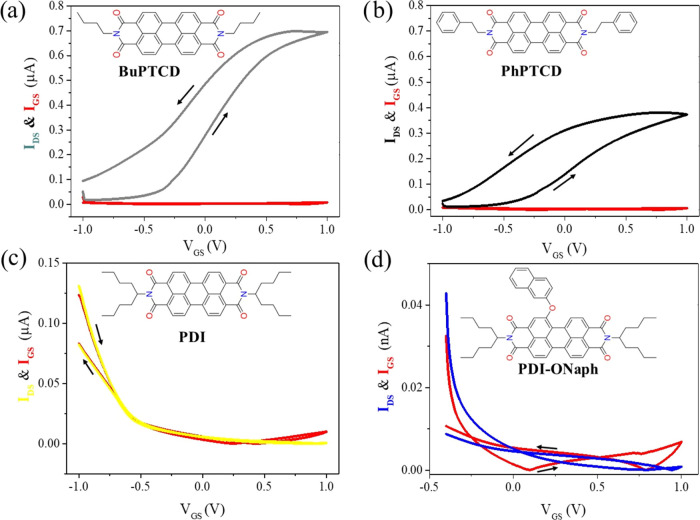
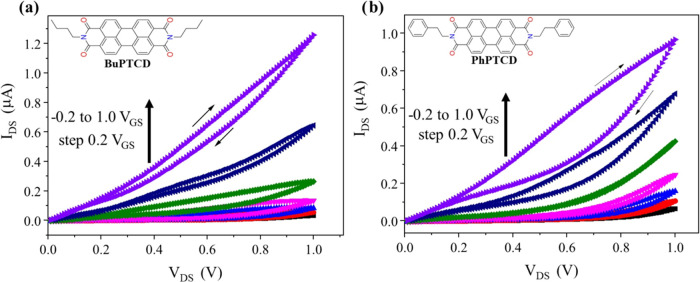
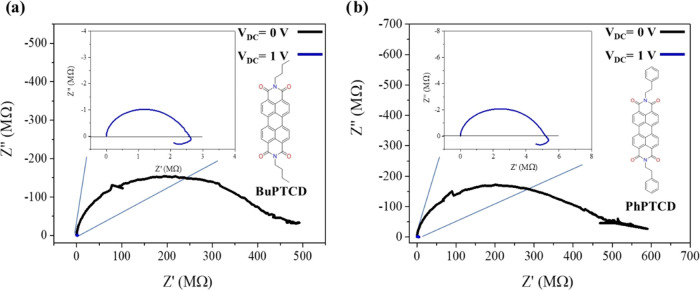
Electronics based on natural or degradable materials are a key requirement for next-generation devices, where sustainability, biodegradability, and resource efficiency are essential. In this context, optimizing the molecular chemical structure of organic semiconductor compounds (OSCs) used as active layers is crucial for enhancing the efficiency of these devices, making them competitive with conventional electronics. In this work, honey-gated organic field-effect transistors (HGOFETs) were fabricated using four different perylene derivative films as OSCs, and the impact of the chemical structure of these perylene derivatives on the performance of HGOFETs was investigated. HGOFETs were fabricated using naturally occurring or low-impact materials in an effort to produce sustainable systems that degrade into benign end products at the end of their life. It is shown that the second chain of four carbons at the imide position present in perylenes ,'-bis(5-nonyl)-perylene-3,4,9,10-bis(dicarboximide) (PDI) and ,'-bis(5-nonyl)-1-naphthoxyperylene-3,4,9,10-bis(dicarboximide) (PDI-ONaph) reduces π-stacking interaction in the active layer, leading to lower AC conductivity and the non-functionality of HGOFETs. On the other side, the chain-on molecular orientation in the film of ,'-dibutylperylen-3,4:9,10-bis(dicarboximide) (BuPTCD) was fundamental for the efficiency of HGOFETs, showing a better performance than the HGOFETs of ,'-bis(2-phenylethyl)-3,4:9,10-bis(dicarboximide) (PhPTCD), which has a face-on molecular orientation. Finally, the HGOFETs of BuPTCD and PhPTCD are good candidates as UV light detectors and are used for the detection of UV radiation.
基于天然或可降解材料的电子产品是下一代设备的关键需求,其中可持续性、生物可降解性和资源效率至关重要。在这种背景下,优化用作有源层的有机半导体化合物(OSC)的分子化学结构对于提高这些设备的效率至关重要,使其能够与传统电子产品竞争。在这项工作中,使用四种不同的苝衍生物薄膜作为OSC制造了蜂蜜门控有机场效应晶体管(HGOFET),并研究了这些苝衍生物的化学结构对HGOFET性能的影响。使用天然存在或低影响材料制造HGOFET,以努力生产可持续系统,这些系统在使用寿命结束时会降解为良性最终产品。结果表明,苝、'-双(5-壬基)-苝-3,4,9,10-双(二甲酰亚胺)(PDI)和、'-双(5-壬基)-1-萘氧基苝-3,4,9,10-双(二甲酰亚胺)(PDI-ONaph)中酰亚胺位置的四个碳的第二条链减少了有源层中的π堆积相互作用,导致较低的交流电导率和HGOFET的无功能性。另一方面,'-二丁基苝-3,4:9,10-双(二甲酰亚胺)(BuPTCD)薄膜中的链上分子取向对于HGOFET的效率至关重要,其性能优于具有面朝上分子取向的、'-双(2-苯乙基)-3,4:9,10-双(二甲酰亚胺)(PhPTCD)的HGOFET。最后,BuPTCD和PhPTCD的HGOFET是作为紫外光探测器的良好候选者,并用于检测紫外线辐射。