Wei Xiuwang, Liang Jianbo, Huang Huanwen, Yang Daming, Wang Xinxin, Wang Xiujia, Chen Changsheng, Li Kaiqiang, Pang Taisen, Hu Bin, Wu Fengning
Department of Urology, The People's Hospital of Guangxi Zhuang Autonomous Region, Nanning, 530000, China.
Department of Rehabilitation, The People's Hospital of Guangxi Zhuang Autonomous Region, Nanning, 530000, China.
Oncol Res. 2024 Dec 20;33(1):161-169. doi: 10.32604/or.2024.048054. eCollection 2025.
Transmembrane emp24 trafficking protein 3 (TMED3) is associated with the development of several tumors; however, whether TMED3 regulates the progression of prostate cancer remains unclear.
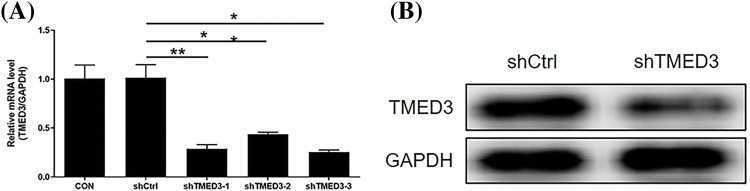
Short hairpin RNA was performed to repress TMED3 in prostate cancer cells (DU145 cells) and in a prostate cancer mice model to determine its function in prostate cancer and .
In the present study, we found that TMED3 was highly expressed in prostate cancer cells. , shTMED3 treatment suppressed the proliferation, invasion, and migration and promoted the apoptosis of DU145 cells. Additionally, the Kyoto Encyclopedia of Genes and Genomes pathway enrichment analysis showed a strong correlation between TMED3 and forkhead box O transcription factor (FOXO) pathway. Furthermore, TMED3 inhibition efficiently decreased FOXO1a and FOXO3a phosphorylation. , TMED3 downregulation suppressed the apoptosis, growth, and metastasis of prostate cancer cells via FOXO1a and FOXO3a.
The present findings show that TMED3 participates in the regulation of prostate cancer progression via FOXO1a and FOXO3a phosphorylation, thereby revealing a novel mechanism underlying prostate cancer development and suggesting that TMED3 inhibition may serve as a novel strategy for prostate cancer treatment.
跨膜emp24转运蛋白3(TMED3)与多种肿瘤的发生发展相关;然而,TMED3是否调节前列腺癌的进展仍不清楚。
采用短发夹RNA在前列腺癌细胞(DU145细胞)和前列腺癌小鼠模型中抑制TMED3,以确定其在前列腺癌中的作用。
在本研究中,我们发现TMED3在前列腺癌细胞中高表达。shTMED3处理抑制了DU145细胞的增殖、侵袭和迁移,并促进了其凋亡。此外,京都基因与基因组百科全书通路富集分析显示TMED3与叉头框O转录因子(FOXO)通路之间存在强相关性。此外,抑制TMED3可有效降低FOXO1a和FOXO3a的磷酸化水平。因此,TMED3的下调通过FOXO1a和FOXO3a抑制了前列腺癌细胞的凋亡、生长和转移。
本研究结果表明,TMED3通过FOXO1a和FOXO3a磷酸化参与前列腺癌进展的调控,从而揭示了前列腺癌发生发展的新机制,并提示抑制TMED3可能成为前列腺癌治疗的新策略。