Jiang Zexi, Zhu Jinhua, Ding Hong, Yan Lihong, Chen Ruoxin, Wang Bin, Li ZuoLin, Liu Hong
Institute of Nephrology, Zhongda Hospital, School of Medicine, Southeast University, Nanjing, China.
Institute of Nephrology, People's Hospital of Yangzhong City, Zhenjiang, Jiangsu, China.
Front Med (Lausanne). 2024 Dec 13;11:1478090. doi: 10.3389/fmed.2024.1478090. eCollection 2024.
This study investigated the association between coronary artery calcification (CAC) and triglyceride glucose-body mass index (TyG-BMI) in patients receiving maintenance hemodialysis (MHD).
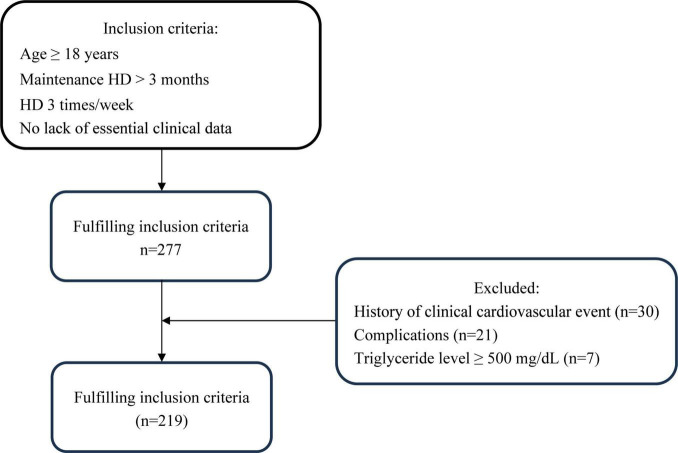
We used computed tomography (CT) to assess coronary artery calcification score (CACS) using the Agatston method. The TyG index was multiplied by BMI to derive the TyG-BMI index. Ordinal logistic regression models were used to analyze the relationship between TyG-BMI and CAC. The dose-response relationship was evaluated using restricted cubic spline regression. Weighted Quantile Sum regression was used to explore the weight of the TyG-BMI index components.
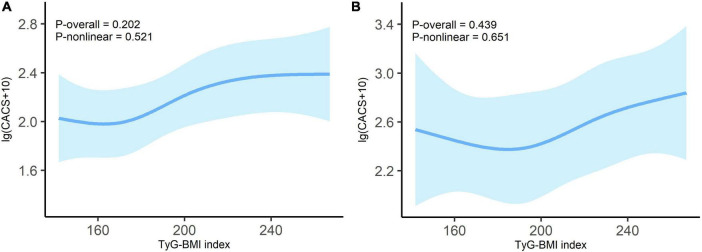
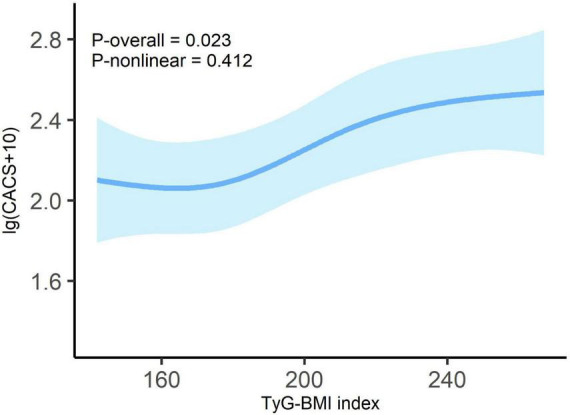
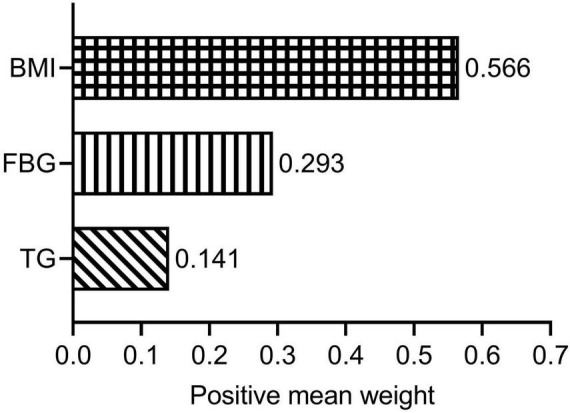
Based on the TyG-BMI, 219 patients with MHD were stratified into three groups. The TyG-BMI index was shown to be an independent risk factor for CACS by multivariate ordinal logistic regression analysis (odds ratio, 1.011; [95% confidence interval, 1.002-1.021]; = 0.021). The relationship between TyG-BMI and lg (CACS + 10) was linear (-overall = 0.023, -non-linear = 0.412). Body mass index (BMI) had the highest weight (0.566) when weights were assigned to the three components of TyG-BMI. In the non-diabetes and diabetes subgroups, TyG-BMI and lg (CACS + 10) did not exhibit a significant non-linear relationship.
TyG-BMI and CAC were independently positively correlated in patients undergoing MHD. These findings suggest that assessing TyG-BMI as a valuable tool for identifying the risk of CAC in patients with MHD.
本研究调查了维持性血液透析(MHD)患者冠状动脉钙化(CAC)与甘油三酯葡萄糖-体重指数(TyG-BMI)之间的关联。
我们使用计算机断层扫描(CT),采用阿加斯顿方法评估冠状动脉钙化评分(CACS)。将TyG指数乘以体重指数(BMI)得出TyG-BMI指数。采用有序逻辑回归模型分析TyG-BMI与CAC之间的关系。使用受限立方样条回归评估剂量反应关系。采用加权分位数和回归探索TyG-BMI指数各组成部分的权重。
根据TyG-BMI,将219例MHD患者分为三组。多变量有序逻辑回归分析显示,TyG-BMI指数是CACS的独立危险因素(比值比,1.011;[95%置信区间,1.002 - 1.021];P = 0.021)。TyG-BMI与lg(CACS + 10)之间的关系呈线性(线性 = 0.023,非线性 = 0.412)。在为TyG-BMI的三个组成部分赋予权重时,体重指数(BMI)的权重最高(0.566)。在非糖尿病和糖尿病亚组中,TyG-BMI与lg(CACS + 10)未表现出显著的非线性关系。
在接受MHD的患者中,TyG-BMI与CAC独立正相关。这些发现表明,评估TyG-BMI是识别MHD患者CAC风险的有价值工具。