Zhang Yanxia, Liu Yunduo, Zhang Mei, Li Guanjie, Zhu Siling, Xie Keping, Xiao Bin, Li Linhai
Department of Laboratory Medicine, The Sixth School of Clinical Medicine, The Affiliated Qingyuan Hospital (Qingyuan People's Hospital), Guangzhou Medical University, Qingyuan, China.
School of Medicine, The South China University of Technology, Guangzhou, China.
PPAR Res. 2024 Dec 21;2024:4164906. doi: 10.1155/ppar/4164906. eCollection 2024.
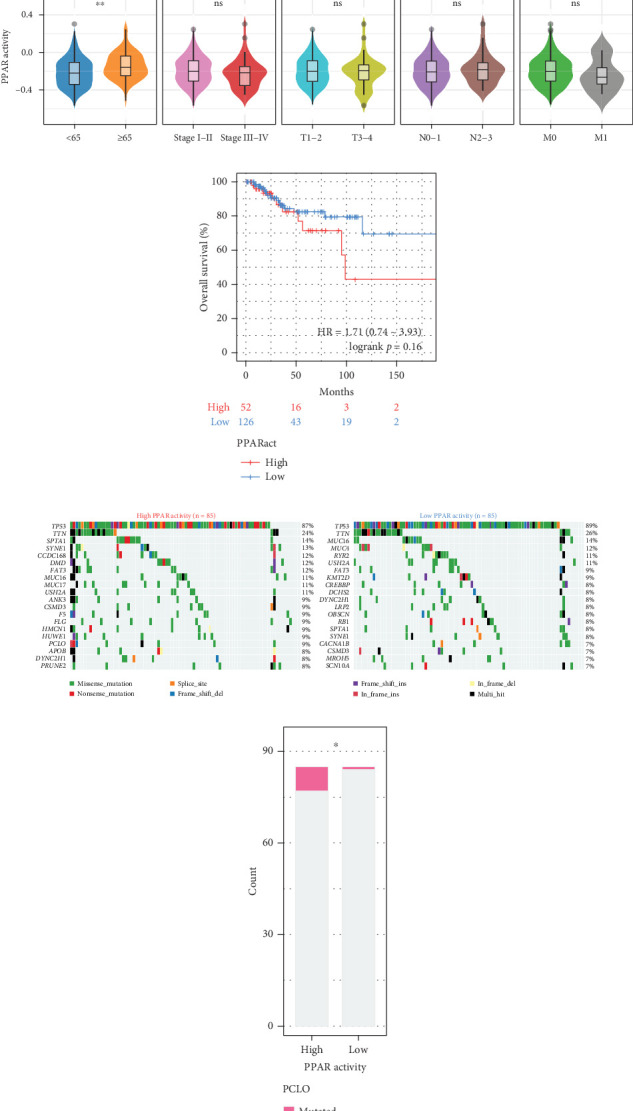
Triple-negative breast cancer (TNBC) is highly heterogeneous and poses a significant medical challenge due to limited treatment options and poor outcomes. Peroxisome proliferator-activated receptors (PPARs) play a crucial role in regulating metabolism and cell fate. While the association between PPAR signal and human cancers has been a topic of concern, its specific relationship with TNBC remains unclear. Integrated analysis of large published datasets from clinical cohorts and cell lines through databases has proven to be a powerful and essential approach for understanding cancer and uncovering new molecular targets. Here, we conducted a comprehensive study investigating the clinical relevance and drug modulation of the PPAR signaling pathway in TNBC, using data from The Cancer Genome Atlas (TCGA) for TNBC patients and Genomics of Drug Sensitivity in Cancer (GDSC) for TNBC cell lines, along with drug perturbation information from Connectivity Map (CMap). In the TCGA-TNBC cohort, higher PPAR signaling activity was not associated with clinical stage, prognosis, tumor mutational burden, microsatellite instability, homologous recombination deficiency, stemness, or proliferation status. However, it was linked to older age; an elevated rate of piccolo presynaptic cytomatrix protein (PCLO) mutations; and oncogenic signal transduction involving MAPK, Ras, and PI3K-Akt pathways. Additionally, it influenced biological pathways including fatty acid metabolism, AMPK signaling, and ferroptosis. Strikingly, higher PPAR activity appeared to promote the formation of an antitumor immune and microbial microenvironment. In the GDSC-TNBC cells, nevertheless, it seemed to incur chemoresistance. Furthermore, we identified a batch of potential compounds that can regulate the PPAR signaling pathway. Lastly, our experimental validation demonstrated the ability of the histone deacetylase (HDAC) inhibitor chidamide to activate the PPAR signal in TNBC cells. In conclusion, the PPAR signaling pathway likely has pleiotropic biological effects in TNBC. These preliminary but interesting findings enhance our understanding of the role played by PPAR signal and provide new insights into the heterogeneity driven by it in TNBC.
三阴性乳腺癌(TNBC)具有高度异质性,由于治疗选择有限且预后较差,构成了重大的医学挑战。过氧化物酶体增殖物激活受体(PPARs)在调节代谢和细胞命运方面发挥着关键作用。虽然PPAR信号与人类癌症之间的关联一直是人们关注的话题,但其与TNBC的具体关系仍不清楚。通过数据库对来自临床队列和细胞系的大量已发表数据集进行综合分析,已被证明是理解癌症和发现新分子靶点的有力且必要的方法。在此,我们进行了一项全面研究,利用来自癌症基因组图谱(TCGA)的TNBC患者数据、癌症药物敏感性基因组学(GDSC)的TNBC细胞系数据以及来自连接图谱(CMap)的药物干扰信息,研究TNBC中PPAR信号通路的临床相关性和药物调节作用。在TCGA - TNBC队列中,较高的PPAR信号活性与临床分期、预后、肿瘤突变负荷、微卫星不稳定性、同源重组缺陷、干性或增殖状态无关。然而,它与年龄较大、小突触前细胞基质蛋白(PCLO)突变率升高以及涉及MAPK、Ras和PI3K - Akt途径的致癌信号转导有关。此外,它还影响包括脂肪酸代谢、AMPK信号传导和铁死亡在内的生物学途径。引人注目的是,较高的PPAR活性似乎促进了抗肿瘤免疫和微生物微环境的形成。然而,在GDSC - TNBC细胞中,它似乎会导致化疗耐药。此外,我们鉴定出一批可以调节PPAR信号通路的潜在化合物。最后,我们的实验验证证明了组蛋白去乙酰化酶(HDAC)抑制剂西达本胺激活TNBC细胞中PPAR信号的能力。总之,PPAR信号通路可能在TNBC中具有多效性生物学效应。这些初步但有趣的发现加深了我们对PPAR信号所起作用的理解,并为其在TNBC中驱动的异质性提供了新的见解。