Kumar Anoop, Jayawardena Dulari, Priyamvada Shubha, Anbazhagan Arivarasu N, Chatterjee Ishita, Saksena Seema, Dudeja Pradeep K
Division of Gastroenterology and Hepatology, Department of Medicine, University of Illinois Chicago, Chicago, Illinois; Jesse Brown VA Medical Center, Chicago, Illinois.
Division of Gastroenterology and Hepatology, Department of Medicine, University of Illinois Chicago, Chicago, Illinois.
Cell Mol Gastroenterol Hepatol. 2025;19(6):101452. doi: 10.1016/j.jcmgh.2024.101452. Epub 2024 Dec 28.
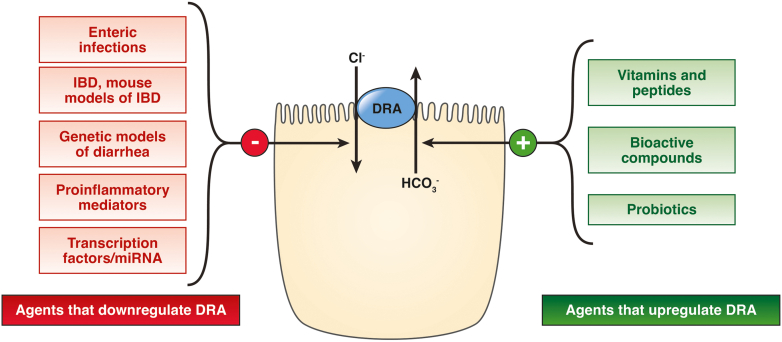
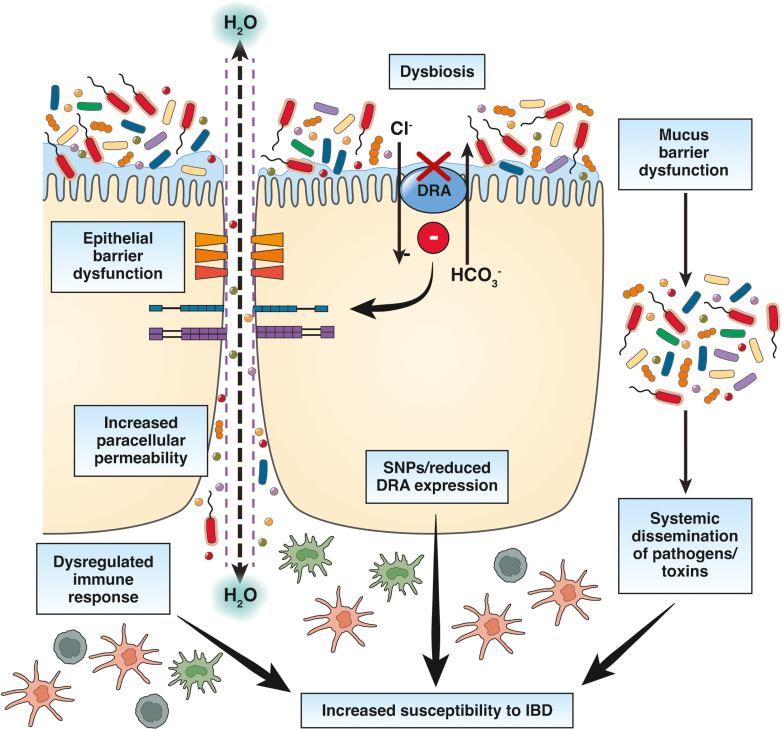
Diarrhea associated with enteric infections, gut inflammation, and genetic defects poses a major health burden and results in significant morbidity and mortality. Impaired fluid and electrolyte absorption or secretion in the intestine are the hallmark of diarrhea. Electroneutral NaCl absorption in the mammalian GI tract involves the coupling of Na/H and Cl/HCO exchangers. SLC26A3 (Down Regulated in Adenoma, DRA) is the major anion exchanger involved in luminal Cl absorption and HCO secretion. Mutations in the SLC26A3 gene cause a severe disease called congenital chloride diarrhea (CLD). Multiple studies have shown that DRA function or expression is downregulated in infectious diarrheal disorders caused by EPEC, C rodentium, Salmonella, Clostridioides difficile and Cryptosporidium parvum infection. In addition, DRA levels are severely depleted in colonic mucosa of IBD patients and in mouse models of IBD (eg, DSS, TNBS, adoptive T-cell transfer, anti-CD-40, and IL-10 KO colitis). In addition, genetic defects exhibiting diarrhea including microvillus inclusion disease (MVID), keratin-8 depletion, knock-out mouse models of transcriptional factors (eg, CDX-2 and HNF1α/1β) also exhibit severe down regulation of DRA. Also, recent studies have shown that DRA is not only critical for chloride absorption but also plays a key role in maintaining gut epithelial barrier integrity, microbiome composition, and has now emerged as an IBD susceptibility gene. In this review, we provide strong evidence that DRA may serve as a novel therapeutic target with dual benefits in not only correcting diarrheal phenotype but also improving gut barrier integrity and inflammation in pathogen infection or IBD.
与肠道感染、肠道炎症及基因缺陷相关的腹泻构成了重大的健康负担,并导致显著的发病率和死亡率。肠道中液体和电解质吸收或分泌受损是腹泻的标志。哺乳动物胃肠道中的电中性氯化钠吸收涉及钠/氢和氯/碳酸氢根交换体的偶联。溶质载体家族26成员3(腺瘤下调基因,DRA)是参与肠腔氯吸收和碳酸氢根分泌的主要阴离子交换体。SLC26A3基因的突变会导致一种名为先天性氯腹泻(CLD)的严重疾病。多项研究表明,在由肠致病性大肠杆菌、鼠柠檬酸杆菌、沙门氏菌、艰难梭菌和微小隐孢子虫感染引起的感染性腹泻疾病中,DRA的功能或表达下调。此外,炎症性肠病患者的结肠黏膜以及炎症性肠病小鼠模型(如葡聚糖硫酸钠、三硝基苯磺酸、过继性T细胞转移、抗CD40和白细胞介素10基因敲除结肠炎)中,DRA水平严重降低。此外,表现出腹泻的基因缺陷,包括微绒毛包涵体病(MVID)、角蛋白8缺失、转录因子基因敲除小鼠模型(如CDX-2和肝细胞核因子1α/1β)也表现出DRA的严重下调。而且,最近的研究表明,DRA不仅对氯吸收至关重要,而且在维持肠道上皮屏障完整性、微生物群组成方面发挥关键作用,并且现已成为一种炎症性肠病易感基因。在本综述中,我们提供了强有力的证据表明,DRA可能作为一种新型治疗靶点,具有双重益处,不仅可以纠正腹泻表型,还可以改善病原体感染或炎症性肠病中的肠道屏障完整性和炎症。