Eros Fanni R, Demers Paul A, Sritharan Jeavana
Occupational Cancer Research Centre, Ontario Health, 525 University Avenue, 5th floor, Toronto, Ontario, M5G 2L3, Canada.
Dalla Lana School of Public Health, University of Toronto, 155 College Street, 6th floor, Toronto, Ontario,, M5T 3M7, Canada.
BMC Musculoskelet Disord. 2024 Dec 31;25(1):1098. doi: 10.1186/s12891-024-08246-8.
Carpal tunnel syndrome (CTS) is a prevalent cumulative strain injury associated with occupational risk factors such as vibration, repetitive and forceful wrist movements, and awkward wrist postures. This study aimed to identify Ontario workers at elevated risk for CTS and to explore sex differences in CTS risk among workers.
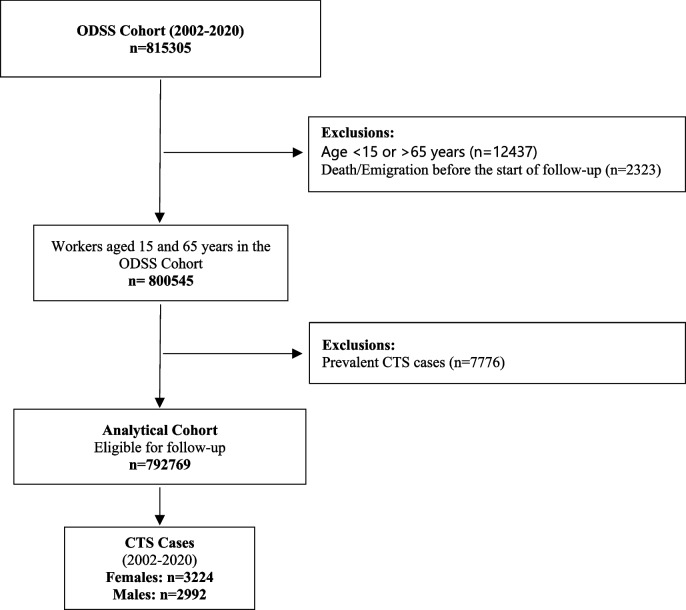
The Occupational Disease Surveillance System (ODSS) links accepted lost time compensation claims to health administrative databases. CTS cases were identified from physician billing (Ontario Health Insurance Plan) records and defined as at least one record for CTS surgery (fee code N290) between 2002 and 2020. A 3-year washout period and restricted follow-up period of 3 years were applied. A total of 792,769 workers were included in the analytical cohort. Cox proportional hazards models were used to estimate hazard ratios (HRs) and 95% confidence intervals (CI) for CTS by occupation and industry, adjusted for age and birth year, stratified by sex.
A total of 3,224 CTS cases among females (f) and 2,992 cases among males (m) were identified in the cohort. We observed elevated risks of CTS in many occupations requiring repetitive and forceful manual work: slaughtering and meat cutting, canning, curing and packing (HR = 2.28, 95%CI = 1.42-3.68; HR = 1.95, 95%CI = 1.33-2.85); welding and flame cutting (HR = 1.83, 95%CI = 1.01-3.32; HR = 1.65, 95%CI = 1.35-2.01); motor vehicle fabricating and assembling (HR = 2.14, 95%CI = 1.74-2.62; HR = 2.43, 95%CI = 2.04-2.89); and packaging (HR = 2.06, 95%CI = 1.43-2.97; HR = 1.82, 95%CI = 1.12-2.98). Elevated risks were observed among males employed as nursing aides and orderlies (HR = 1.72, 95%CI = 1.13-2.62), in mining (HR = 1.57, 95%CI = 1.01-2.45), and in construction (HR = 1.32, 95%CI = 1.19-1.47). Elevated risks were observed among females in mineral, metal, chemical processing (HR = 1.58, 95%CI = 1.27-1.97), textile processing (HR = 1.89, 95%CI = 1.22-2.94), wood machining (HR = 2.84, 95%CI = 1.47-5.45), and females employed as janitors, charworkers and cleaners (HR = 1.50, 95%CI = 1.32-1.71). Findings by industry were consistent with occupation results.
The risk of CTS varied by occupation, industry, and sex in this large cohort. Workers engaged in highly repetitive and forceful manual work were at elevated CTS risk, highlighting the need to further understand and reduce ergonomic hazards among identified groups. Future studies should also explore CTS risk by sex, with a focus on female workers.
腕管综合征(CTS)是一种常见的累积性劳损损伤,与职业风险因素有关,如振动、重复性和强力的手腕运动以及手腕姿势不当。本研究旨在识别安大略省CTS风险较高的工人,并探讨工人中CTS风险的性别差异。
职业病监测系统(ODSS)将已接受的误工补偿索赔与健康管理数据库相链接。CTS病例从医生计费(安大略省医疗保险计划)记录中识别出来,并定义为2002年至2020年期间至少有一条CTS手术(费用代码N290)记录。采用3年的洗脱期和3年的受限随访期。分析队列共纳入792,769名工人。采用Cox比例风险模型,按职业和行业估计CTS的风险比(HRs)和95%置信区间(CI),并根据年龄和出生年份进行调整,按性别分层。
队列中女性(f)共识别出3224例CTS病例,男性(m)共识别出2992例。我们观察到,在许多需要重复性和强力体力劳动的职业中,CTS风险升高:屠宰和肉类切割、罐头加工、腌制和包装(HR = 2.28,95%CI = 1.42 - 3.68;HR = 1.95,95%CI = 1.33 - 2.85);焊接和火焰切割(HR = 1.83,95%CI = 1.01 - 3.32;HR = 1.65,95%CI = 1.35 - 2.01);汽车制造和装配(HR = 2.14,95%CI = 1.74 - 2.62;HR = 2.43,95%CI = 2.04 - 2.89);以及包装(HR = 2.06,95%CI = 1.43 - 2.97;HR = 1.82,95%CI = 1.12 - 2.98)。在担任护理助理和勤杂工的男性中(HR = 1.72,95%CI = 1.13 - 2.62)、采矿行业(HR = 1.57,95%CI = 1.01 - 2.45)以及建筑行业(HR = 1.32,95%CI = 1.19 - 1.47)观察到风险升高。在从事矿物、金属、化学加工的女性中(HR = 1.58,95%CI = 1.27 - 1.97)、纺织加工行业(HR = 1.89,95%CI = 1.22 - 2.94)、木材加工行业(HR = 2.84,95%CI = 1.47 - 5.45)以及担任门卫、杂工和清洁工的女性中(HR = 1.50,95%CI = 1.32 - 1.71)观察到风险升高。行业研究结果与职业研究结果一致。
在这个大型队列中,CTS风险因职业、行业和性别而异。从事高度重复性和强力体力劳动的工人CTS风险升高,这突出表明需要进一步了解并降低已识别群体中的人体工程学危害。未来的研究还应按性别探讨CTS风险,重点关注女性工人。