Rodor Julie, Klimi Eftychia, Brown Simon D, Krilis Georgios, Braga Luca, Ring Nadja A R, Ballantyne Margaret D, Kesidou Despoina, Nguyen Dinh Cat Aurelie, Miscianinov Vladislav, Vacante Francesca, Miteva Katarina, Bennett Matthew, Beqqali Abdelaziz, Giacca Mauro, Zacchigna Serena, Baker Andrew H
Centre for Cardiovascular Science, The Queen's Medical Research Institute, University of Edinburgh, EH16 4TJ Edinburgh, UK.
International Centre for Genetic Engineering and Biotechnology (ICGEB), 34149 Trieste, Italy.
Mol Ther. 2025 Feb 5;33(2):615-630. doi: 10.1016/j.ymthe.2024.12.037. Epub 2024 Dec 30.
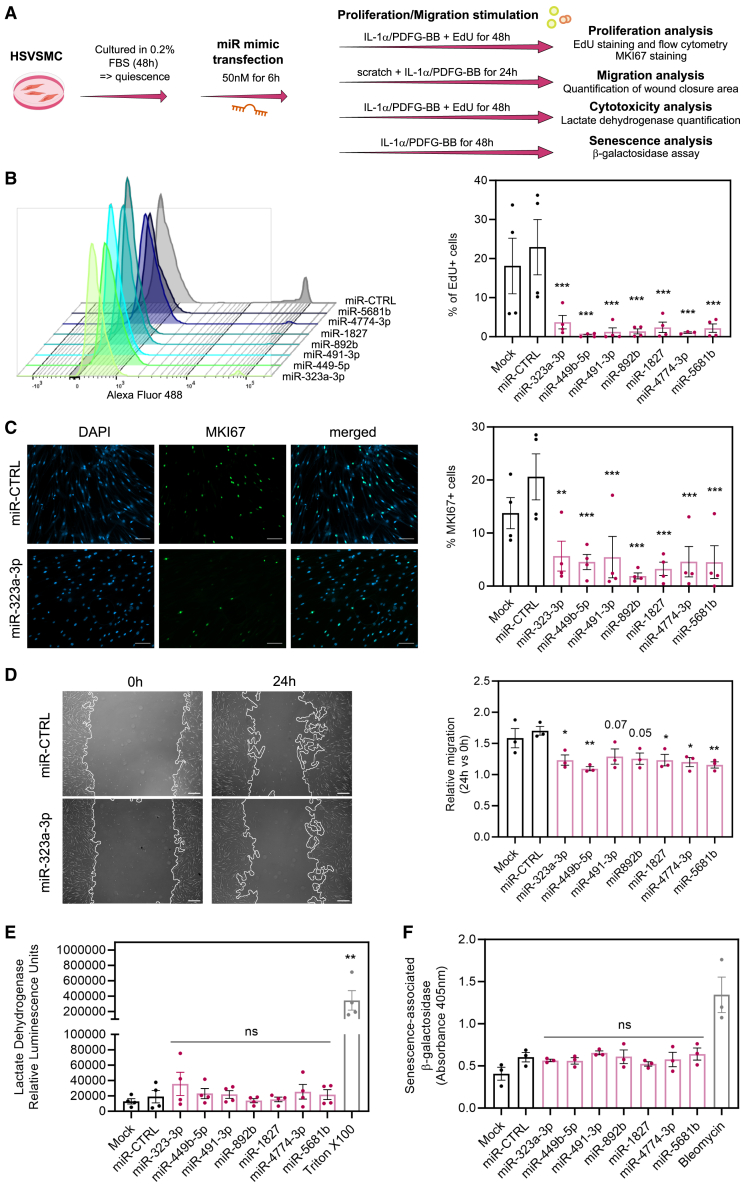
Proliferation of vascular smooth muscle cells (vSMCs) is a crucial contributor to pathological vascular remodeling. MicroRNAs (miRNAs) are powerful gene regulators and attractive therapeutic agents. Here, we aimed to systematically identify and characterize miRNAs with therapeutic potential in targeting vSMC proliferation. Using high-throughput screening, we assessed the impact of 2,042 human miRNA mimics on vSMC proliferation and identified seven miRNAs with novel vSMC anti-proliferative function: miR-323a-3p, miR-449b-5p, miR-491-3p, miR-892b, miR-1827, miR-4774-3p, and miR-5681b. miRNA-mimic treatment affects proliferation of vSMCs from different vascular beds. Focusing on vein graft failure, where miRNA-based therapeutics can be applied to the graft ex vivo, we showed that these miRNAs reduced human saphenous vein smooth muscle cell (HSVSMC) proliferation without toxic effect. HSVSMC transcriptomics revealed a distinct set of targets for each miRNA, leading to the common downregulation of a cell-cycle gene network for all miRNAs. For miR-449b-5p, we showed that its candidate target, CCND1, contributes to HSVSMC proliferation. In contrast to HSVSMCs, miRNA overexpression in endothelial cells led to a limited response in terms of proliferation and transcriptomics. In an ex vivo vein organ model, overexpression of miR-323a-3p and miR-449b-5p reduced medial proliferation. Collectively, the results of our study show the therapeutic potential of seven miRNAs to target pathological vascular remodeling.
血管平滑肌细胞(vSMC)的增殖是病理性血管重塑的关键因素。微小RNA(miRNA)是强大的基因调节剂和有吸引力的治疗剂。在此,我们旨在系统地鉴定和表征具有靶向vSMC增殖治疗潜力的miRNA。通过高通量筛选,我们评估了2042种人类miRNA模拟物对vSMC增殖的影响,并鉴定出七种具有新型vSMC抗增殖功能的miRNA:miR-323a-3p、miR-449b-5p、miR-491-3p、miR-892b、miR-1827、miR-4774-3p和miR-5681b。miRNA模拟物处理会影响来自不同血管床的vSMC的增殖。聚焦于静脉移植物失败,基于miRNA的治疗方法可在体外应用于移植物,我们发现这些miRNA可降低人隐静脉平滑肌细胞(HSVSMC)的增殖且无毒性作用。HSVSMC转录组学揭示了每种miRNA的一组独特靶点,导致所有miRNA共同下调细胞周期基因网络。对于miR-449b-5p,我们表明其候选靶点CCND1促进HSVSMC增殖。与HSVSMC不同,内皮细胞中miRNA的过表达在增殖和转录组学方面导致的反应有限。在体外静脉器官模型中,miR-323a-3p和miR-449b-5p的过表达减少了中层增殖。总体而言,我们的研究结果显示了七种miRNA靶向病理性血管重塑的治疗潜力。