Liu Shuhua, Xu Liping, Cheng Yan, Liu Dehong, Zhang Bin, Chen Xianxia, Zheng Mingming
Department of Obstetrics and Gynecology, Hefei Maternal and Child Health Hospital, Hefei, China.
Department of Obstetrics and Gynecology, Anhui Women and Children's Medical Center, Hefei, China.
Front Endocrinol (Lausanne). 2024 Dec 16;15:1490336. doi: 10.3389/fendo.2024.1490336. eCollection 2024.
Gestational diabetes mellitus (GDM) is a common complication during pregnancy and increases the risk of metabolic diseases in offspring. We hypothesize that the poor intrauterine environment in pregnant women with GDM may lead to chromosomal DNA damage and telomere damage in umbilical cord blood cells, providing evidence of an association between intrauterine programming and increased long-term metabolic disease risk in offspring.
We measured telomere length (TL), serum telomerase (TE) activity, and oxidative stress markers in umbilical cord blood mononuclear cells (CBMCs) from pregnant women with GDM (N=200) and healthy controls (Ctrls) (N=200) and analysed the associations of TL with demographic characteristics, biochemical indicators, and blood glucose levels.
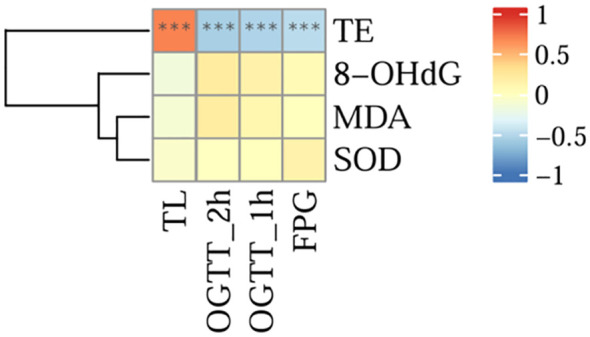
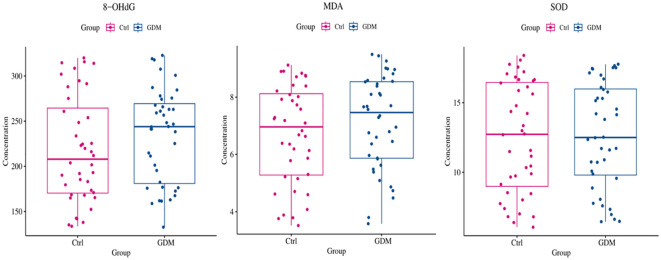
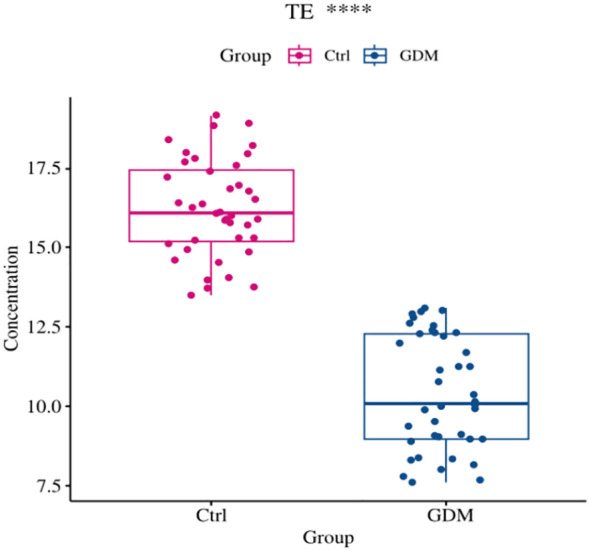
The length of telomeres in umbilical CBMCs in the GDM group was significantly shorter than that in the Ctrl group (P<0.001), and the shortening of telomeres in male infants in the GDM group was more significant than that in the Ctrl group (P<0.001) after adjustment for Pre-pregnancy body mass index (PBMI), Pregnancy weight gain (PGW), and Triglyceride (TG) as confounding factors. In addition, the TE expression level in the GDM group was lower after adjustment. There was no statistically significant difference in oxidative stress hydroxydeoxyguanosine (8-OHdG), malondialdehyde (MDA) and superoxide dismutase (SOD) between the two groups. TL was positively correlated with TE activity, and both were negatively correlated with blood glucose levels. There was no correlation between TL and Gestational age (GA), PBMI, PGW, or TG levels.
The poor intrauterine environment in pregnant women with GDM increases telomere attrition and reduces TE activity, which may be potential genetic risk factors for an increased risk of metabolic diseases in offspring later in life due to intrauterine reprogramming.
妊娠期糖尿病(GDM)是孕期常见并发症,会增加后代患代谢性疾病的风险。我们推测,患有GDM的孕妇子宫内环境不佳可能导致脐带血细胞中的染色体DNA损伤和端粒损伤,为子宫内编程与后代长期代谢疾病风险增加之间的关联提供证据。
我们测量了患有GDM的孕妇(N = 200)和健康对照组(Ctrl)(N = 200)脐带血单个核细胞(CBMC)中的端粒长度(TL)、血清端粒酶(TE)活性和氧化应激标志物,并分析了TL与人口统计学特征、生化指标和血糖水平之间的关联。
在将孕前体重指数(PBMI)、孕期体重增加(PGW)和甘油三酯(TG)作为混杂因素进行调整后,GDM组脐带CBMC中的端粒长度明显短于Ctrl组(P < 0.001),且GDM组男婴的端粒缩短比Ctrl组更显著(P < 0.001)。此外,调整后GDM组的TE表达水平较低。两组之间的氧化应激羟基脱氧鸟苷(8-OHdG)、丙二醛(MDA)和超氧化物歧化酶(SOD)无统计学显著差异。TL与TE活性呈正相关,且二者均与血糖水平呈负相关。TL与孕周(GA)、PBMI、PGW或TG水平之间无相关性。
患有GDM的孕妇子宫内环境不佳会增加端粒损耗并降低TE活性,这可能是由于子宫内重编程导致后代日后患代谢性疾病风险增加的潜在遗传危险因素。