16th Department, Plastic Surgery Hospital, Chinese Academy of Medical Sciences and Peking Union Medical College, Beijing, China.
8th Department, Plastic Surgery Hospital, Chinese Academy of Medical Sciences and Peking Union Medical College, Beijing, China.
Aging Cell. 2023 Aug;22(8):e13899. doi: 10.1111/acel.13899. Epub 2023 Jun 5.
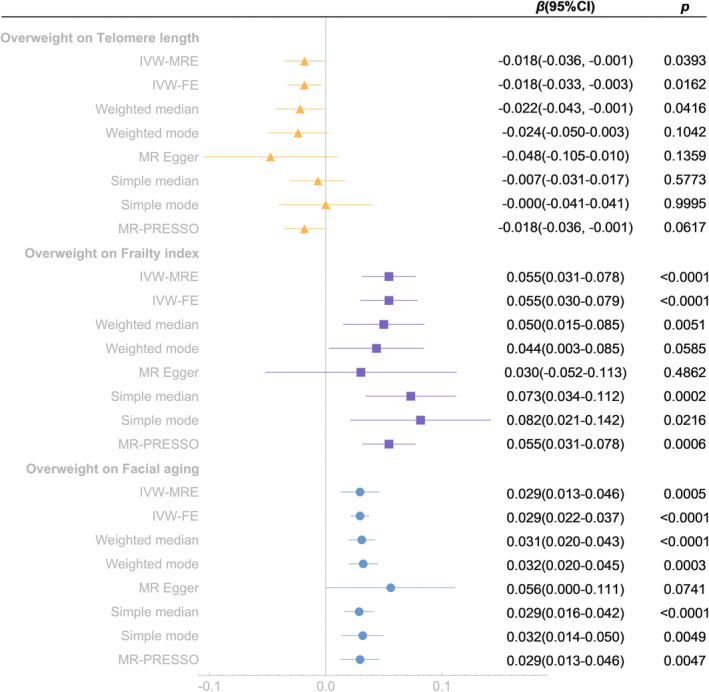
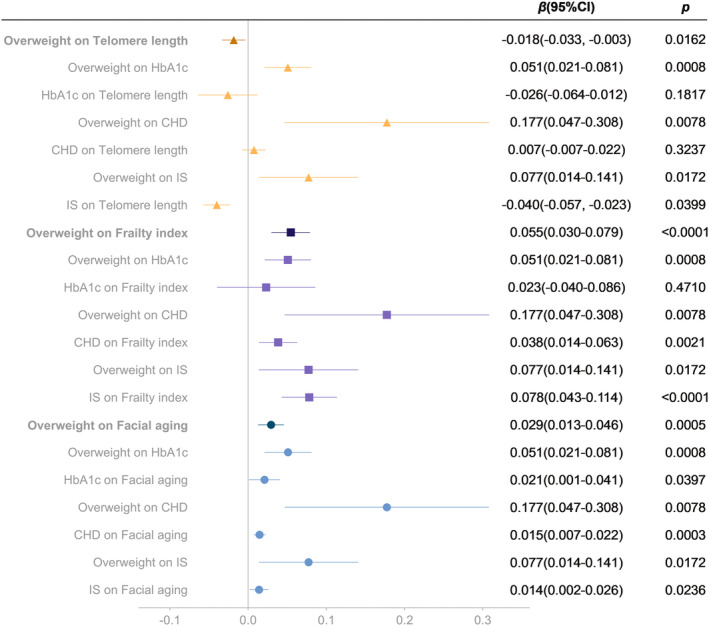
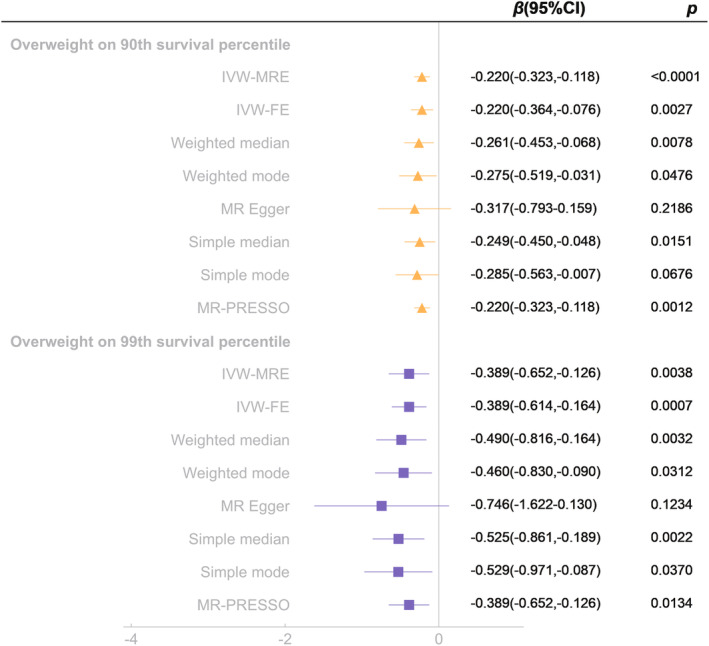
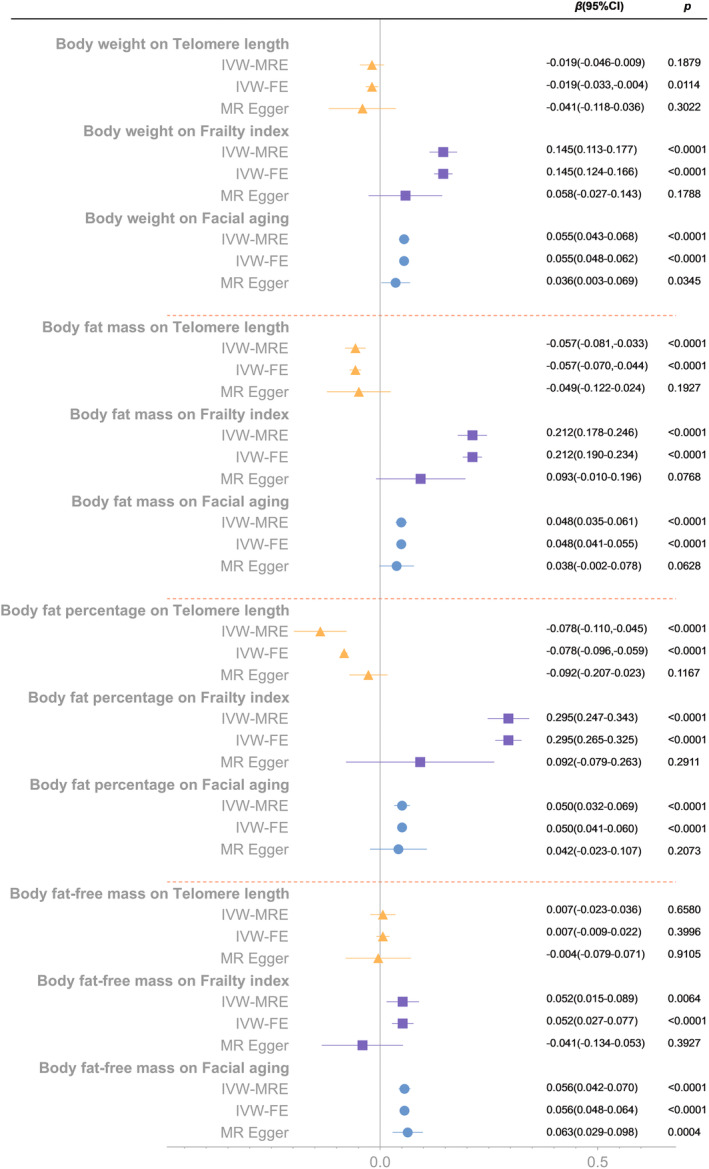
It is reported that overweight may lead to accelerated aging. However, there is still a lack of evidence on the causal effect of overweight and aging. We collected genetic variants associated with overweight, age proxy indicators (telomere length, frailty index and facial aging), etc., from genome-wide association studies datasets. Then we performed MR analyses to explore associations between overweight and age proxy indicators. MR analyses were primarily conducted using the inverse variance weighted method, followed by various sensitivity and validation analyses. MR analyses indicated that there were significant associations of overweight on telomere length, frailty index, and facial aging (β = -0.018, 95% CI = -0.033 to -0.003, p = 0.0162; β = 0.055, 95% CI = 0.030-0.079, p < 0.0001; β = 0.029, 95% CI = 0.013-0.046, p = 0.0005 respectively). Overweight also had a significant negative causality with longevity expectancy (90th survival percentile, β = -0.220, 95% CI = -0.323 to -0.118, p < 0.0001; 99th survival percentile, β = -0.389, 95% CI = -0.652 to -0.126, p = 0.0038). Moreover, the findings tend to favor causal links between body fat mass/body fat percentage on aging proxy indicators, but not body fat-free mass. This study provides evidence of the causality between overweight and accelerated aging (telomere length decreased, frailty index increased, facial aging increased) and lower longevity expectancy. Accordingly, the potential significance of weight control and treatment of overweight in combating accelerated aging need to be emphasized.
据报道,超重可能导致加速衰老。然而,超重与衰老之间的因果关系仍缺乏证据。我们从全基因组关联研究数据集收集了与超重相关的遗传变异、年龄替代指标(端粒长度、脆弱指数和面部衰老)等。然后,我们进行了 MR 分析,以探讨超重与年龄替代指标之间的关联。MR 分析主要采用逆方差加权法进行,随后进行了各种敏感性和验证性分析。MR 分析表明,超重与端粒长度、脆弱指数和面部衰老存在显著关联(β=-0.018,95%CI=-0.033 至-0.003,p=0.0162;β=0.055,95%CI=0.030-0.079,p<0.0001;β=0.029,95%CI=0.013-0.046,p=0.0005)。超重也与长寿预期呈显著负相关(90 生存百分位数,β=-0.220,95%CI=-0.323 至-0.118,p<0.0001;99 生存百分位数,β=-0.389,95%CI=-0.652 至-0.126,p=0.0038)。此外,这些发现倾向于支持身体脂肪量/体脂率与衰老替代指标之间的因果关系,但不支持身体无脂肪量。本研究提供了超重与加速衰老(端粒长度缩短、脆弱指数增加、面部衰老增加)和长寿预期降低之间因果关系的证据。因此,需要强调体重控制和超重治疗在对抗加速衰老方面的潜在重要性。