
在光敏水凝胶中共培养神经和骨髓间充质干细胞可增强脊髓损伤修复。
Co-culturing neural and bone mesenchymal stem cells in photosensitive hydrogel enhances spinal cord injury repair.
作者信息
Bai Jianzhong, Liu Guoping, Gao Yang, Zhang Xishan, Niu Guoqi, Zhang Hongtao
机构信息
Department of Orthopedics, The First Affiliated Hospital of Soochow University, Soochow University, Suzhou, Jiangsu, China.
Department of Orthopedics, The Second Affiliated Hospital of Shandong First Medical University, Tai'an, China.
出版信息
Front Bioeng Biotechnol. 2024 Dec 16;12:1431420. doi: 10.3389/fbioe.2024.1431420. eCollection 2024.
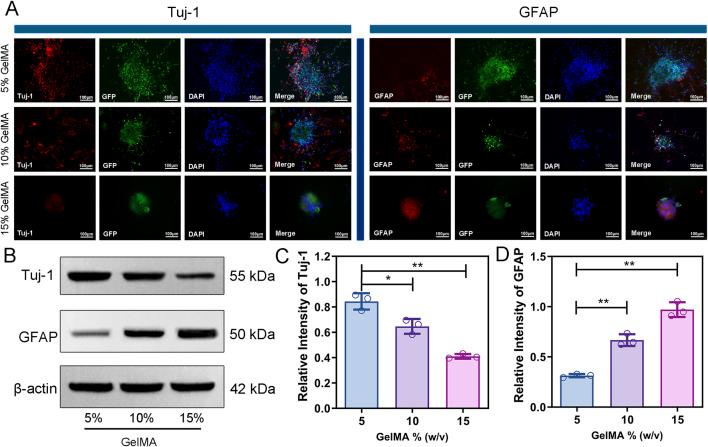
In mammalian species, neural tissues cannot regenerate following severe spinal cord injury (SCI), for which stem cell transplantation is a promising treatment. Neural stem cells (NSCs) have the potential to repair SCI; however, in unfavourable microenvironments, transplanted NSCs mainly differentiate into astrocytes rather than neurons. In contrast, bone mesenchymal stem cells (BMSCs) promote the differentiation of NSCs into neurons and regulate inflammatory responses. Owing to their easily controllable mechanical properties and similarities to neural tissue, gelatin methacrylate (GelMA) hydrogels offer remarkable cell biocompatibility and regulate the differentiation of NSCs. Therefore, in this study, we propose co-culturing NSCs and BMSCs within low-modulus GelMA hydrogel scaffolds to promote regeneration following SCI. comparisons revealed that the viability, proliferation, migration, and neuron differentiation capacity of cells in these low-modulus scaffolds exhibit substantially superior performance compared to those in high-modulus hydrogel scaffolds. To the best of our knowledge, this study is the first to report that NSCs/BMSCs co-culture implants can remarkably enhance motor function recovery in SCI rats, reduce the area of spinal cord cavities, stimulate neuron regeneration, and suppress scar tissue formation. Thus, this hydrogel system loaded with co-cultured cells represents a promising therapeutic approach for SCI repair.
在哺乳动物物种中,严重脊髓损伤(SCI)后神经组织无法再生,而干细胞移植是一种很有前景的治疗方法。神经干细胞(NSCs)有修复SCI的潜力;然而,在不利的微环境中,移植的NSCs主要分化为星形胶质细胞而非神经元。相比之下,骨髓间充质干细胞(BMSCs)可促进NSCs向神经元分化并调节炎症反应。由于其易于控制的力学性能以及与神经组织的相似性,甲基丙烯酸明胶(GelMA)水凝胶具有出色的细胞生物相容性并能调节NSCs的分化。因此,在本研究中,我们提出在低模量GelMA水凝胶支架内共培养NSCs和BMSCs,以促进SCI后的再生。比较结果显示,与高模量水凝胶支架中的细胞相比,这些低模量支架中的细胞在活力、增殖、迁移和神经元分化能力方面表现出显著更优的性能。据我们所知,本研究首次报道NSCs/BMSCs共培养植入物可显著增强SCI大鼠的运动功能恢复,减少脊髓空洞面积,刺激神经元再生,并抑制瘢痕组织形成。因此,这种负载共培养细胞的水凝胶系统代表了一种很有前景的SCI修复治疗方法。




 Zotero 插件