
乳酸脱氢酶比值(LMR)的纵向动态变化可作为具核梭杆菌阳性结直肠癌患者复发的生物标志物。
A Longitudinal Dynamic Change in LMR Can Be a Biomarker for Recurrence in Fusobacterium Nucleatum-Positive Colorectal Cancer Patients.
作者信息
Chen Shan, Chang Wan-Hua, Zhang Jie, Liu Xiao-Yuan, Gao Ting, Qi Xiao-Wei, Cai Dong-Yan, Mao Yong, Lu Ting-Xun
机构信息
Department of Oncology, Affiliated Hospital of Jiangnan University, Wuxi, Jiangsu Province, People's Republic of China.
Department of Gastroenterology, Huaian Hospital of Huaian City, Huai'an, Jiangsu Province, People's Republic of China.
出版信息
J Inflamm Res. 2024 Dec 25;17:11587-11604. doi: 10.2147/JIR.S489432. eCollection 2024.
PURPOSE
This study assessed lymphocyte-to-monocyte ratio (LMR) changes to predict postoperative recurrence in Fusobacterium nucleatum-positive (Fn-positive) CRC patients.
PATIENTS AND METHODS
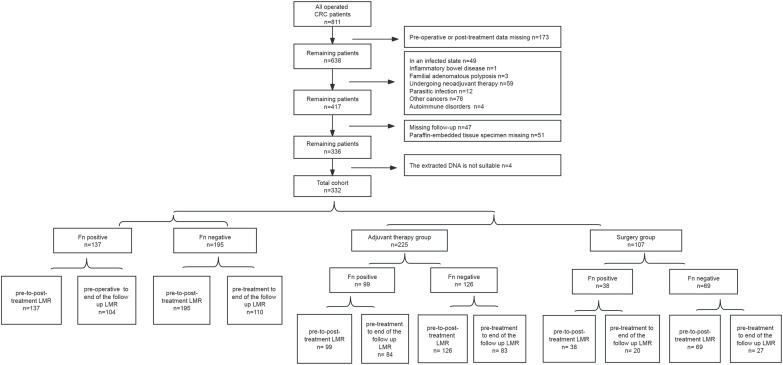
Clinical information and paraffin tissue specimens were collected from a retrospective cohort of 332 patients. The abundance of Fn in tumor tissue was measured using a quantitative polymerase chain reaction. We evaluated the prognostic value and diagnostic performance of the dynamic changes of LMR from pre-operative to post-treatment (pr-LMR-po) and the dynamic alterations of LMR from pre-operative to post-treatment to pre-end of follow-up (pr-LMR-f) in predicting recurrence in Fn-positive CRC.
RESULTS
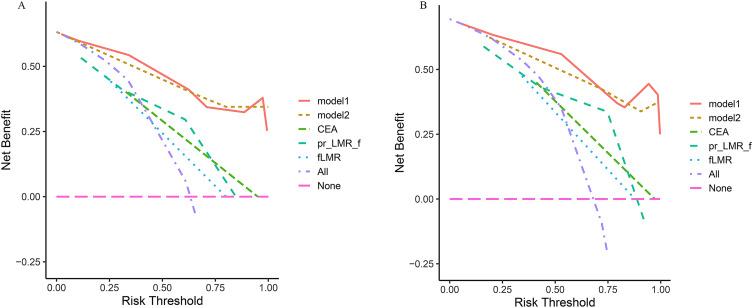
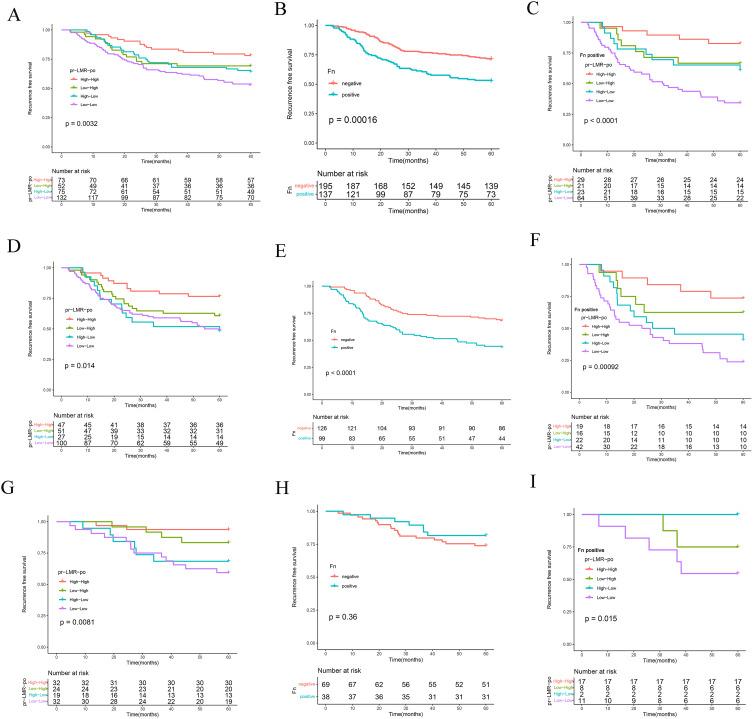
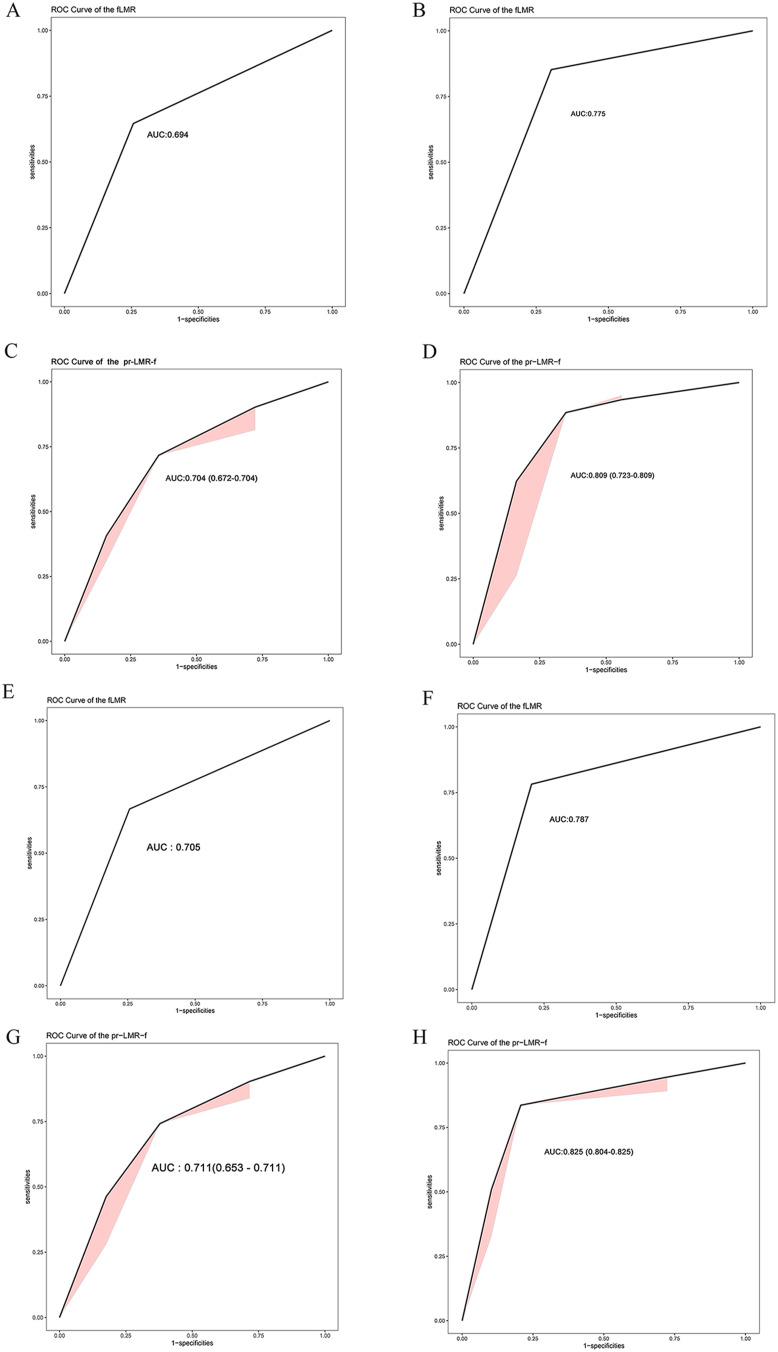
In the total cohort and adjuvant therapy group cohort, pr-LMR-po independently predicted recurrence-free survival in Fn-positive CRC patients. In the adjuvant therapy group, pr-LMR-po (High-High vs Low-Low: HR: 3.896, 95% CI: 1.503-10.095, p=0.005) was particularly significant. Meanwhile, pr-LMR-f can serve as a predictive biomarker for Fn-positive CRC recurrence, especially in the adjuvant therapy group cohort where the c-statistic for pr-LMR-f was 0.825 (95% CI: 0.804-0.8251), with a sensitivity of 83.6% and a specificity of 79.3%. Compared to the overall adjuvant therapy group cohort, the prognostic performance of pr-LMR-f was superior in the Fn-positive CRC adjuvant therapy group cohort (AUC: 0.825 VS 0.711). Finally, we constructed a prediction model combining pr-LMR-f and CEA. After internal validation using the bootstrap resampling, the model had an AUC of 0.9295, a sensitivity of 94%, and a specificity of 72.7% in the Fn-positive CRC adjuvant therapy group cohort.
CONCLUSION
This study found that pr-LMR-po predicts Fn-positive CRC prognosis, and pr-LMR-f may predict Fn-positive CRC recurrence.
目的
本研究评估淋巴细胞与单核细胞比值(LMR)变化,以预测具核梭杆菌阳性(Fn阳性)的结直肠癌(CRC)患者术后复发情况。
患者与方法
从332例患者的回顾性队列中收集临床信息和石蜡组织标本。采用定量聚合酶链反应测量肿瘤组织中Fn的丰度。我们评估了术前至治疗后LMR的动态变化(pr-LMR-po)以及术前至治疗后至随访结束时LMR的动态变化(pr-LMR-f)在预测Fn阳性CRC复发方面的预后价值和诊断性能。
结果
在整个队列和辅助治疗组队列中,pr-LMR-po可独立预测Fn阳性CRC患者的无复发生存期。在辅助治疗组中,pr-LMR-po(高-高与低-低:HR:3.896,95%CI:1.503-10.095,p = 0.005)尤为显著。同时,pr-LMR-f可作为Fn阳性CRC复发的预测生物标志物,尤其是在辅助治疗组队列中,pr-LMR-f的c统计量为0.825(95%CI:0.804-0.8251),敏感性为83.6%,特异性为79.3%。与整个辅助治疗组队列相比,pr-LMR-f在Fn阳性CRC辅助治疗组队列中的预后性能更优(AUC:0.825对0.711)。最后,我们构建了一个结合pr-LMR-f和癌胚抗原(CEA)的预测模型。在使用自举重采样进行内部验证后,该模型在Fn阳性CRC辅助治疗组队列中的AUC为0.9295,敏感性为94%,特异性为72.7%。
结论
本研究发现pr-LMR-po可预测Fn阳性CRC的预后,而pr-LMR-f可能预测Fn阳性CRC的复发。
 Zotero 插件