Huang Hui-Bin, Zhu Yi-Bing, Yu Da-Xing
Department of Critical Care Medicine, Guang'anmen Hospital, China Academy of Chinese Medical Sciences, Beijing, China.
Front Nutr. 2024 Dec 16;11:1387602. doi: 10.3389/fnut.2024.1387602. eCollection 2024.
Sarcopenia has been shown to worsen survival after liver transplantation. However, it remains unclear whether coexisting sarcopenia and obesity, so-called sarcopenic obesity (SO), may also synergistically increase their adverse effects. This meta-analysis aimed to evaluate whether pre-transplant SO independently predicts survival in this population.
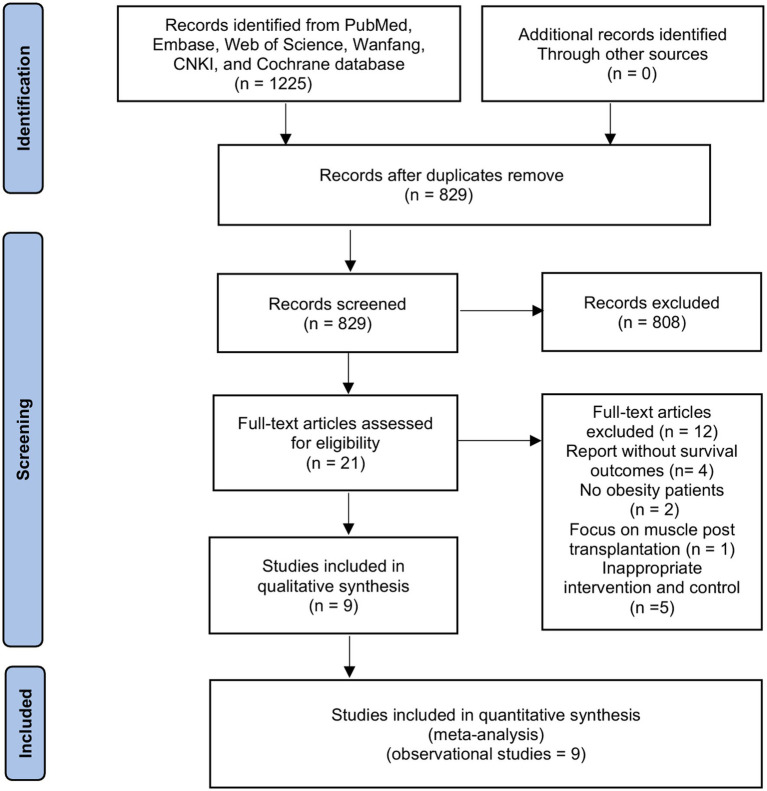
We conducted this study according to the Preferred Reporting Items for Systematic Review and Meta-Analyses guidelines. The PubMed, Embase, Web of Science, Wanfang, CNKI, and Cochrane databases were searched up to 15 October 2023, for studies with any study design evaluating the relationship between SO and post-transplant survival in patients undergoing liver transplantation. We used ROBINS-E to assess the study quality. The primary outcome was all-cause mortality at any length of follow-up. We calculated pooled odds risks (ORs) or hazard risks (HRs) with 95% confidence intervals (CIs). Heterogeneity was quantified with statistics. Subgroup analyses and publication bias evaluations were also conducted.
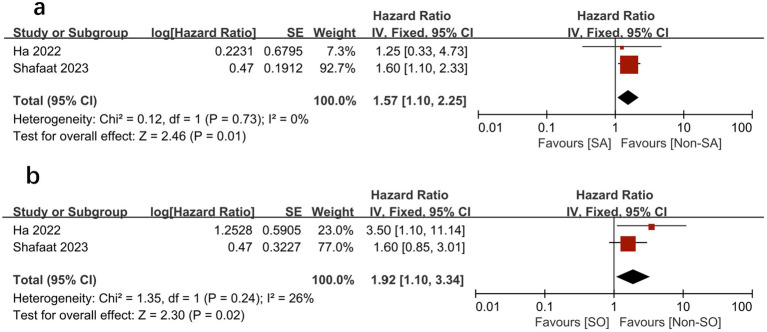
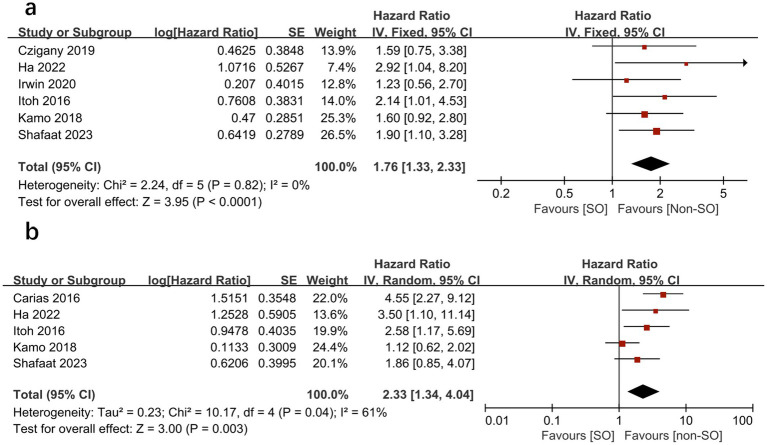
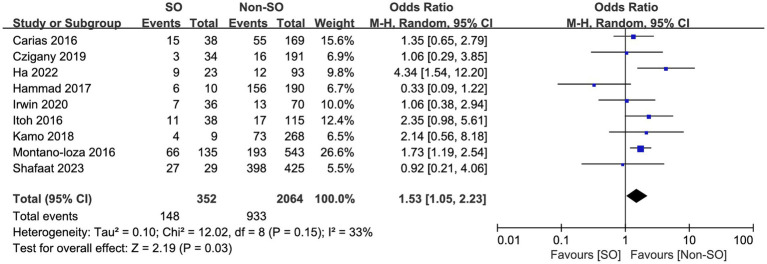
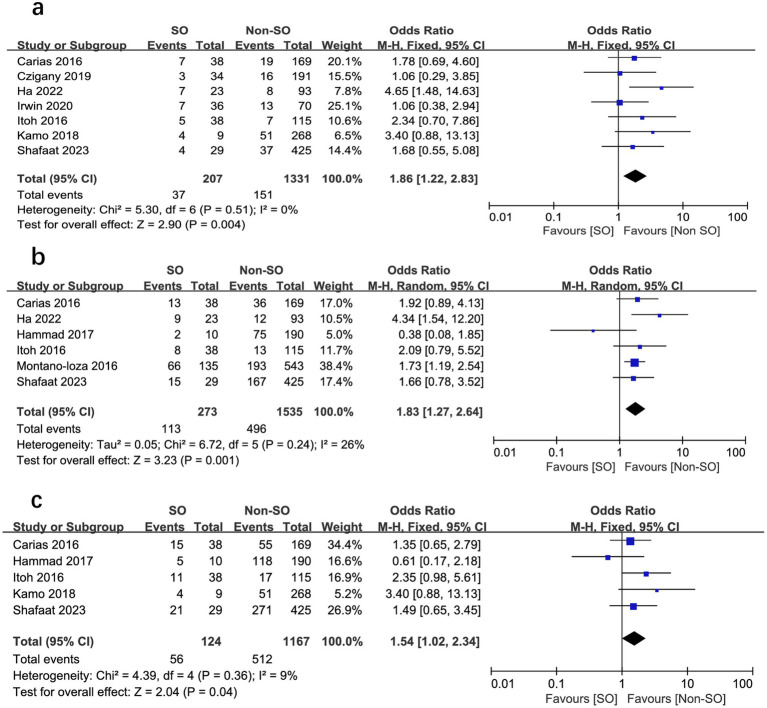
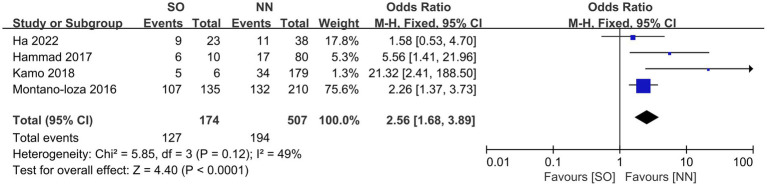
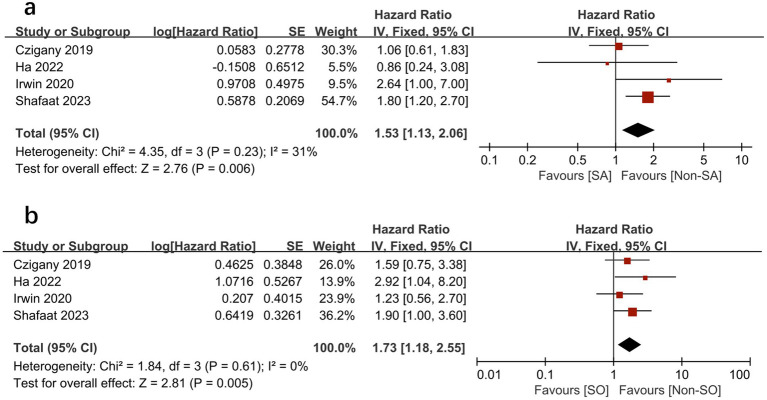
We included nine cohort studies with 2,416 patients. These studies were moderate to high quality. Pre-liver transplant patients commonly experience SO, with a mean prevalence as high as 34%. Overall, patients with SO exhibited a significantly higher overall mortality than patients without SO, as demonstrated by pooled studies using both univariate analysis [HR = 1.76, 95%C 1.33-2.33, < 0.0001] and multivariate analysis (HR = 2.33, 95%CI 1.34-4.04, = 0.003). Similar results were also found when comparing patients with or without SO at 1, 3, and 5 years of follow-up (OR = 1.86, 95%CI 1.22-2.83; OR = 1.83, 95%CI: 1.27-2.64; and OR = 1.54, 95% CI 1.02-2.34, respectively). In addition, subgroup analysis based on studies that reported HRs of both sarcopenia and SO indicated both had independent negative effects on post-transplant survival.
Our meta-analysis showed that SO occurs frequently in liver transplant patients. SO is associated with an increased risk of mortality in such patient populations.
https://doi.org/10.37766/inplasy2024.2.0069 [inplasy2024.2.0069].
肌肉减少症已被证明会使肝移植后的生存率降低。然而,目前尚不清楚同时存在的肌肉减少症和肥胖症,即所谓的肌少性肥胖(SO),是否也会协同增加其不良影响。这项荟萃分析旨在评估移植前的SO是否能独立预测该人群的生存率。
我们按照系统评价和荟萃分析的首选报告项目指南进行了这项研究。截至2023年10月15日,对PubMed、Embase、Web of Science、万方、知网和Cochrane数据库进行了检索,以查找任何研究设计的、评估SO与肝移植患者移植后生存率之间关系的研究。我们使用ROBINS-E评估研究质量。主要结局是任何随访时长的全因死亡率。我们计算了合并比值比(OR)或风险比(HR)以及95%置信区间(CI)。用I²统计量对异质性进行量化。还进行了亚组分析和发表偏倚评估。
我们纳入了9项队列研究,共2416例患者。这些研究质量为中等至高。肝移植前患者普遍存在SO,平均患病率高达34%。总体而言,SO患者的总体死亡率显著高于无SO患者,单因素分析的汇总研究[HR = 1.76,95%CI 1.33 - 2.33,P < 0.0001]和多因素分析(HR = 2.33,95%CI 1.34 - 4.04,P = 0.003)均证明了这一点。在随访1年、3年和5年时比较有或无SO的患者也发现了类似结果(OR分别为1.86,95%CI 1.22 - 2.83;OR为1.83,95%CI:1.27 - 2.64;OR为1.54,95%CI 1.02 - 2.34)。此外,基于报告了肌肉减少症和SO的HR的研究进行的亚组分析表明,两者对移植后生存率均有独立的负面影响。
我们的荟萃分析表明,SO在肝移植患者中很常见。SO与这类患者群体的死亡风险增加有关。
https://doi.org/10.37766/inplasy2024.2.0069 [inplasy2024.2.0069]