Wang Juanjuan, Li Junqin, Zhou Ling, Hou Hui, Zhang Kaiming
Shanxi Key Laboratory of Stem Cells for Immunological Dermatosis, Institute of Dermatology, Taiyuan Central Hospital, Taiyuan, China.
State Key Breeding Laboratory of Stem Cells for Immunological Dermatosis, Institute of Dermatology, Taiyuan Central Hospital, Taiyuan, China.
Front Immunol. 2024 Dec 16;15:1498067. doi: 10.3389/fimmu.2024.1498067. eCollection 2024.
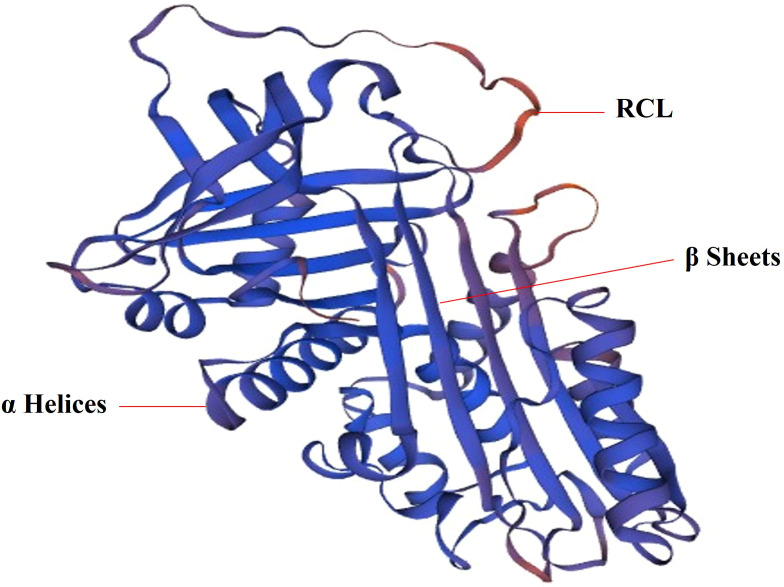
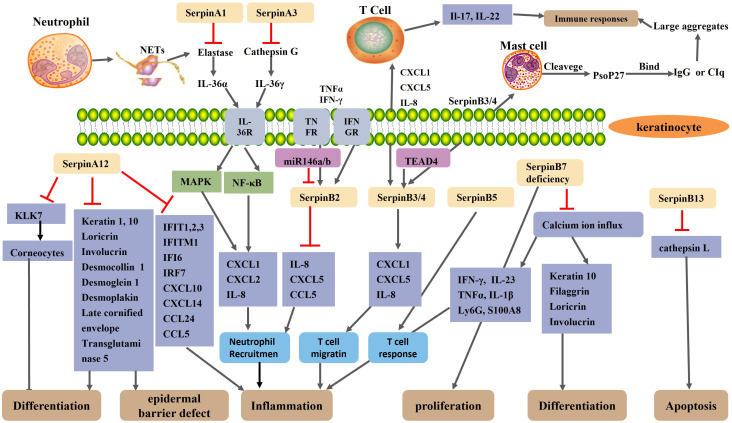
Serine protease inhibitors (Serpins) are a protein superfamily of protease inhibitors that are thought to play a role in the regulation of inflammation, immunity, tumorigenesis, coagulation, blood pressure and cancer metastasis. Serpins is enriched in the skin and play a vital role in modulating the epidermal barrier and maintaining skin homeostasis. Psoriasis is a chronic inflammatory immune-mediated skin disease. At present, most serpins focus on the pathogenesis of psoriasis vulgaris. Only a small number, such as the mutation of SerpinA1/A3/B3, are involved in the pathogenesis of GPP. SerpinA12 and SerpinG1 are significantly elevated in the serum of patients with psoriatic arthritis, but their specific mechanism of action in psoriatic arthritis has not been reported. Some Serpins, including SerpinA12, SerpinB2/B3/B7, play multiple roles in skin barrier function and pathogenesis of psoriasis. The decrease in the expression of SerpinA12, SerpinB7 deficiency and increase in expression of SerpinB3/4 in the skin can promote inflammation and poor differentiation of keratinocyte, with damaged skin barrier. Pso p27, derived from SerpinB3/B4, is an autoantigen that can enhance immune response in psoriasis. SerpinB2 plays a role in maintaining epidermal barrier integrity and inhibiting keratinocyte proliferation. Here we briefly introduce the structure, functional characteristics, expression and distribution of serpins in skin and focus on the regulation of serpins in the epidermal barrier function and the pathogenic role of serpins in psoriasis.
丝氨酸蛋白酶抑制剂(Serpins)是一类蛋白酶抑制剂的蛋白质超家族,被认为在炎症、免疫、肿瘤发生、凝血、血压和癌症转移的调节中发挥作用。Serpins在皮肤中富集,在调节表皮屏障和维持皮肤稳态方面起着至关重要的作用。银屑病是一种慢性炎症性免疫介导的皮肤病。目前,大多数Serpins聚焦于寻常型银屑病的发病机制。只有少数,如SerpinA1/A3/B3的突变,参与了泛发性脓疱型银屑病(GPP)的发病机制。SerpinA12和SerpinG1在银屑病关节炎患者的血清中显著升高,但其在银屑病关节炎中的具体作用机制尚未见报道。一些Serpins,包括SerpinA12、SerpinB2/B3/B7,在皮肤屏障功能和银屑病发病机制中发挥多种作用。皮肤中SerpinA12表达降低、SerpinB7缺乏以及SerpinB3/4表达增加可促进炎症和角质形成细胞分化不良,导致皮肤屏障受损。源自SerpinB3/B4的Pso p27是一种自身抗原,可增强银屑病中的免疫反应。SerpinB2在维持表皮屏障完整性和抑制角质形成细胞增殖中发挥作用。在此,我们简要介绍Serpins在皮肤中的结构、功能特性、表达和分布,并重点关注Serpins在表皮屏障功能中的调节作用以及Serpins在银屑病中的致病作用。